Originaldokument
GPT Image 2 · en
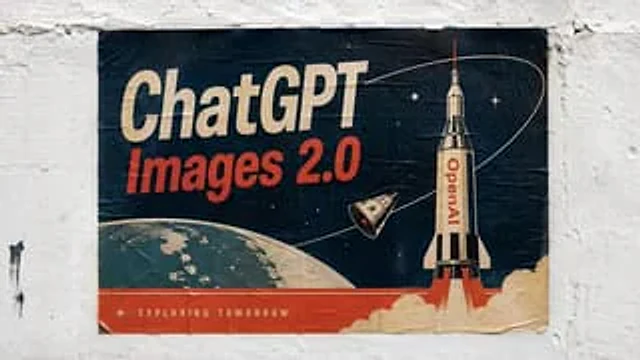
A vintage medieval space race poster, affixed to a rough white plaster wall, is photographed directly in natural light. Slightly wrinkled, creased, and weathered, with worn edges and small tears, the poster presents a realistic, aged paper texture. The design employs a limited vintage color palette of deep navy, faded cream, soft reddish-orange, and grayish-blue. A prominent headline in the upper left corner dominates the design:{argument name="headline text" default="ChatGPT Images 2.0"} The text features "ChatGPT" in an oversized cream-colored sans-serif font, with "Images 2.0" below in bold reddish-orange. On the right, a towering vintage rocket stands vertically, launching upwards through cream-colored smoke, accompanied by vertical lettering on its fuselage.{argument name="rocket text" default="OpenAI"} The color is reddish-orange. A thin orbital trajectory line runs from left to right across the upper half of the poster, encircling the rocket. Slightly to the left of center, a small, detachable spacecraft floats along the trajectory path. The lower left shows the Earth's curved horizon, presented in a retro illustration style, with cyan oceans and cream-colored land. At the bottom is a long, solid reddish-orange bar containing evenly spaced small cream-colored text.{argument name="tagline text" default="EXPLORING TOMORROW"} The design should include four visible stars or celestial objects in a dark sky: two tiny starbursts, one small cream dot, and one larger cream dot. The overall composition should evoke the feel of a 1950s-1960s science fiction travel poster or Soviet/American space age advertising print, featuring silkscreen textures, subtle creases, nostalgic typography, and a cinematic retro-futuristic atmosphere.Verwendung
- Den vollständigen Original-Prompt einschließlich Parametern kopieren.
- Motiv, Text und Komposition an die eigenen Anforderungen anpassen.
- Ein kompatibles externes Werkzeug nutzen; Zugangsbedingungen und Ergebnis prüfen.
Vor dem Start
- Prüfen, ob ein Referenzbild nötig ist. Kompatibilität belegt nicht das tatsächlich verwendete Modell.
- Namen, Zahlen und Bildtexte prüfen; Modellversionen können andere Ergebnisse liefern.