Originaldokument
GPT Image 2 · en
{
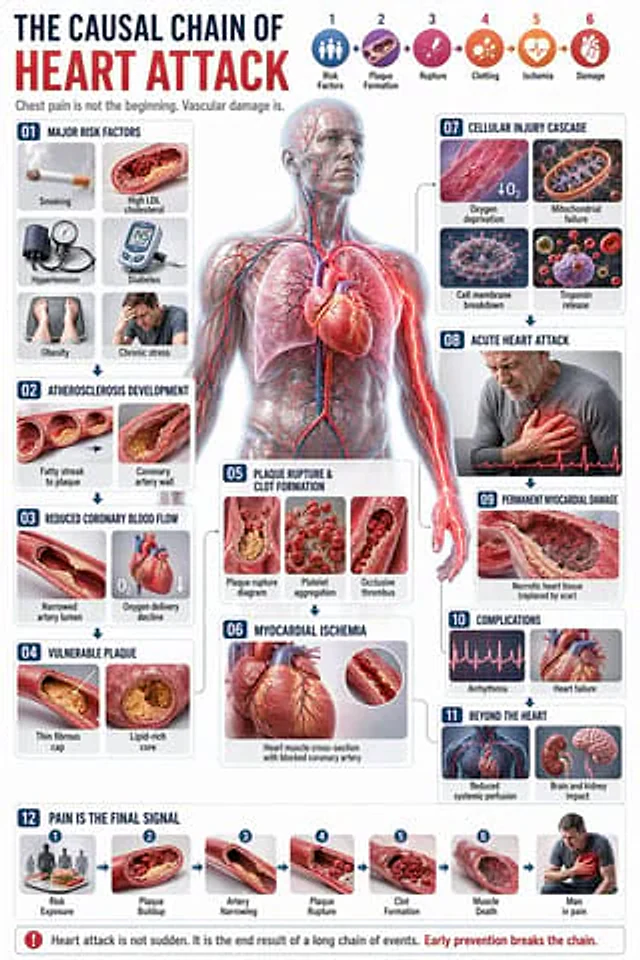
  "type": "Comprehensive Medical Infographic",
  "style": "Highly detailed 3D medical illustrations with a clinical white background and clean typography.",
  "header": {
    "title_cn": "The causal chain of a heart attack",
    "title_en": "{argument name=\"english title\" default=\"THE CAUSAL CHAIN OF HEART ATTACK\"}",
    "subtitle": "Chest pain is not the starting point; vascular damage is.",
    "top_right_sequence": {
      "count": 6,
      "labels": [
        "Risk factors",
        "plaque formation",
        "plaque rupture",
        "thrombosis",
        "ischemia",
        "damage"
      ]
    }
  },
  "centerpiece": {
    "description": "{argument name=\"central figure\" default=\"A transparent human anatomical model showcasing the heart, coronary arteries, lungs, and vascular system.\"}",
    "details": "by{argument name=\"highlight color\" default=\"glowing red\"} The highlighted path emphasizes the coronary artery and the pain radiating to the chest and left arm."
  },
  "layout": {
    "left_column": [
      {
        "id": "01",
        "title": "Key risk factors",
        "elements": 6,
        "labels": [
          "Smoking",
          "High LDL cholesterol",
          "hypertension",
          "diabetes",
          "obesity",
          "Chronic stress"
        ]
      },
      {
        "id": "02",
        "title": "The development of atherosclerosis",
        "elements": 2,
        "labels": [
          "From fatty streaks to plaques",
          "Coronary artery wall"
        ]
      },
      {
        "id": "03",
        "title": "Reduced coronary blood flow",
        "elements": 2,
        "labels": [
          "Arterial stenosis",
          "oxygen delivery decrease"
        ]
      },
      {
        "id": "04",
        "title": "Vulnerable plaques",
        "elements": 2,
        "labels": [
          "Thin fiber cap",
          "lipid-rich core"
        ]
      }
    ],
    "center_overlay": [
      {
        "id": "05",
        "title": "Plaque rupture and thrombosis",
        "elements": 3,
        "labels": [
          "Schematic diagram of plaque rupture",
          "Platelet aggregation",
          "Occlusive thrombosis"
        ]
      },
      {
        "id": "06",
        "title": "Myocardial ischemia",
        "elements": 1,
        "labels": [
          "Cross-section of myocardium in coronary artery obstruction"
        ]
      }
    ],
    "right_column": [
      {
        "id": "07",
        "title": "Cell damage cascade",
        "elements": 4,
        "labels": [
          "hypoxia",
          "Mitochondrial failure",
          "Cell membrane rupture",
          "Troponin release"
        ]
      },
      {
        "id": "08",
        "title": "acute heart attack",
        "elements": 1,
        "labels": [
          "The patient clutching his chest"
        ]
      },
      {
        "id": "09",
        "title": "Permanent myocardial damage",
        "elements": 1,
        "labels": [
          "Necrotic myocardial tissue"
        ]
      },
      {
        "id": "10",
        "title": "complication",
        "elements": 2,
        "labels": [
          "arrhythmia",
          "Heart failure"
        ]
      },
      {
        "id": "11",
        "title": "Effects outside the heart",
        "elements": 2,
        "labels": [
          "Reduced systemic perfusion",
          "Effects on the brain and kidneys"
        ]
      }
    ],
    "bottom_row": [
      {
        "id": "12",
        "title": "Pain is the final signal",
        "elements": 7,
        "labels": [
          "Risk Exposure",
          "plaque buildup",
          "Arterial stenosis",
          "plaque rupture",
          "thrombosis",
          "Myocardial necrosis",
          "People in pain"
        ]
      }
    ]
  },
  "theme": "{argument name=\"disease focus\" default=\"Heart attack and coronary artery blockage\"}"
}
Verwendung
- Den vollständigen Original-Prompt einschließlich Parametern kopieren.
- Motiv, Text und Komposition an die eigenen Anforderungen anpassen.
- Ein kompatibles externes Werkzeug nutzen; Zugangsbedingungen und Ergebnis prüfen.
Vor dem Start
- Prüfen, ob ein Referenzbild nötig ist. Kompatibilität belegt nicht das tatsächlich verwendete Modell.
- Namen, Zahlen und Bildtexte prüfen; Modellversionen können andere Ergebnisse liefern.