Originaldokument
GPT Image 2 · en
{
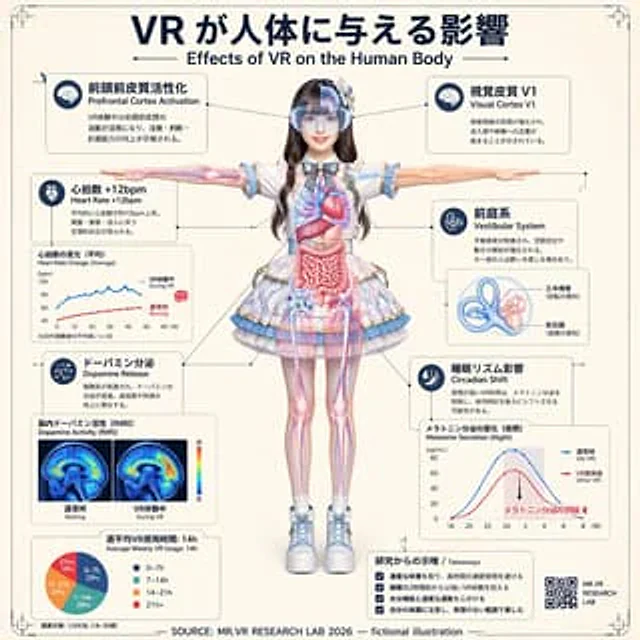
  "type": "Medical Infographic Poster",
  "subject": "Front view of a full-body anime idol girl with semi-transparent anatomical overlays.",
  "style": {
    "overall": "A simple Japanese educational infographic that blends cute anime character art with scientific visualization.",
    "background": "The paper has a warm off-white tone with a subtle grid pattern.",
    "palette": "Navy blue, cream, soft pastel pink, pastel blue, medical red and blue",
    "rendering": "Highly detailed and exquisite poster design, clear vector UI frames, soft character shadows, and realistic anatomical illustrations composited onto the body."
  },
  "character": {
    "gender_presentation": "woman",
    "age_appearance": "Teenagers to young adults",
    "pose": "Stand upright with your body centered and arms extended horizontally to the sides.",
    "outfit": "A pastel idol dress with short puff sleeves, ruffled hem, layered skirt, blue ribbon bow at the neckline, lace trim, white ankle socks, and blue high-top sneakers.",
    "hair": {
      "color": "Dark brown",
      "style": "Long, wavy pigtails fall over her shoulders and extend below her chest, parted in the middle, and adorned with small decorative flower hair accessories."
    },
    "face": "Intentionally blurring/obscuring"
  },
  "anatomy_overlay": {
    "visible_parts_count": 8,
    "visible_parts": [
      "A head that glows",
      "Lungs and heart in the chest",
      "Abdominal digestive organs",
      "Glowing reproductive/urinary areas in the pelvis",
      "Arteries in both arms",
      "veins in both arms",
      "Arteries and veins in the legs",
      "Highlighted inner ear balance structures near the head"
    ]
  },
  "layout": {
    "title_block": {
      "count": 2,
      "lines": [
        "The effects of VR on the human body",
        "The effects of VR on the human body"
      ],
      "position": "Centered at the top"
    },
    "main_centerpiece": "The character is depicted in a T-shape, marked with dotted lines, connecting various body parts to surrounding information boxes.",
    "info_boxes": {
      "count": 6,
      "items": [
        {
          "title": "Precortical activation",
          "subtitle": "Prefrontal cortex activation",
          "position": "Top left",
          "icon": "brain"
        },
        {
          "title": "Visual cortex V1",
          "subtitle": "Visual cortex V1",
          "position": "Top right",
          "icon": "brain"
        },
        {
          "title": "Heart rate +12 bpm",
          "subtitle": "Heart rate +12 bpm",
          "position": "Top left center",
          "icon": "heart"
        },
        {
          "title": "vestibular system",
          "subtitle": "vestibular system",
          "position": "Right Center",
          "icon": "head and balance"
        },
        {
          "title": "Dopamine secretion",
          "subtitle": "Dopamine secretion",
          "position": "Left center bottom",
          "icon": "molecule/network"
        },
        {
          "title": "Influence on sleep rhythm",
          "subtitle": "circadian rhythm shift",
          "position": "Right center bottom",
          "icon": "moon and stars"
        }
      ]
    },
    "charts": {
      "count": 4,
      "items": [
        {
          "title": "Heart rate changes (average)",
          "subtitle": "Heart rate variability (average)",
          "position": "Left center bottom",
          "chart_type": "Line graph with blue and red lines",
          "labels": [
            "VR experience",
            "Normal state",
            "+12"
          ]
        },
        {
          "title": "Brain dopamine activity (fMRI)",
          "subtitle": "Brain dopamine activity (fMRI)",
          "position": "Bottom left",
          "chart_type": "Two brain scans with color-coded scales",
          "labels": [
            "Normal state",
            "VR experience",
            "resting state",
            "VR period"
          ]
        },
        {
          "title": "Changes in melatonin secretion (at night)",
          "subtitle": "Changes in melatonin secretion (at night)",
          "position": "Bottom right",
          "chart_type": "Line graph with blue and red curves",
          "labels": [
            "Normal state",
            "After watching VR",
            "No VR",
            "VR after",
            "Melatonin secretion is suppressed"
          ]
        },
        {
          "title": "Average weekly VR usage time: 14 hours",
          "subtitle": "Average weekly VR usage time: 14 hours",
          "position": "Bottom left",
          "chart_type": "Pie chart",
          "labels": [
            "0–7 hours",
            "7–14 hours",
            "14–21 hours",
            "21 hours+"
          ]
        }
      ]
    },
    "diagrams": {
      "count": 1,
      "items": [
        {
          "title": "Inner ear balance chart",
          "position": "Lower right, near the vestibular system frame",
          "labels": [
            "Tripartite canal",
            "Otoliths"
          ]
        }
      ]
    },
    "research_box": {
      "count": 1,
      "position": "Bottom Middle Right",
      "title": "Research Implications / Takeaways",
      "bullet_count": 4
    },
    "branding": {
      "count": 3,
      "items": [
        "Source: MR.VR RESEARCH LAB 2026",
        "MR.VR RESEARCH LAB",
        "QR code in the bottom right corner"
      ]
    },
    "border": "The edges feature a decorative technical border, with corner accents and small, measurement-mark-like scales."
  },
  "text_density": "High, the full text includes English and Japanese subheadings.",
  "composition": "The poster is symmetrical, with labels on both sides of the characters, a chart fixed in the bottom corner, and a prominent, bold title at the top.",
  "quality": "Clear, suitable for publication, square format"
}
Verwendung
- Den vollständigen Original-Prompt einschließlich Parametern kopieren.
- Motiv, Text und Komposition an die eigenen Anforderungen anpassen.
- Ein kompatibles externes Werkzeug nutzen; Zugangsbedingungen und Ergebnis prüfen.
Vor dem Start
- Prüfen, ob ein Referenzbild nötig ist. Kompatibilität belegt nicht das tatsächlich verwendete Modell.
- Namen, Zahlen und Bildtexte prüfen; Modellversionen können andere Ergebnisse liefern.