Originaldokument
GPT Image 2 · en
Scene:
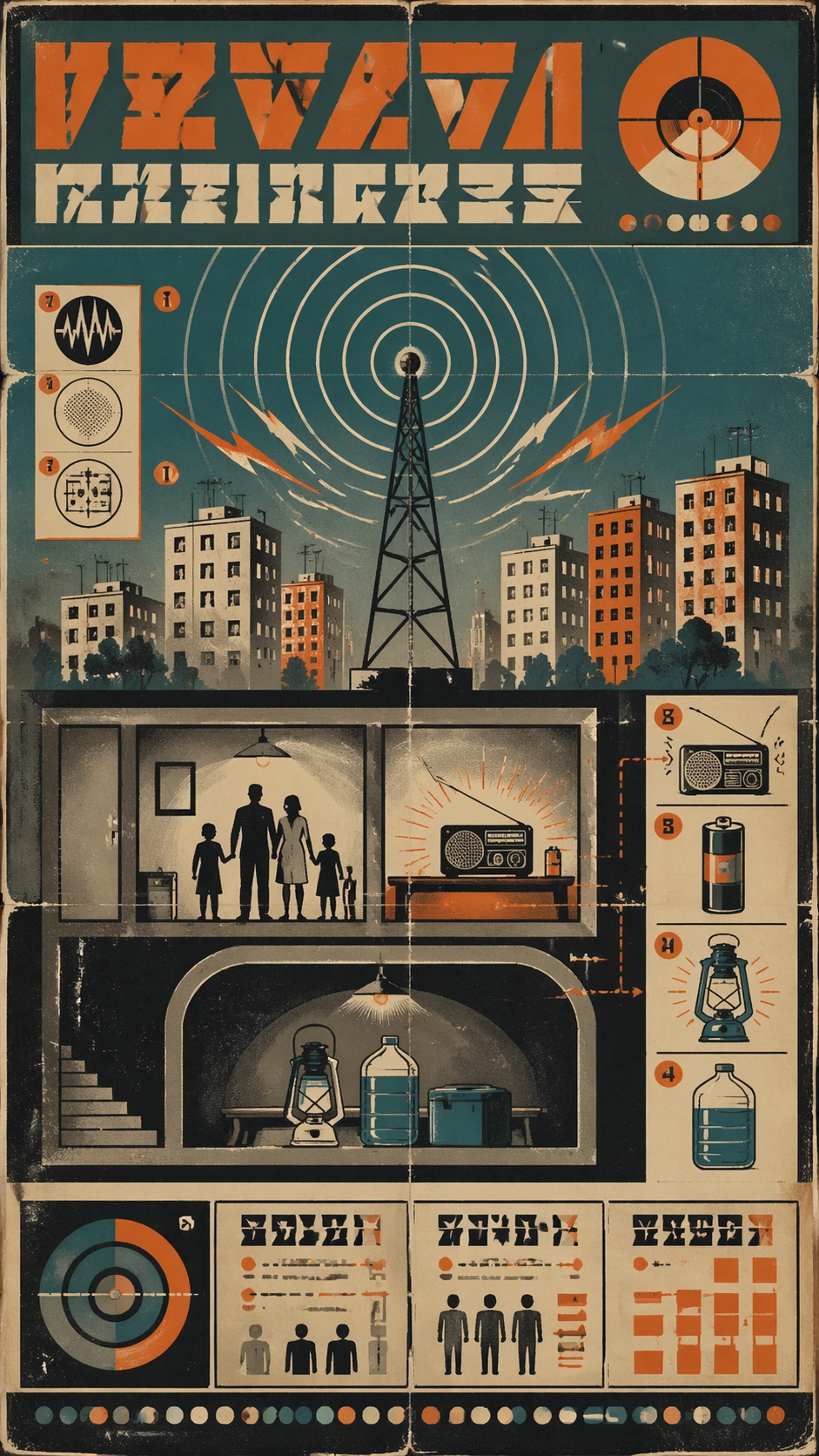
A vertical 9:16 fictional poster study inspired by mid-century civil-defense and broadcast-information graphics. The palette is faded teal, orange, black, cream, and gray, with screenprint grain, folded paper creases, and modular diagram panels. A large headline region at the top and a footer instruction strip are filled with unreadable pseudo-letter blocks. The poster must feel like a historical museum artifact, not present-day emergency guidance.

Subject:
A generic radio tower emits concentric signal rings over a simplified city cutaway: apartment blocks, basement shelter icon, family silhouettes, battery lamp, water jug, and a small tabletop radio. All elements are invented and unbranded. No government seal, national emblem, real agency name, warning code, or readable instruction appears. The layout uses diagram arrows and numbered-looking circles, but they remain abstract and non-readable.

Important details:
Capture civil-defense poster grammar: anxious but orderly information design, bold icon system, practical object diagrams, signal waves, limited screenprint colors, and strong modular hierarchy. Keep the educational design-history lens clear by avoiding real instructions or current hazards. The diagram should be visually plausible while preventing actual public-safety advice from being readable. Use aging, ink misregistration, and paper texture to ground the period style.

Use case:
Propaganda Poster History single study 8/8, an independent civil-defense broadcast poster-language specimen for design-history comparison.

Constraints:
No readable text, no watermark, no logos, preserve exact 9:16 vertical aspect ratio, no real government seal, no actual emergency instruction, no real warning code, no national flag, no contemporary political or disaster reference.
Verwendung
- Den vollständigen Original-Prompt einschließlich Parametern kopieren.
- Motiv, Text und Komposition an die eigenen Anforderungen anpassen.
- Ein kompatibles externes Werkzeug nutzen; Zugangsbedingungen und Ergebnis prüfen.
Vor dem Start
- Prüfen, ob ein Referenzbild nötig ist. Kompatibilität belegt nicht das tatsächlich verwendete Modell.
- Namen, Zahlen und Bildtexte prüfen; Modellversionen können andere Ergebnisse liefern.