Originaldokument
GPT Image 2.5 · en
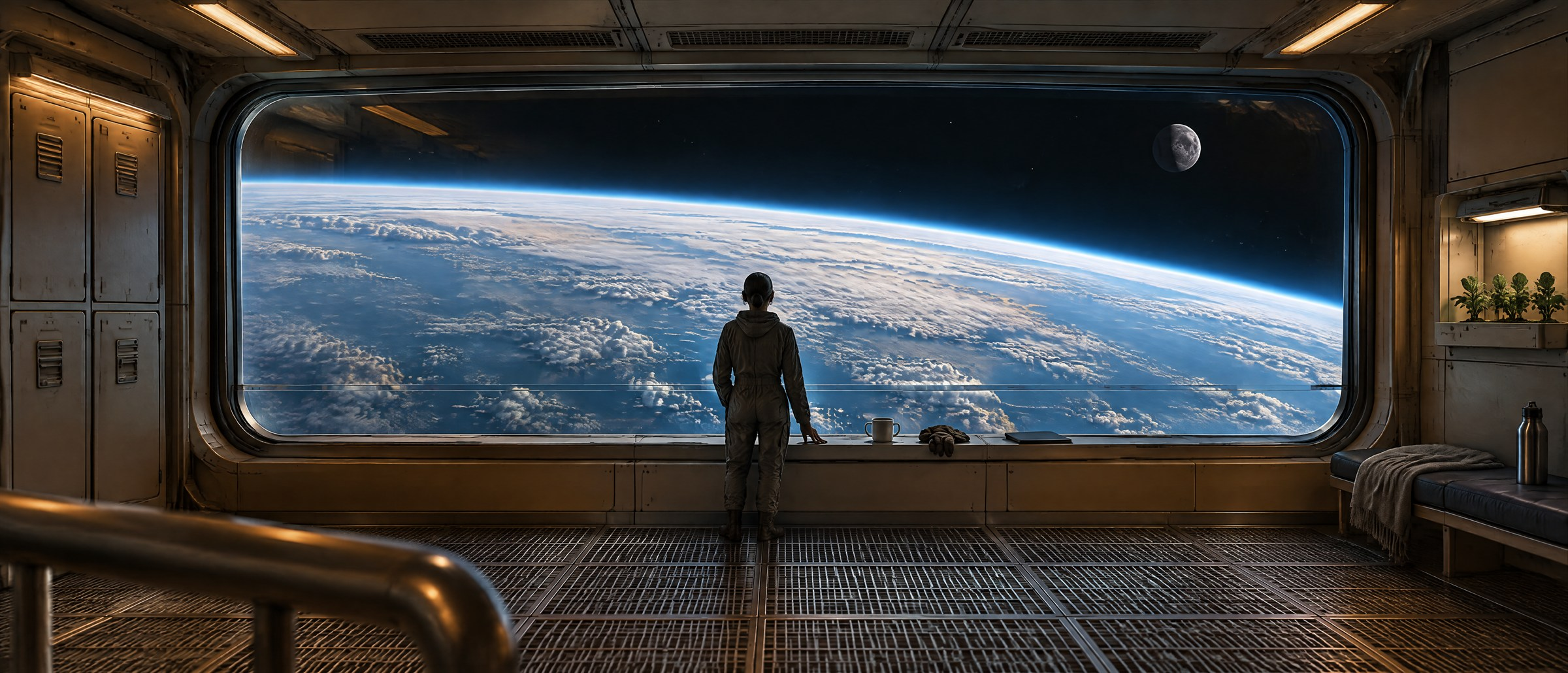
An interior photograph from inside an orbital station's observation deck, 21:9, looking out through a huge
curved window at the limb of a planet. Shot on a wide lens from the back of the deck so the window frame, the
interior and the view all read at once.

THE WINDOW
The window is the far wall: a single curved pane about four metres tall and twelve wide, held in a deep
structural frame. The frame is heavy and layered — an outer structural rib, then a primary seal, then an inner
trim panel — and every layer is visible in section where it meets the glass. Running horizontally across the
glass at waist height is one thin defroster wire, and at its lower edge a narrow metal sill. The glass itself
is not perfectly clear: a faint double reflection of the interior lights sits across its upper left, and where
the deck's warm light is brightest the glass picks up a soft haze.

THE VIEW
A planet limb fills the lower two thirds of the window, seen from low orbit: a curved horizon running from the
lower left to the middle right, cloud bands layered in soft horizontal streaks, and a deep blue ocean under
broken cloud toward the terminator. Above the horizon, a thin bright arc of atmosphere — a single luminous
line of pale blue-white — separates the planet from the black of space. Above that, space is almost black with
a very sparse scatter of stars, no more than thirty visible in the whole pane. In the upper right of the
window, one small airless moon, a plain grey disc with visible craters along its lower edge, no larger than a
thumbnail at this distance.

THE DECK
The interior is compact and functional. In the foreground, low and slightly out of focus, the top rail of a
steel handrail crosses the lower left. Along the left wall, four equipment lockers with louvred vents and
plain recessed latches. On the ceiling, two continuous strips of warm light running the length of the deck,
their housings visible. The floor is open steel grating. Against the right wall, a narrow upholstered bench
with a folded grey blanket and one steel water bottle. In a recessed tray beside the window, a shallow
hydroponic unit with four small green plants under a single small grow lamp. On the sill by the window, one
ceramic mug, a pair of work gloves and a hand-held tablet lying face down.

THE FIGURE
One person, standing at the centre of the window with their back to camera, small in the frame — about one
ninth of the frame height — silhouetted against the planet, wearing a soft grey flight suit with the hood down,
one hand resting on the sill. No other person anywhere.

LIGHT
Two sources only. Inside: the warm amber ceiling strips, which light the deck, the lockers, the bench and the
figure's shoulders from above and behind, and put a warm reflection across the upper left of the glass.
Outside: the cold blue-white light of the planet, which rims the window frame from beyond and lights nothing
inside the deck. The two temperatures never mix: interiors stay amber, the planet stays cold, and the figure is
read as a silhouette because the outside is brighter than the inside.

CONSTRAINTS
No text anywhere: no signage, no labels on the lockers, no warning placards, no numbers, no stencilled
lettering, no readable screens, no watermark. Do not add a second figure, a spaceship, a satellite, a docking
bay, a spacecraft passing by, or a laser. No lens flare, no light beams, no god rays. Do not make space purple,
do not add nebulae or coloured stars, and do not fill the window with debris. Keep the verticals of the window
frame true and the horizon a genuine curve, not a straight line. No HUD overlays, no targeting reticles, no
graphics layered over the view.
Verwendung
- Den vollständigen Original-Prompt einschließlich Parametern kopieren.
- Motiv, Text und Komposition an die eigenen Anforderungen anpassen.
- Ein kompatibles externes Werkzeug nutzen; Zugangsbedingungen und Ergebnis prüfen.
Vor dem Start
- Prüfen, ob ein Referenzbild nötig ist. Kompatibilität belegt nicht das tatsächlich verwendete Modell.
- Namen, Zahlen und Bildtexte prüfen; Modellversionen können andere Ergebnisse liefern.