Originaldokument
GPT Image 2 · en
{
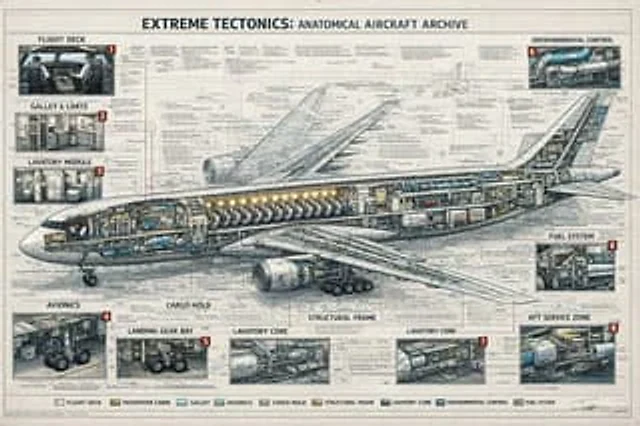
"type": "Technical aircraft profile information poster",
"subject": {
"title": "{argument name=\"headline text\" default=\"Limit Structures: Aircraft Anatomy Files\"}",
"aircraft": "A side sectional view of a wide-body commercial airliner, with the nose facing left and the tail facing right. The landing gear is down, revealing a large underwing engine. The interior cabin and systems are fully exposed.",
"style": "The design combines ultra-refined aerospace engineering blueprints with architectural archival drawings, featuring precise cross-sectional drawings, dense annotation lines, clearly legible microtext, soft ink wash rendering, off-white aged paper texture, blue-gray graphite lines, and subtle brown and steel accents."
},
"layout": {
"format": "Single large horizontal poster",
"background": "The entire page contains engineering diagrams with layered orthographic projection outlines, measurement marks, leader lines, technical specifications, and a faint drawing grid.",
"centerpiece": "A massive cross-section of an aircraft, spanning almost the entire width of the page, showcases the cockpit, passenger seating rows, service bay, internal piping, cargo hold, structural frame, and tail system.",
"sections": [
{
"title": "Cockpit",
"position": "Top left",
"count": 1,
"labels": [
"1"
],
"description": "Cockpit interior illustrations, including the pilot's seat, instrument panel, windows, and surrounding avionics."
},
{
"title": "Kitchen and food cart",
"position": "Below the upper left cockpit",
"count": 1,
"labels": [
"2"
],
"description": "Service kitchen illustrations, including storage shelves, ovens, serving carts, cabinets, and narrow aisles."
},
{
"title": "Toilet module",
"position": "Left-middle kitchen bottom",
"count": 1,
"labels": [
"3"
],
"description": "Small bathroom illustrations, including a toilet, sink, wall panels, and door."
},
{
"title": "Environmental control system",
"position": "Top right",
"count": 1,
"labels": [
"6"
],
"description": "Illustrations of mechanical systems, including pipes, turbines, and cylindrical equipment."
},
{
"title": "fuel system",
"position": "Right Center",
"count": 1,
"labels": [
"8"
],
"description": "Compact mechanical illustrations showing oil tanks, pumps, and piping systems."
},
{
"title": "Avionics",
"position": "Bottom left",
"count": 1,
"labels": [
"4"
],
"description": "An illustration of the electronics compartment, including cabling, cabinets, equipment racks, and nearby landing gear."
},
{
"title": "Landing gear bay",
"position": "Lower left center",
"count": 1,
"labels": [
"5"
],
"description": "An illustration of the landing gear bay, highlighting the wheel assembly, struts, and surrounding structure."
},
{
"title": "core area of the toilet",
"position": "Bottom Center",
"count": 2,
"labels": [
"LAVATORY CORE",
"LAVATORY CORE"
],
"description": "Two separate illustrations of the service core showcasing the exposed cylindrical water tank, piping, and internal support system; the illustration on the right is labeled 7."
},
{
"title": "Rear service area",
"position": "Bottom right",
"count": 1,
"labels": [
"8"
],
"description": "Aft technical bay illustration, featuring large blue cylindrical units, pipes, service entrances, and structural frames."
}
],
"additional_labels": [
{
"text": "cargo hold",
"position": "Lower left"
},
{
"text": "Structural framework",
"position": "Shimonaka"
}
],
"legend": {
"position": "Bottom Center",
"count": 9,
"labels": [
"Cockpit",
"cabin",
"kitchen",
"Avionics",
"cargo hold",
"Structural framework",
"core area of the toilet",
"Environmental control system",
"fuel system"
]
}
},
"composition": {
"camera": "Orthographic side view",
"poster_margins": "The entire sheet of paper has a thin border around it.",
"text_density": "Very high, with numerous tiny annotations, arrows, and part labels scattered throughout the page.",
"lighting": "Flat, archival illustration lighting, non-photographic style, optimized for readability.",
"finish": "Clear 4K infographic print quality, no garbled text, authentic typography, and precise line accuracy."
}
}Verwendung
- Den vollständigen Original-Prompt einschließlich Parametern kopieren.
- Motiv, Text und Komposition an die eigenen Anforderungen anpassen.
- Ein kompatibles externes Werkzeug nutzen; Zugangsbedingungen und Ergebnis prüfen.
Vor dem Start
- Prüfen, ob ein Referenzbild nötig ist. Kompatibilität belegt nicht das tatsächlich verwendete Modell.
- Namen, Zahlen und Bildtexte prüfen; Modellversionen können andere Ergebnisse liefern.