Documento original
GPT Image 2 · en
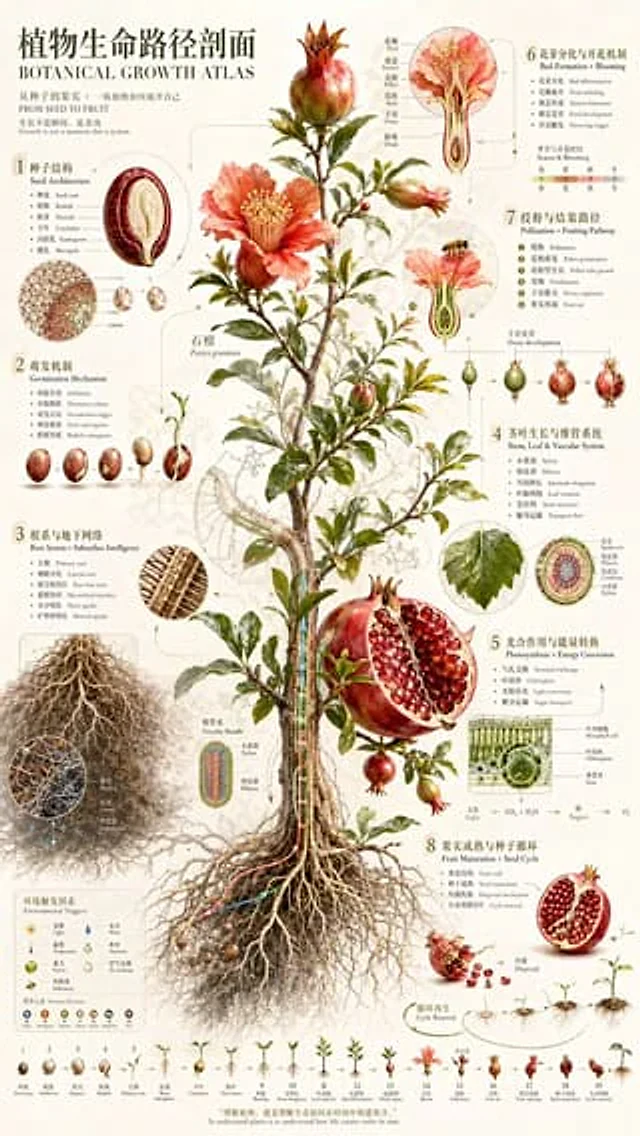
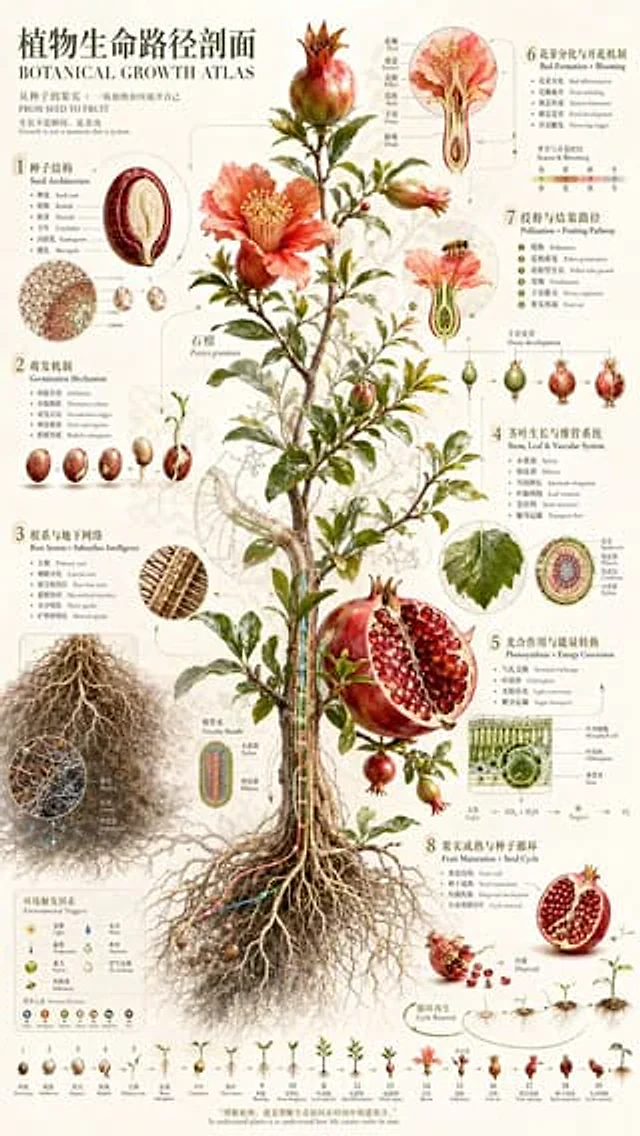
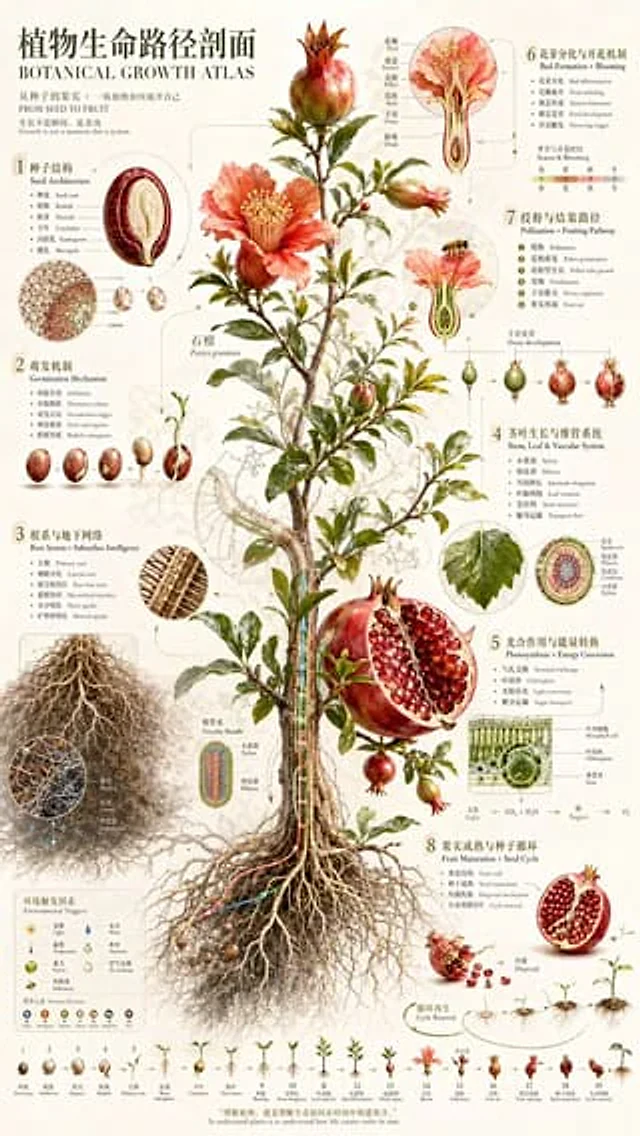
Create a richly detailed retro-style scientific botanical infographic poster on warm ivory paper, inspired by 19th-century natural history atlases, but optimized with modern, minimalist typography. The main subject is a complete pomegranate plant, labeled as follows:{argument name="plant name" default="Pomegranate"} /{argument name="latin name" default="Punica granatum"} Presented in a centered, vertical sectional style, the poster offers an unobstructed view from crown to roots. It depicts a slender, woody trunk with abundant branches, glossy green leaves, several orange-red flowers, unopened buds, young fruit, ripe fruit, and a large, split-open pomegranate revealing dense, ruby-like seeds. Below, the sprawling root system is fully visible. The poster is rendered with exquisite watercolor and ink, featuring realistic plant anatomy, precise lines, subtle dark brown shading, fine leading lines, arrows, and small numbered circles. The main title is located in the upper left corner of the poster.{argument name="headline text" default="Plant life path profile"} Below is the English subtitle:{argument name="subtitle text" default="BOTANICAL GROWTH ATLAS"} Add a brief bilingual introductory text below the title. The tall, elongated educational poster, in a 9:16 aspect ratio, centers on the plant surrounded by illustrative charts. Eight numbered educational sections surround the plant, each with a prominent Chinese title and a smaller English translation, arranged in a graphic style: 1. Seed Structure—A large cross-section of the seed, labeled with internal parts, accompanied by a smaller illustration of a cell cross-section. 2. Germination Mechanism—The left-hand sequence, comprising five stages, showing seed swelling, splitting, germination, radicle emergence, and early seedling morphology. 3. Root System and Substrate Intelligence—The lower left shows a large, bare root system, accompanied by two circular magnified illustrations of root details, showing branching structure and root hair/network texture. 4. Stem, Leaf, and Vascular System—The right-center area, containing two anatomical circular cross-sections and a separate leaf illustration, labeled with xylem, phloem, epidermis, and related tissues. 5. Photosynthesis and Energy Conversion – The lower right biology panel contains three green microscopic structural diagrams, including leaf tissue/cell-like sections, and simple chemical flow lines indicating the conversion of CO2 + H2O into sugars and O2. 6. Bud Formation and Flowering – The upper right flowering section contains two large flower anatomy diagrams (side view and longitudinal section), labeled with stamens, petals, ovary, and pollen structures. 7. Pollination and Fruiting Pathway – The right-hand developmental bar contains five stages of pomegranate fruit development from bud to maturity, along with an illustration showing a bee approaching the flower for pollination. 8. Fruit Maturation and Seed Cycle – The lower right life cycle section contains three fruit illustrations showing a complete fruit, a split fruit, and a split fruit revealing seeds, plus three diagrams of seedling growth. At the bottom edge, a long growth documentary strip contains 19 small step illustrations, each numbered 1 to 19, showcasing the plant life cycle from dormant seed to germination, root growth, seedling emergence, sapling development, flowering, fruit setting, maturity, seed dispersal, and cyclical renewal. A small environmental factors panel is added to the lower left, with icon-based indicators for light, temperature, water, nutrients, and air. Bilingual labeling is used throughout, with Chinese titles highlighted and English translations in a smaller serif font. The overall aesthetic should present an academic, elegant, museum-quality feel with a dense sense of information, complemented by refined classical typography, a soft beige background, realistic red and green tones, and a balanced and clean graphic layout.Cómo usar
- Copia el prompt original completo, incluidos los parámetros.
- Adapta el tema, el texto y la composición a tus necesidades.
- Usa una herramienta externa compatible; comprueba el acceso y el resultado.
Antes de empezar
- Comprueba si necesita una imagen de referencia. La compatibilidad no demuestra qué modelo generó el ejemplo.
- Revisa nombres, cifras y textos; el resultado puede variar entre versiones del modelo.