
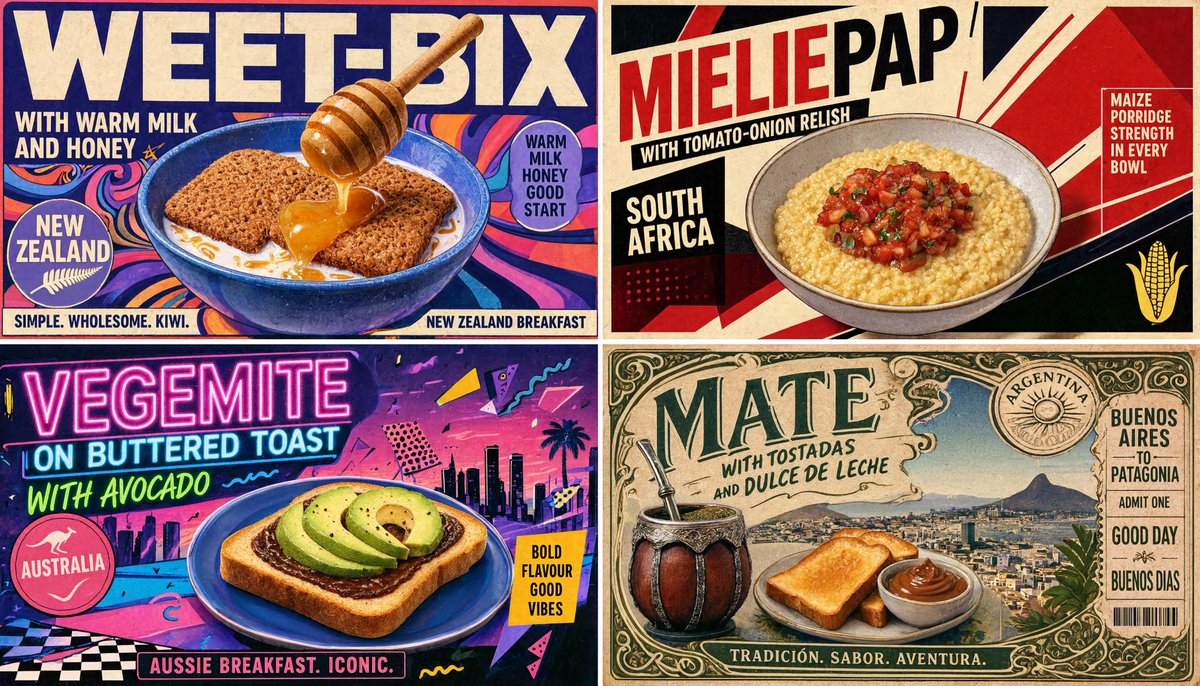
Documento original
Nano Banana Pro · en
2x2 grid, 16:9, do this for 4 under rated breakfasts of Southern hemisphere: INPUT = [{argument name="category" default="TOPIC_CATEGORY"} / {argument name="region" default="REGION_SET"} / {argument name="criteria" default="SELECTION_CRITERIA"} / {argument name="mood" default="MOOD"}]
MODE = no_hardcoding / inference_only

Run REGIONAL_CULTURAL_ATLAS_EXTRACTION:

CATEGORY_DNA := infer what type of thing is being compared, how it is used, why it matters, and what makes it visually recognizable

REGION_DNA[each] := infer local environment, visual culture, palette, typography attitude, textures, symbols, landscapes, tools, rituals, and social context

ITEM_SELECTION[each] := infer one overlooked or representative item that fits TOPIC_CATEGORY + REGION + SELECTION_CRITERIA

HERO_VISUAL[each] := infer the best visual treatment:
plated food, product close-up, ritual scene, tool layout, garment portrait, object still life, landscape-backed artifact, map-backed diagram, or symbolic vignette

COPY_SYSTEM[each] := generate:
- large item title
- short emotional tagline
- origin/location label
- 2–4 tiny descriptors
- stamp or badge phrase
- small contextual note

GRAPHIC_SYSTEM := infer torn paper, printed grid, muted color blocks, topographic lines, stamps, borders, halftone, atlas marks, and editorial spacing

Render:
A premium regional comparison poster where each panel feels locally specific but belongs to one unified cultural theme.

Forbidden:
hard-coded Southern Hemisphere, fixed breakfasts, fixed foods, fixed countries, fixed beige/red/green palette, fake local facts, random travel-poster clichés.
Cómo usar
- Copia el prompt original completo, incluidos los parámetros.
- Adapta el tema, el texto y la composición a tus necesidades.
- Usa una herramienta externa compatible; comprueba el acceso y el resultado.
Antes de empezar
- Comprueba si necesita una imagen de referencia. La compatibilidad no demuestra qué modelo generó el ejemplo.
- Revisa nombres, cifras y textos; el resultado puede variar entre versiones del modelo.