
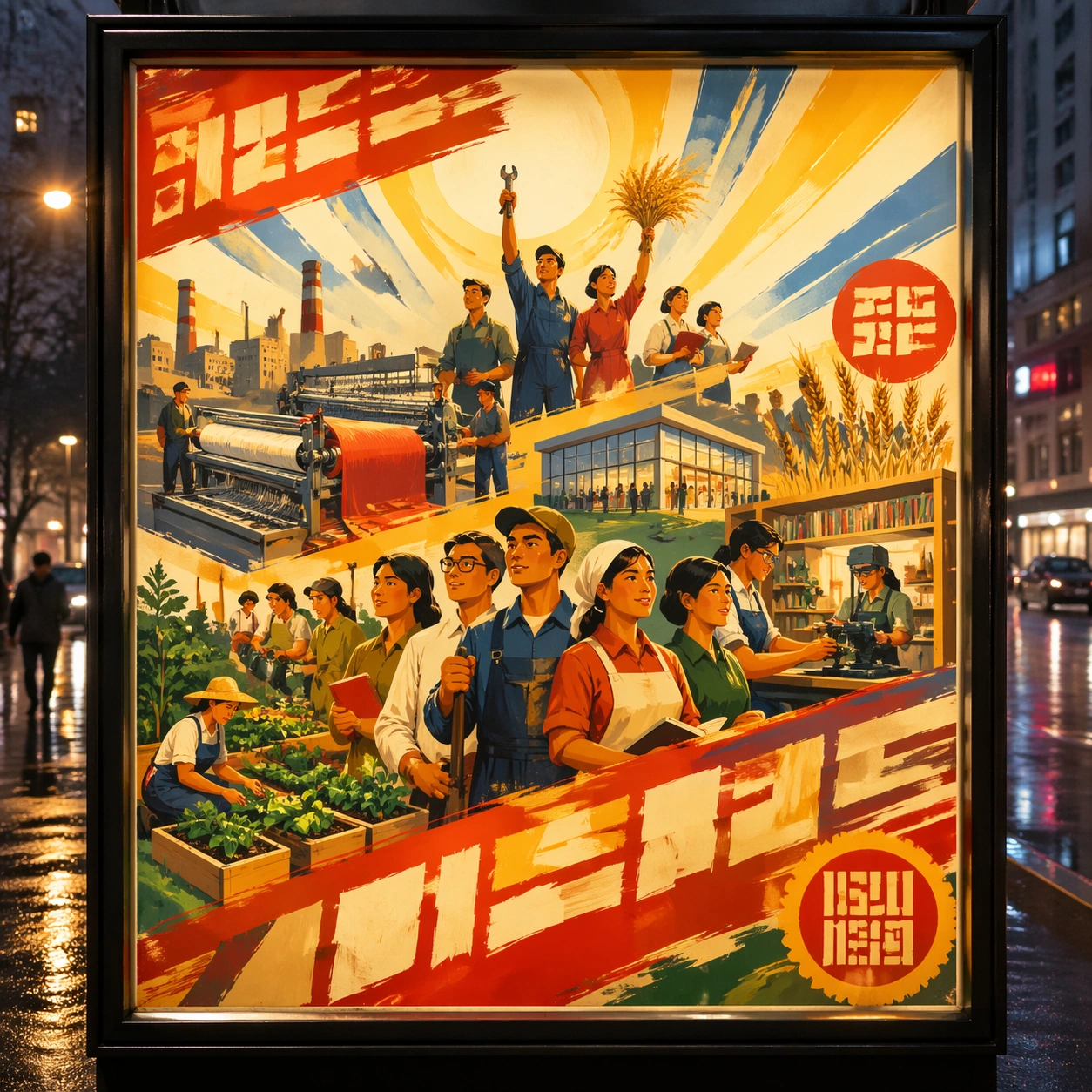
Documento original
GPT Image 2 · en
Scene:
A square dusk street photograph of a backlit transit poster glowing inside glass, with faint rain reflections, soft city blur in the distance, and the poster remaining fully legible as a composition. The poster should express late-1970s handmade gouache poster language with bright optimism, grouped figures, clean silhouettes, and celebratory sunlit staging, using red, gold, sky blue, leaf green, cream, and warm skin tones painted opaquely and a tactile surface appropriate to the medium.

Subject:
Adapt the poster into a public-facing lightbox version that still honors the original style grammar while feeling bold enough to stop a passerby from several meters away. Use workers, farmers, teachers, textile mills, books, wheat, machinery, and radiant sky bands as the main visual ingredients, and organize them with brush slogan panels and seal forms treated as non-readable compositional devices. For the contemporary-subject axis, thread in urban community gardens, public libraries, and makerspaces rendered through optimistic collective poster grammar. The poster must feel like an original design object rather than a reproduction of any known work.

Important details:
Let the style survive the illumination test: color blocking, silhouette contrast, and abstract lettering should stay controlled under bright internal light and reflective glass. Preserve uplifted expressions, gouache blending, clear grouping hierarchy, and warm public-education energy without specific portraiture. Keep every letterform abstract and non-readable, as if it were a typographic texture rather than language. Make the style unmistakable through composition, palette, surface behavior, and symbolic compression. no actual political portraits, no national emblem, no cynical decay, no muddy desaturated palette.

Use case:
Chinese 70s Poster single study 3/9, testing distance readability in public display.

Constraints:
No readable text, no watermark, no logos, preserve exact 1:1 aspect ratio, no copyrighted characters, no real brand marks, no QR codes, no interface chrome, no accidental gibberish lettering.
Cómo usar
- Copia el prompt original completo, incluidos los parámetros.
- Adapta el tema, el texto y la composición a tus necesidades.
- Usa una herramienta externa compatible; comprueba el acceso y el resultado.
Antes de empezar
- Comprueba si necesita una imagen de referencia. La compatibilidad no demuestra qué modelo generó el ejemplo.
- Revisa nombres, cifras y textos; el resultado puede variar entre versiones del modelo.