Document original
GPT Image 2 · en
{
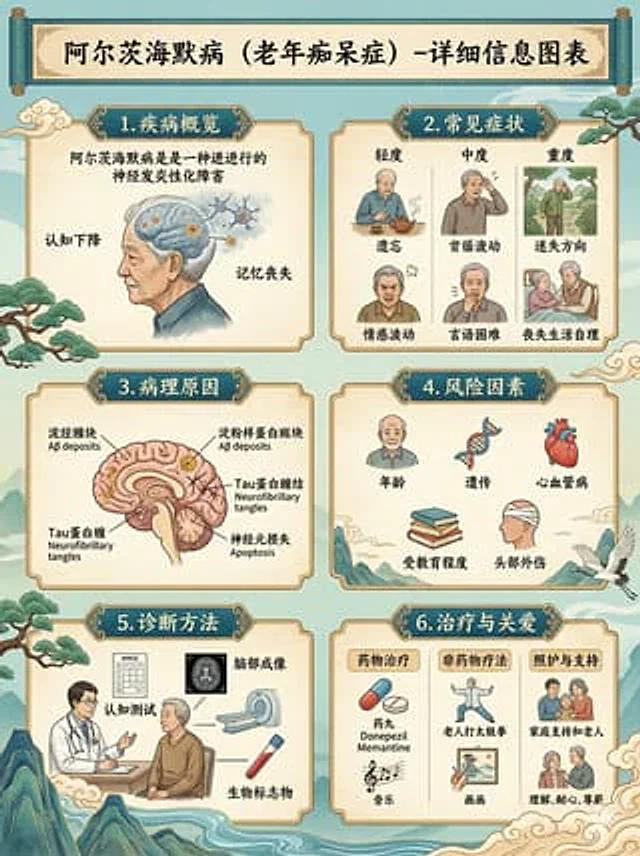
  "type": "Traditional Chinese Medical Science Popularization Infographic Poster",
  "topic": "{argument name=\"topic\" default=\"Alzheimer's disease (senile dementia)\"}",
  "title": "{argument name=\"headline text\" default=\"Alzheimer's Disease (Dementia) - Detailed Information Chart\"}",
  "language": "Chinese",
  "style": {
    "overall": "Educational health infographics with a retro Chinese poster style",
    "rendering": "Elegant hand-drawn illustrations, soft watercolor texture, delicate ink lines, and low-saturation, soft colors.",
    "palette": "Cyan, beige, cream, jade green, gray-blue, warm brown, light coral",
    "decorative frame": "Ornate scroll-style border with gold trim",
    "background": "The background is light sky blue, incorporating traditional Chinese landscape elements such as freehand cloud patterns, pine trees, mountains, cranes, and waves."
  },
  "layout": {
    "format": "Vertical poster",
    "sections": [
      {
        "title": "1. Disease Overview",
        "position": "top-left",
        "count": 1,
        "labels": [
          "Cognitive decline",
          "Memory loss"
        ],
        "content": "A large panel explaining Alzheimer's disease as a progressive neurodegenerative disease is accompanied by a profile portrait of an elderly person with a semi-transparent, degenerated brain surrounded by small neuron icons."
      },
      {
        "title": "2. Common symptoms",
        "position": "top-right",
        "count": 6,
        "labels": [
          "Mild",
          "moderate",
          "Severe",
          "Forget",
          "Emotional fluctuations",
          "Speech difficulties",
          "Lost",
          "Loss of self-care"
        ],
        "content": "The symptom section is divided into three columns according to severity, and includes six illustrations of everyday life scenes of the elderly: forgetfulness at the dinner table, emotional fluctuations, headaches or confusion, speech difficulties, getting lost outdoors, and performing daily care with the assistance of others."
      },
      {
        "title": "3. Pathological causes",
        "position": "middle-left",
        "count": 4,
        "labels": [
          "amyloid plaques",
          "Aβ deposition",
          "Tau protein tangles",
          "Neurofibrillary tangles",
          "neuron loss",
          "Apoptosis"
        ],
        "content": "Cross-sectional images of brain anatomy, with bilingual annotations, pointing to amyloid plaques, tau tangles, neurofibrillary tangles, and neuronal loss."
      },
      {
        "title": "4. Risk Factors",
        "position": "middle-right",
        "count": 5,
        "labels": [
          "age",
          "Heredity",
          "Cardiovascular disease",
          "Education level",
          "Head injury"
        ],
        "content": "Five icon-based risk factors are presented in a grid format: a half-body portrait of an older person representing age, a DNA double helix representing heredity, an anatomical heart representing cardiovascular disease, stacked books representing education level, and a side profile of a head wrapped in bandages."
      },
      {
        "title": "5. Diagnostic methods",
        "position": "bottom-left",
        "count": 4,
        "labels": [
          "Cognitive Test",
          "MMSE",
          "Brain imaging",
          "biomarkers"
        ],
        "content": "The diagnostic section shows a doctor examining an elderly patient at a table, along with three diagnostic visual elements: the MMSE test form, an MRI-like brain scan image, and test tubes representing biomarkers."
      },
      {
        "title": "6. Treatment and Care",
        "position": "bottom-right",
        "count": 7,
        "labels": [
          "Drug treatment",
          "pill",
          "Donepezil",
          "Memantine",
          "Non-drug therapy",
          "Elderly people practicing Tai Chi",
          "music",
          "draw",
          "Care and support",
          "Family support and the elderly",
          "Understanding, patience, respect"
        ],
        "content": "The nursing and treatment section is divided into three columns: drug therapy displays two pills and the words donepezil and memantine; non-drug therapies display Tai Chi, music, and painting; and nursing support displays family companionship, accompanied by heartwarming scenes emphasizing understanding, patience, and respect."
      }
    ],
    "header": {
      "count": 1,
      "text": "Large Chinese calligraphy title banner centered at the top"
    },
    "panel_style": "Six cream-colored rounded rectangular panels with decorative lapis lazuli title labels"
  },
  "composition": {
    "symmetry": "A balanced two-column layout with three rows of paired sections.",
    "readability": "A clear educational hierarchy, including main headings, numbered chapter titles, medium-sized illustrations, and prominent labels.",
    "density": "Information-dense but visually friendly"
  },
  "negative_constraints": [
    "No realistic photos",
    "No modern flat UI",
    "No dark or terrifying color scheme",
    "There is no clutter outside the six main sections.",
    "There are no additional chapters besides the 6 numbered sections."
  ],
  "quality": "High-resolution, detailed infographics suitable for public health education, hospital waiting rooms, science communication tweets, or social media comparison charts."
}
Mode d’emploi
- Copiez le prompt original complet, paramètres compris.
- Adaptez le sujet, le texte et la composition à vos besoins.
- Utilisez un outil externe compatible ; vérifiez l’accès et le résultat.
Avant de commencer
- Vérifiez si une image de référence est nécessaire. La compatibilité ne prouve pas le modèle utilisé pour cet exemple.
- Vérifiez noms, chiffres et textes ; les versions du modèle peuvent produire des résultats différents.