Document original
GPT Image 2 · en
Scene:
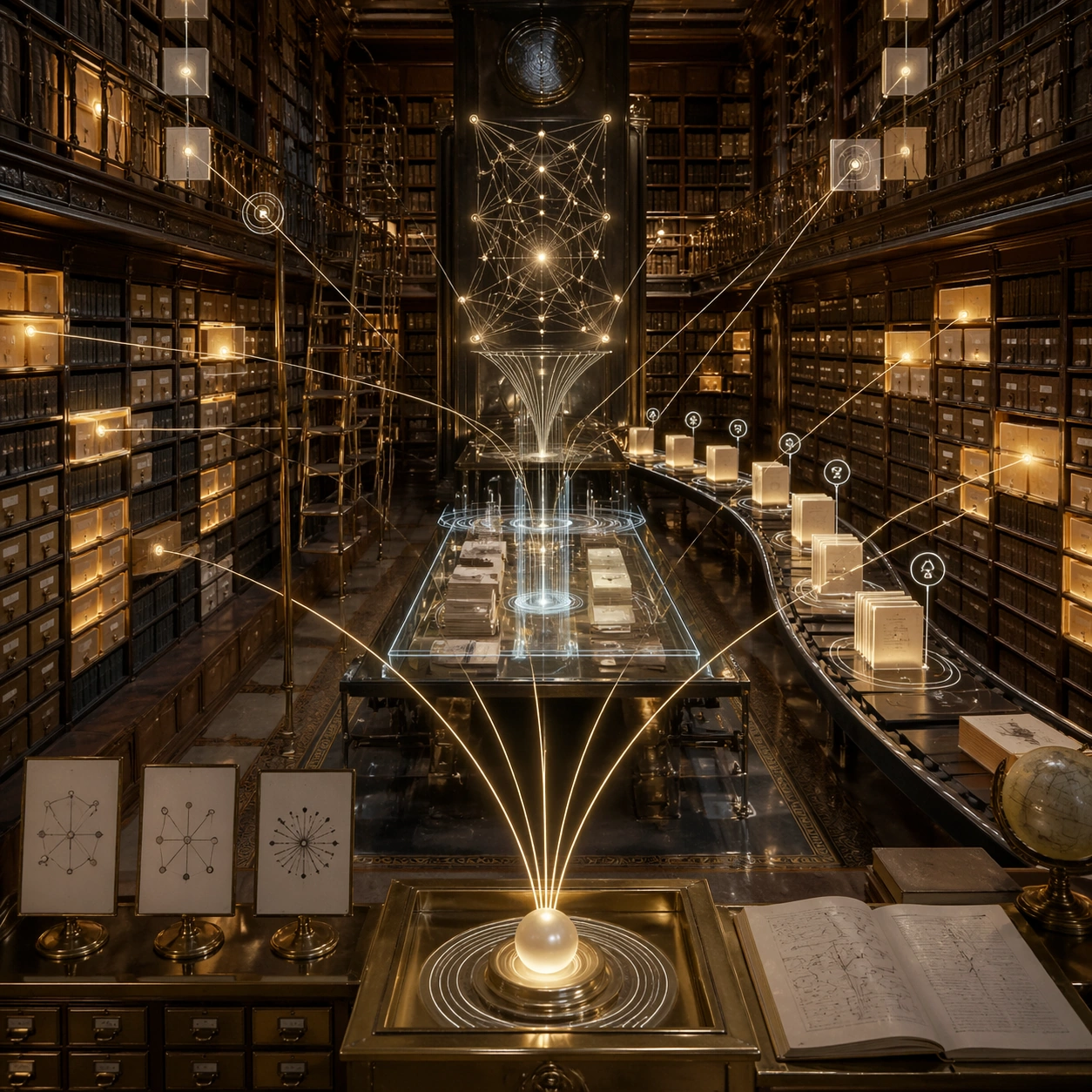
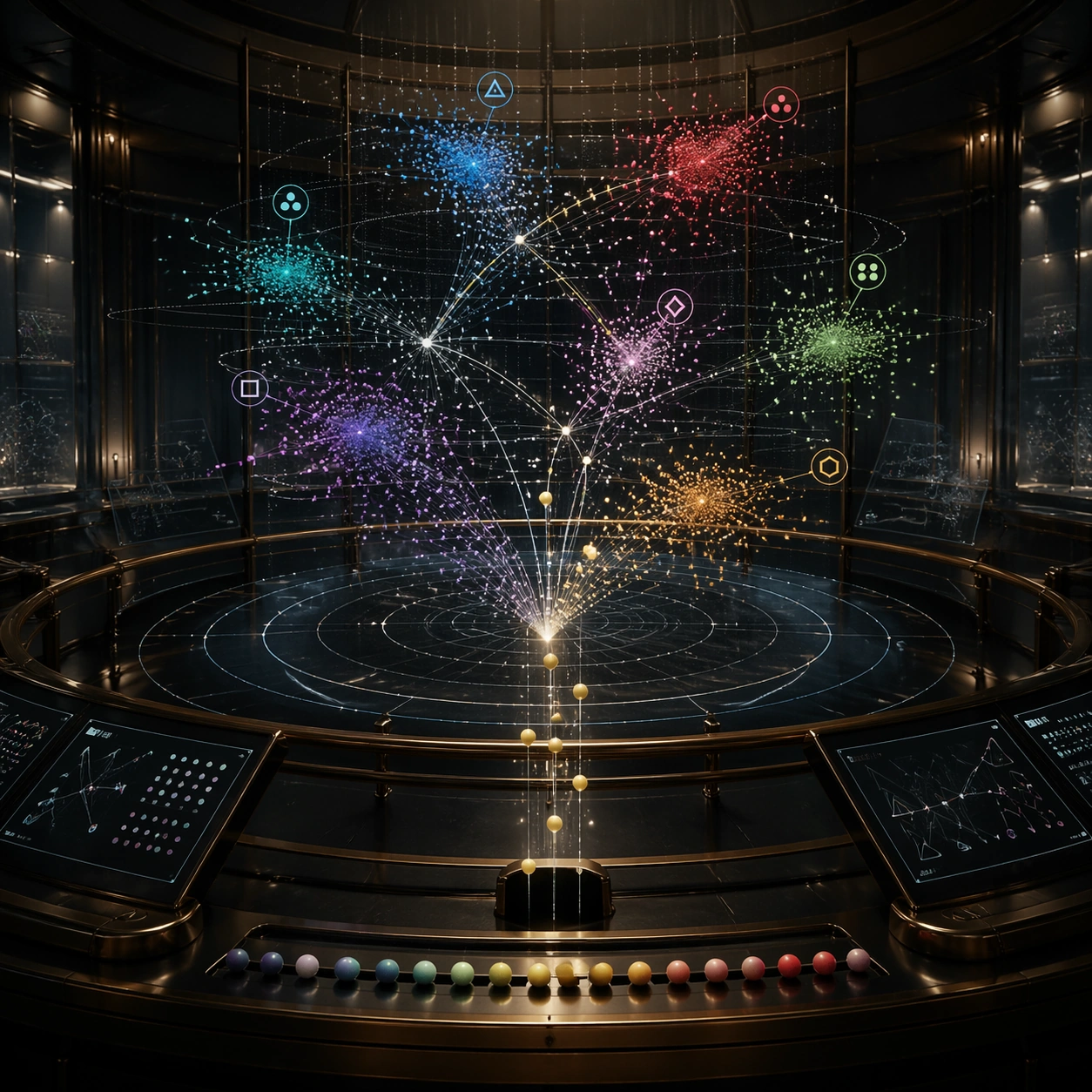
A square photoreal observatory-like room where a neural network explains token embeddings as a navigable spatial map. Use dim architectural lighting, a circular floor, brass rails, glass projection surfaces, and a suspended constellation of points. The composition should be elegant, academic, and physically plausible, with a strong central focus.

Subject:
Thousands of tiny luminous points float in clustered neighborhoods like stars, connected by faint proximity filaments. Small token-like beads enter from a slot at the bottom, then project upward into the embedding constellation, landing near semantically related clusters represented by abstract icons and color regions. Curved distance rings, vector arrows, and similarity bridges show how meanings are positioned relative to one another. Use annotation tablets with only non-readable symbolic marks, dots, and line codes.

Important details:
The image must communicate mapping from discrete symbols into continuous space. Show before-and-after: raw bead sequence at the edge, projected vectors, clustered geometry, and retrieval of nearby neighbors. Clusters should be visually distinct but not random; use density, color, and distance to show relationships. Avoid literal word labels, planets, or generic galaxy art. The neural network should feel like it is presenting its own coordinate system as a scientific instrument.

Use case:
Neural Network Self-Explanation single study 4/8, testing token embedding and semantic neighborhood structure as a photoreal observatory map.

Constraints:
No readable text, no watermark, no logos, preserve exact 1:1 aspect ratio, no real vocabulary labels, no code, no equations, no private chain-of-thought, no astrology look, no random starfield, no disconnected vectors, no illegible cluster hierarchy.
Mode d’emploi
- Copiez le prompt original complet, paramètres compris.
- Adaptez le sujet, le texte et la composition à vos besoins.
- Utilisez un outil externe compatible ; vérifiez l’accès et le résultat.
Avant de commencer
- Vérifiez si une image de référence est nécessaire. La compatibilité ne prouve pas le modèle utilisé pour cet exemple.
- Vérifiez noms, chiffres et textes ; les versions du modèle peuvent produire des résultats différents.