Document original
GPT Image 2 · en
Scene:
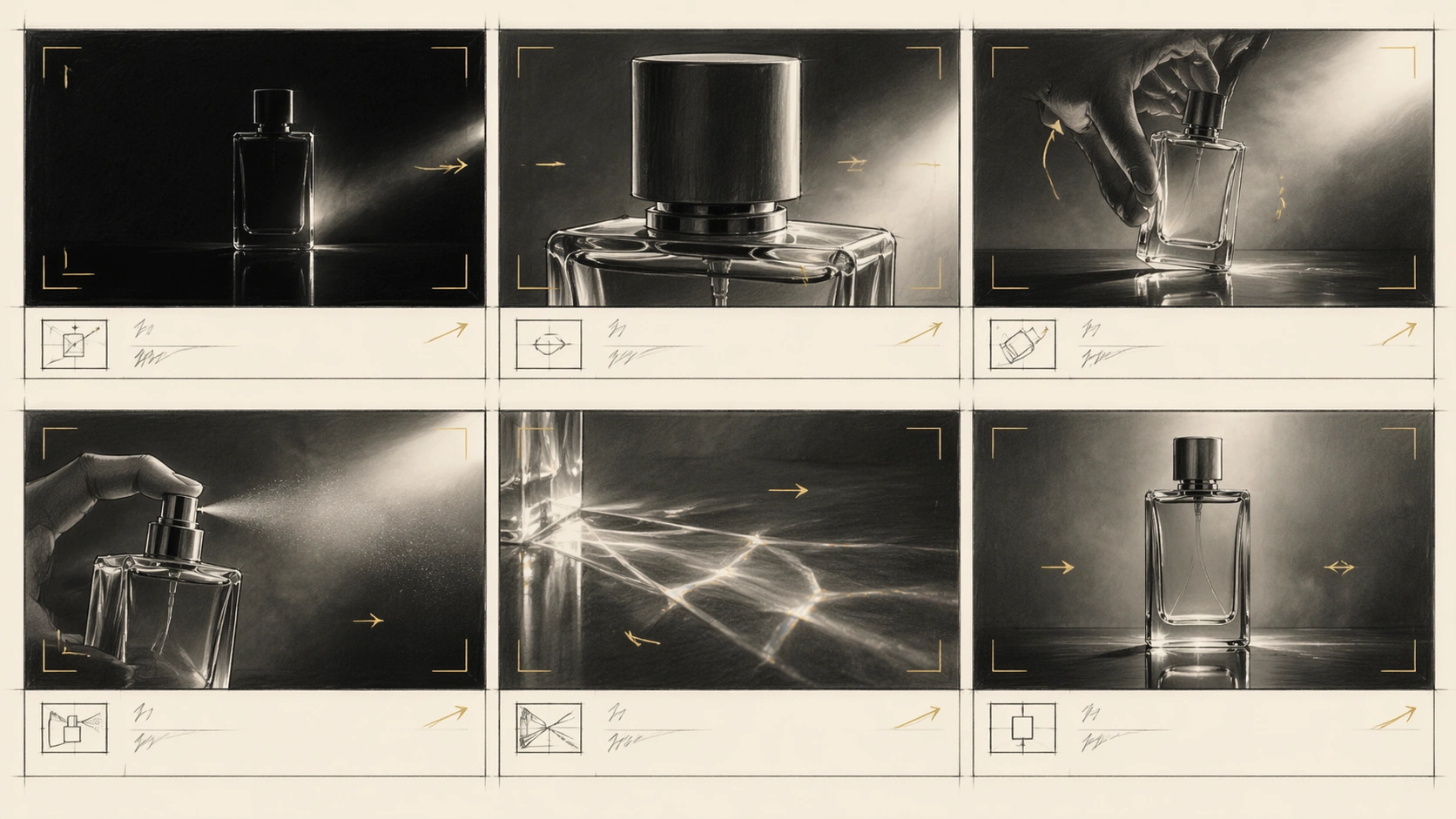
A horizontal 16:9 premium product storyboard sheet in graphite pencil, warm gray marker, and minimal gold wash, arranged as six equal panels with precise gutters. Each cell has camera arrows, lens-framing brackets, blank note bands, and unreadable shorthand marks. The board visualizes a perfume commercial on a dark reflective table with one unbranded glass bottle, hard side light, mist, and optical caustics.

Subject:
Six frames describe the commercial beat: black frame opening to a rim-lit bottle silhouette, macro push toward the cap, hand lifting the bottle, atomizer mist catching light, prism-like caustic patterns moving across the table, and final hero shot of the bottle centered against soft haze. The bottle is elegant but generic: clear rectangular glass, plain cap, no label, no logo, no readable engraving. The hand model appears only where needed for scale.

Important details:
The sheet should read as a commercial-mockup storyboard rather than a finished ad. Keep the six-panel sequence coherent, with consistent bottle proportions, light source direction, table reflection, and camera grammar. Camera movement arrows should imply push-in, rack focus, tilt, and light sweep without readable labels. Material accuracy matters: glass thickness, refraction, specular edges, atomized mist, caustic shapes, and reflection falloff. Preserve pencil hand-drawn texture and production-board hierarchy.

Use case:
Film Storyboard Sequence single study 6/8, an independent product-commercial storyboard testing glass optics and shot planning.

Constraints:
No readable text, no watermark, no logos, preserve exact 16:9 horizontal aspect ratio, no brand label, no legible bottle engraving, no broken panel gutters, no random extra products, no glossy finished poster style.
Mode d’emploi
- Copiez le prompt original complet, paramètres compris.
- Adaptez le sujet, le texte et la composition à vos besoins.
- Utilisez un outil externe compatible ; vérifiez l’accès et le résultat.
Avant de commencer
- Vérifiez si une image de référence est nécessaire. La compatibilité ne prouve pas le modèle utilisé pour cet exemple.
- Vérifiez noms, chiffres et textes ; les versions du modèle peuvent produire des résultats différents.