Document original
GPT Image 2 · en
Scene:
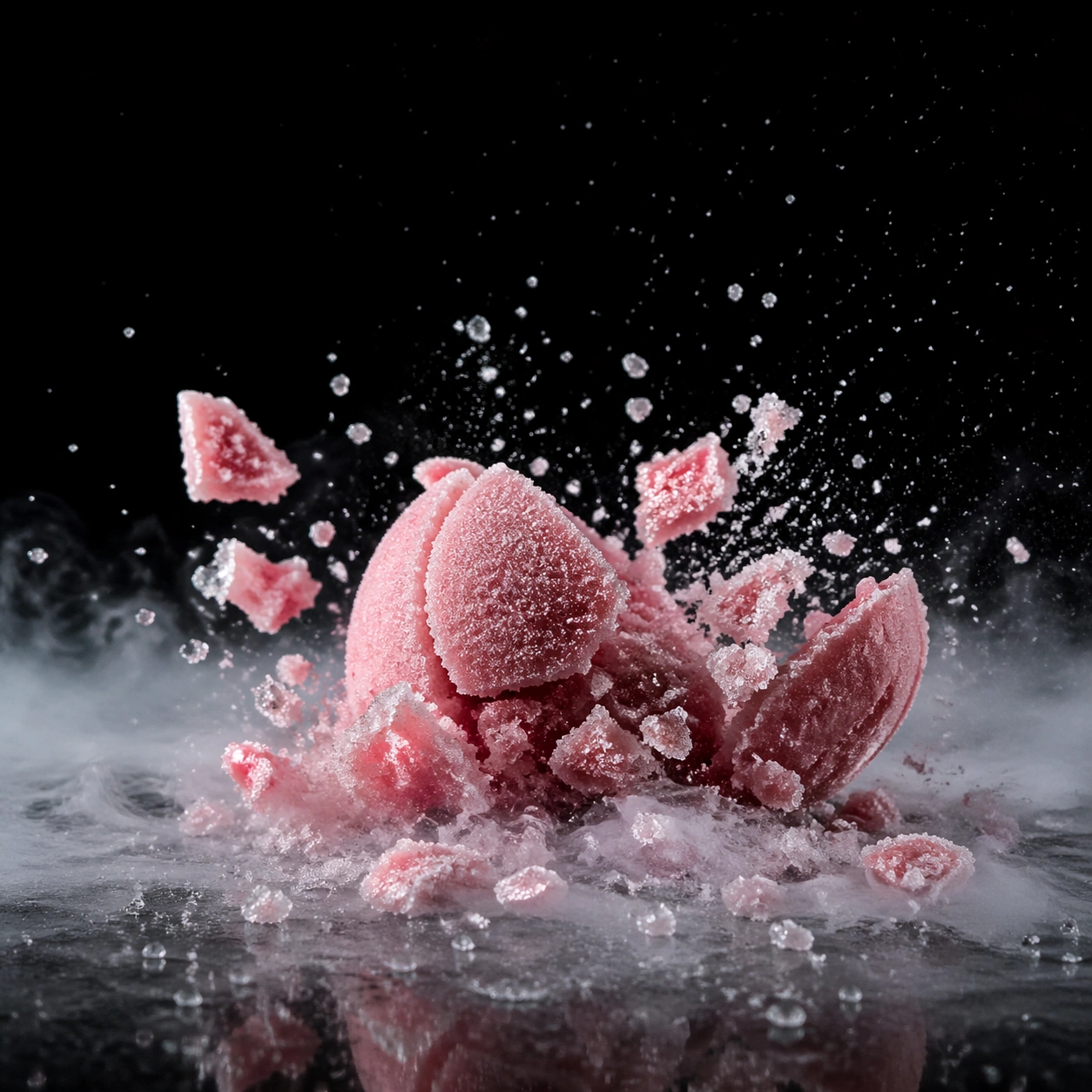
Create a square ultra-high-speed food photograph on a dark stage with precise flash freezing every crystal, fragment, and droplet. Cold vapor should sink and spread along the surface rather than billow upward like theatrical smoke. The scene must feel like a controlled scientific capture of an extreme thermal event, with deep blacks, disciplined highlights, and severe physical clarity. Create a square dark-stage action image with crisp flash and a shallow glossy floor, keeping the overall mood scientific and severe. The background should stay deep black so the pale frozen fragments stand out with maximum clarity.

Subject:
Show a compact scoop or quenelle of sorbet impacting the surface and breaking into brittle shards, icy dust, and small faceted chunks. A little cold vapor should spread outward along the floor plane as the impact occurs. The fragments must remain clearly readable as sorbet, not generic ice.

Important details:
The key challenge is believable thermal physics: frost bloom, brittle fracture, vapor density, wet-to-frozen transitions, and the texture of suddenly shocked food all need to feel accurate. Motion can be violent, but the image should remain legible and elegant. Every fragment must still read as part of a real food object. Focus on granular frozen texture, fracture edge sharpness, and how the impact converts a smooth scoop into angular crystalline debris. The scene should feel physically inevitable rather than stylized for spectacle.

Use case:
Liquid nitrogen frozen moment single study 5/9, testing brittle impact in frozen sorbet.

Constraints:
No readable text, no watermark, no logos, preserve exact 1:1 aspect ratio, no fire effects, no sci-fi blue laser glow, no generic splash stock-photo look, no readable gauges, no dramatic stage props, no colorful sprinkles, no gelatin bounce look, no blurred motion.
Mode d’emploi
- Copiez le prompt original complet, paramètres compris.
- Adaptez le sujet, le texte et la composition à vos besoins.
- Utilisez un outil externe compatible ; vérifiez l’accès et le résultat.
Avant de commencer
- Vérifiez si une image de référence est nécessaire. La compatibilité ne prouve pas le modèle utilisé pour cet exemple.
- Vérifiez noms, chiffres et textes ; les versions du modèle peuvent produire des résultats différents.