Document original
Nano Banana · en
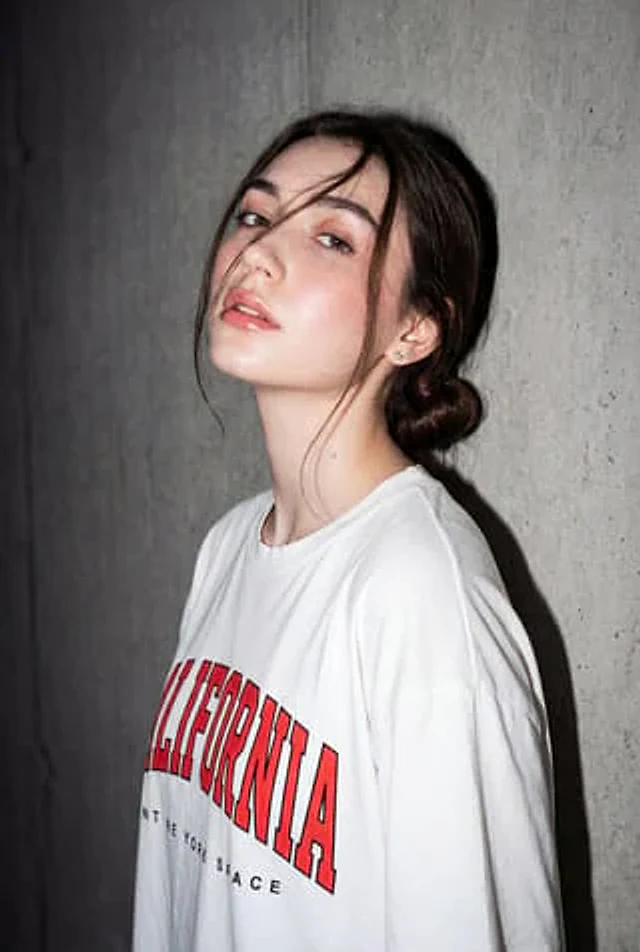
A high-resolution, close-up editorial-style portrait of a young woman standing against a textured gray concrete wall, captured with direct on-camera flash that creates a raw, moody, high-contrast aesthetic. She is positioned slightly angled to the side with her head tilted back and chin lifted, giving an effortlessly cool, candid expression. Her face has a fair, smooth complexion with a natural sheen from the flash, soft rosy blush across the cheeks, minimal eye makeup, lightly defined brows, and glossy natural pink lips that are slightly parted, conveying a relaxed yet confident mood. Wispy strands of her dark brown hair fall loosely across her face, partially covering one eye, while the rest of her hair is pulled back into a low, casual style, enhancing the spontaneous, fashion-editorial feel. Her eyes look slightly upward and past the camera, adding to the detached, artistic vibe. She is wearing a loose-fitting white oversized T-shirt with bold red typography reading “CALIFORNIA” across the chest, along with smaller black text underneath, giving a casual streetwear aesthetic. Small, subtle stud earrings are visible, adding minimal detail without distracting from the overall look. The lighting is harsh and frontal, producing sharp shadows behind her on the wall and emphasizing skin texture, hair strands, and fabric folds, while the background remains simple and uncluttered. The color palette is muted and neutral—gray wall, white shirt, and red lettering—allowing the subject’s face and expression to remain the focal point. The overall atmosphere feels intimate, modern, slightly gritty, and effortlessly stylish, like a candid fashion snapshot captured at night with flash photography. Use this uploaded photo as the only and exact face reference. The generated image must use this same face exactly as shown, without any changes to identity, facial structure, or expression.Mode d’emploi
- Copiez le prompt original complet, paramètres compris.
- Adaptez le sujet, le texte et la composition à vos besoins.
- Utilisez un outil externe compatible ; vérifiez l’accès et le résultat.
Avant de commencer
- Vérifiez si une image de référence est nécessaire. La compatibilité ne prouve pas le modèle utilisé pour cet exemple.
- Vérifiez noms, chiffres et textes ; les versions du modèle peuvent produire des résultats différents.