Documento originale
GPT Image 2 · en
Scene:
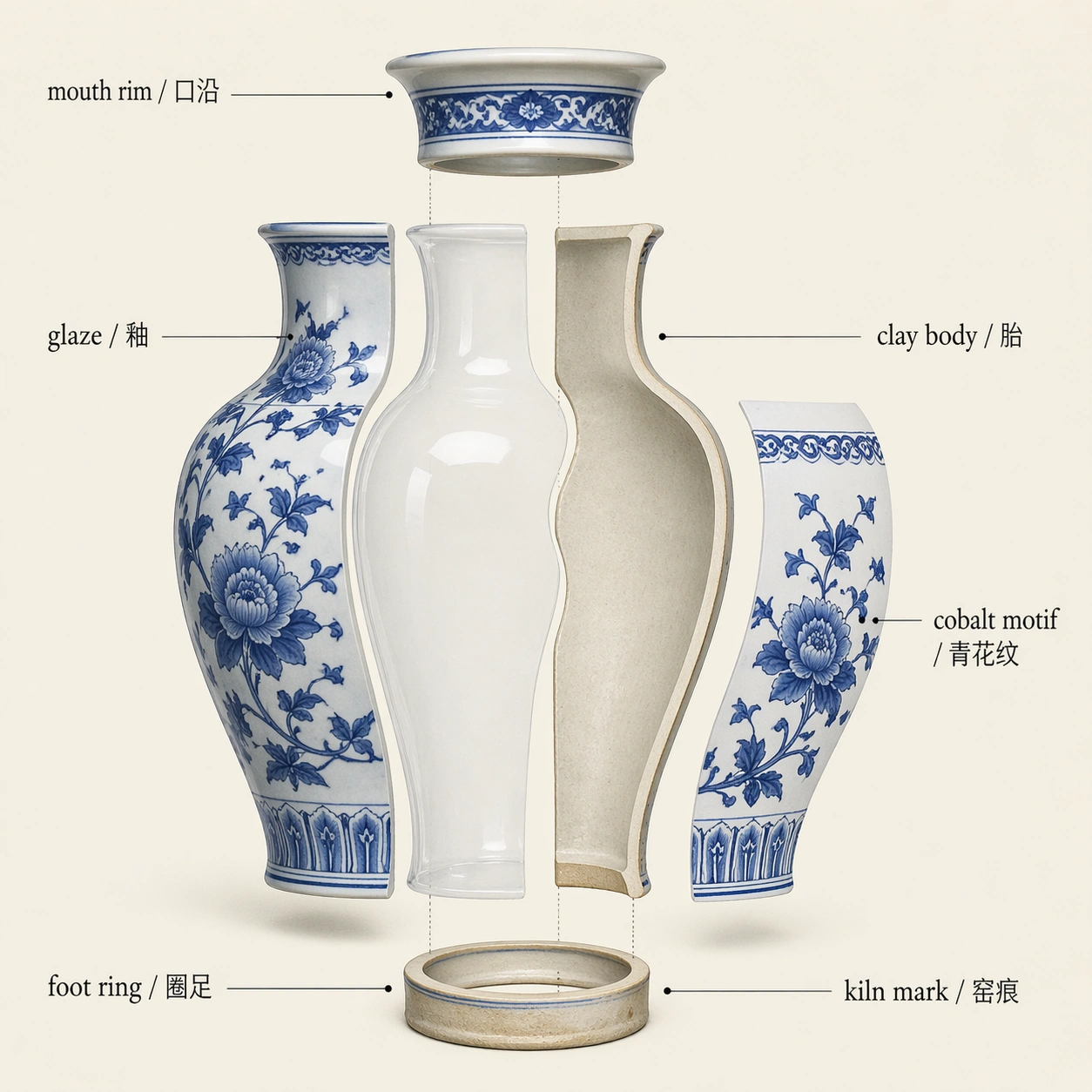
A square museum conservation diagram on pale cream paper, rendered as a clean orthographic exploded cutaway of a porcelain vase. Use bright but soft studio lighting, delicate blue-and-white ceramic color, graphite leader lines, and subtle drop shadows under separated layers. The style should sit between a catalog plate and a technical restoration note.

Subject:
Show a blue-white porcelain vase separated into its structural and surface layers: mouth rim lifted slightly, glaze layer peeling outward as a transparent shell, clay body cross-section visible, painted cobalt motif isolated on one floating sheet, and foot ring shown below. Include only these readable bilingual labels: glaze / 釉, clay body / 胎, cobalt motif / 青花纹, mouth rim / 口沿, foot ring / 圈足, kiln mark / 窑痕. The vase remains elegant and museum-like, not broken rubble.

Important details:
The material behavior must be credible: porcelain is thin, hard, slightly translucent at edges; glaze is glossy and continuous; cobalt pigment sits under the glaze; the foot ring has unglazed texture. Keep labels aligned around the object with no leader-line tangles. The image should explain construction and craft at a glance.

Use case:
Museum Exploded View single study 5/8, testing a porcelain artifact cutaway with bilingual technical callouts.

Constraints:
No readable text except the specified bilingual labels, no watermark, no logos, preserve exact 1:1 aspect ratio, no shattered vase, no modern barcode, no random dynasty stamp, no cluttered restoration tools, no illegible micro labels.
Come usare
- Copia tutto il prompt originale, inclusi i parametri.
- Adatta soggetto, testo e composizione alle tue esigenze.
- Usa uno strumento esterno compatibile; verifica accesso e risultato.
Prima di iniziare
- Controlla se serve un’immagine di riferimento. La compatibilità non prova il modello usato per l’esempio.
- Verifica nomi, numeri e testi; i risultati cambiano con le versioni del modello.