Documento originale
GPT Image 2 · en
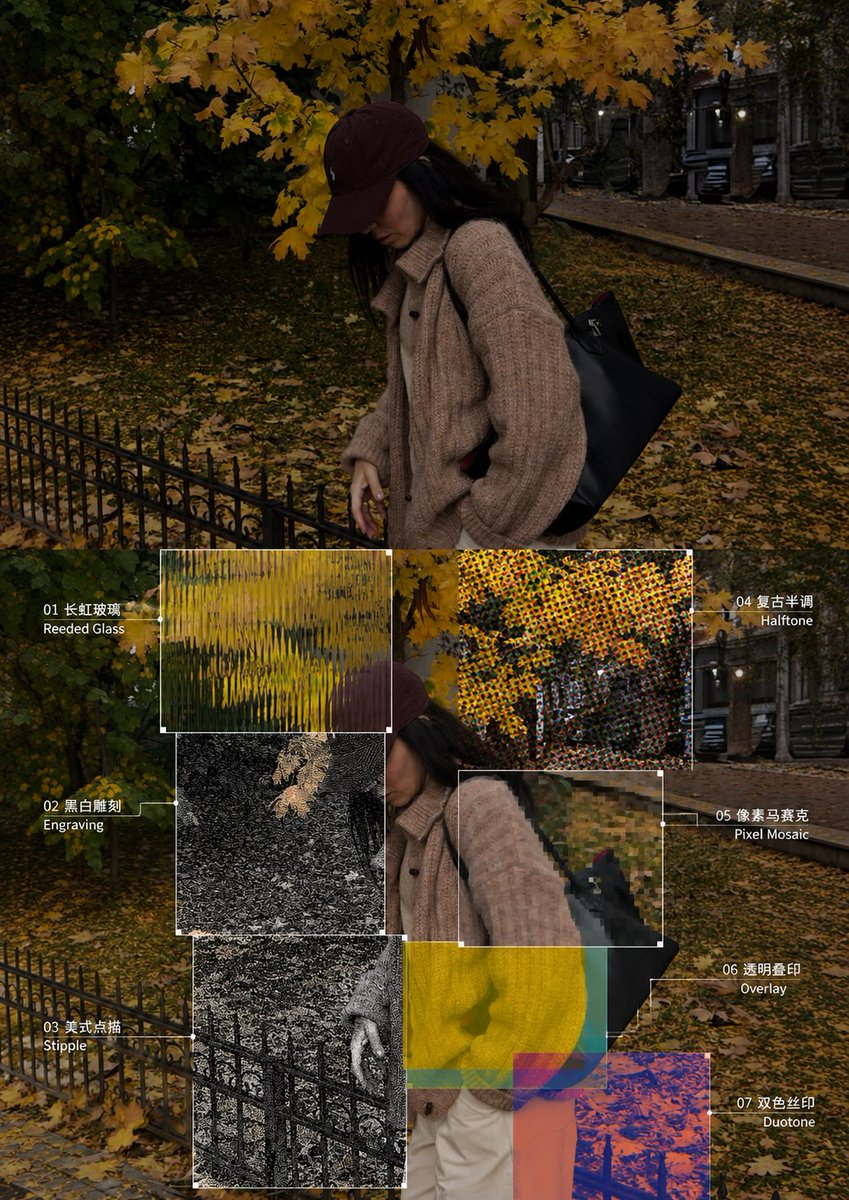
Create one vertical 3:4 diptych for each uploaded photo, divided into equal top and bottom halves with a seamless join. No divider, frame, or collage. Swiss editorial design, experimental photography, and vintage print aesthetics.

TOP HALF — ORIGINAL PHOTOGRAPH
Preserve the original identity, pose, scene, composition, perspective, lighting, and colors. Allow only subtle color grading and background extension. No text.

BOTTOM HALF — SEVEN EXPERIMENTAL TEXTURE ZONES
Repeat the entire original photo. Overlay seven asymmetrical rectangular zones of different sizes directly onto the image pixels, crossing non-critical details. Maintain visual continuity inside and outside every zone. Never crop, zoom, shift, duplicate, or redraw the image. Keep all important focal features visible.

SEVEN NUMBERED TECHNIQUES

01. Reeded Glass: Vertical optical refraction.

02. Black-and-White Engraving: Fine etched lines and crosshatching.

03. American Stipple: Black-and-white microdot texture.

04. Vintage Halftone: CMYK printing dots.

05. Pixel Mosaic: Square pixel blocks.

06. Transparent Overlay: 2–4 translucent overlapping layers.

07. Duotone Screen Print: Two-color screen-printing effect.

DESIGN DETAILS
Add hairline borders, tiny corner squares, and fine leader lines to identify each rectangular zone. Label every technique with its corresponding number and English name. Keep all areas outside the seven zones photographic and realistic.

STRICT REQUIREMENTS
No logos, watermarks, extra images, or unnecessary decorative elements. Preserve the original photograph's integrity and maintain a clean, sophisticated editorial layout.

OUTPUT: One high-definition 3:4 vertical poster with equal top and bottom halves.
Come usare
- Copia tutto il prompt originale, inclusi i parametri.
- Adatta soggetto, testo e composizione alle tue esigenze.
- Usa uno strumento esterno compatibile; verifica accesso e risultato.
Prima di iniziare
- Controlla se serve un’immagine di riferimento. La compatibilità non prova il modello usato per l’esempio.
- Verifica nomi, numeri e testi; i risultati cambiano con le versioni del modello.