
Documento originale
GPT Image 2 · en
Scene:
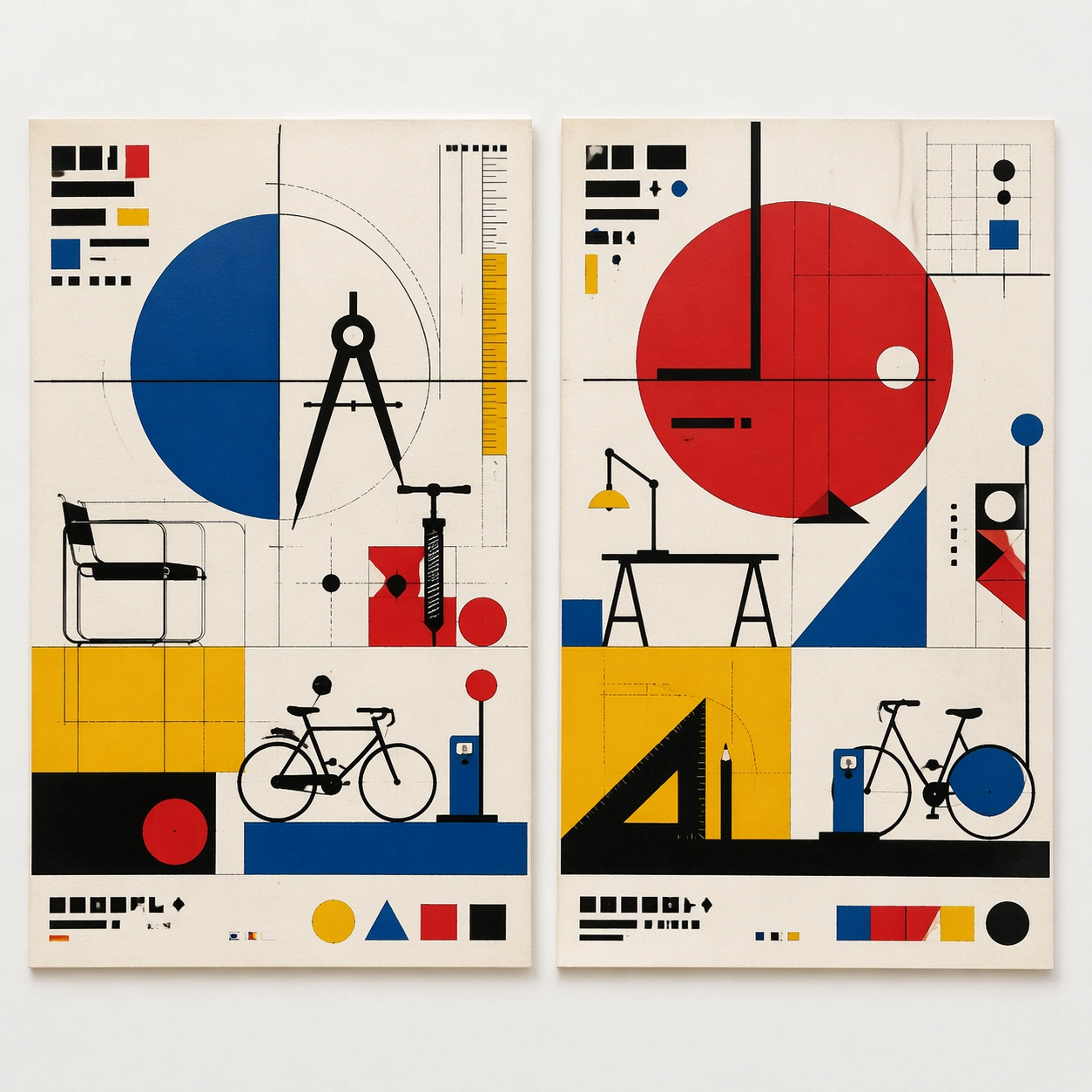
A square white-wall installation showing two companion posters hung side by side with equal spacing, photographed frontally so the pair reads as a designed conversation rather than two unrelated sheets. The poster should express strict geometric modernism built from circles, bars, triangles, squares, and measured negative space, using cobalt blue, mustard yellow, cadmium red, black, and warm paper white and a tactile surface appropriate to the medium.

Subject:
Compose a matched diptych: two posters sharing one style system while splitting the narrative across paired motifs, mirrored masses, or complementary color emphasis. Use modular furniture silhouettes, workshop tools, compass arcs, ruler lines, and architecture-school diagrams as the main visual ingredients, and organize them with geometric sans-serif blocks and numerals treated purely as non-readable forms. For the contemporary-subject axis, thread in a bike-share docking station and urban wayfinding elements reduced into pure geometry. The poster must feel like an original design object rather than a reproduction of any known work.

Important details:
Both halves should feel distinct yet inseparable. Preserve one coherent visual language, but let each sheet carry its own focal symbol and rhythm without readable wording. Preserve mathematical spacing, flat planes, hard edges, exact weight distribution, and clean asymmetry. Keep every letterform abstract and non-readable, as if it were a typographic texture rather than language. Make the style unmistakable through composition, palette, surface behavior, and symbolic compression. no decorative flourishes, no gradients, no photoreal portraits, no soft painterly blending.

Use case:
Bauhaus Poster single study 6/9, testing system flexibility across a paired set.

Constraints:
No readable text, no watermark, no logos, preserve exact 1:1 aspect ratio, no copyrighted characters, no real brand marks, no QR codes, no interface chrome, no accidental gibberish lettering.
Come usare
- Copia tutto il prompt originale, inclusi i parametri.
- Adatta soggetto, testo e composizione alle tue esigenze.
- Usa uno strumento esterno compatibile; verifica accesso e risultato.
Prima di iniziare
- Controlla se serve un’immagine di riferimento. La compatibilità non prova il modello usato per l’esempio.
- Verifica nomi, numeri e testi; i risultati cambiano con le versioni del modello.