

Guarda in azione
Change review: find the caller outside the diff
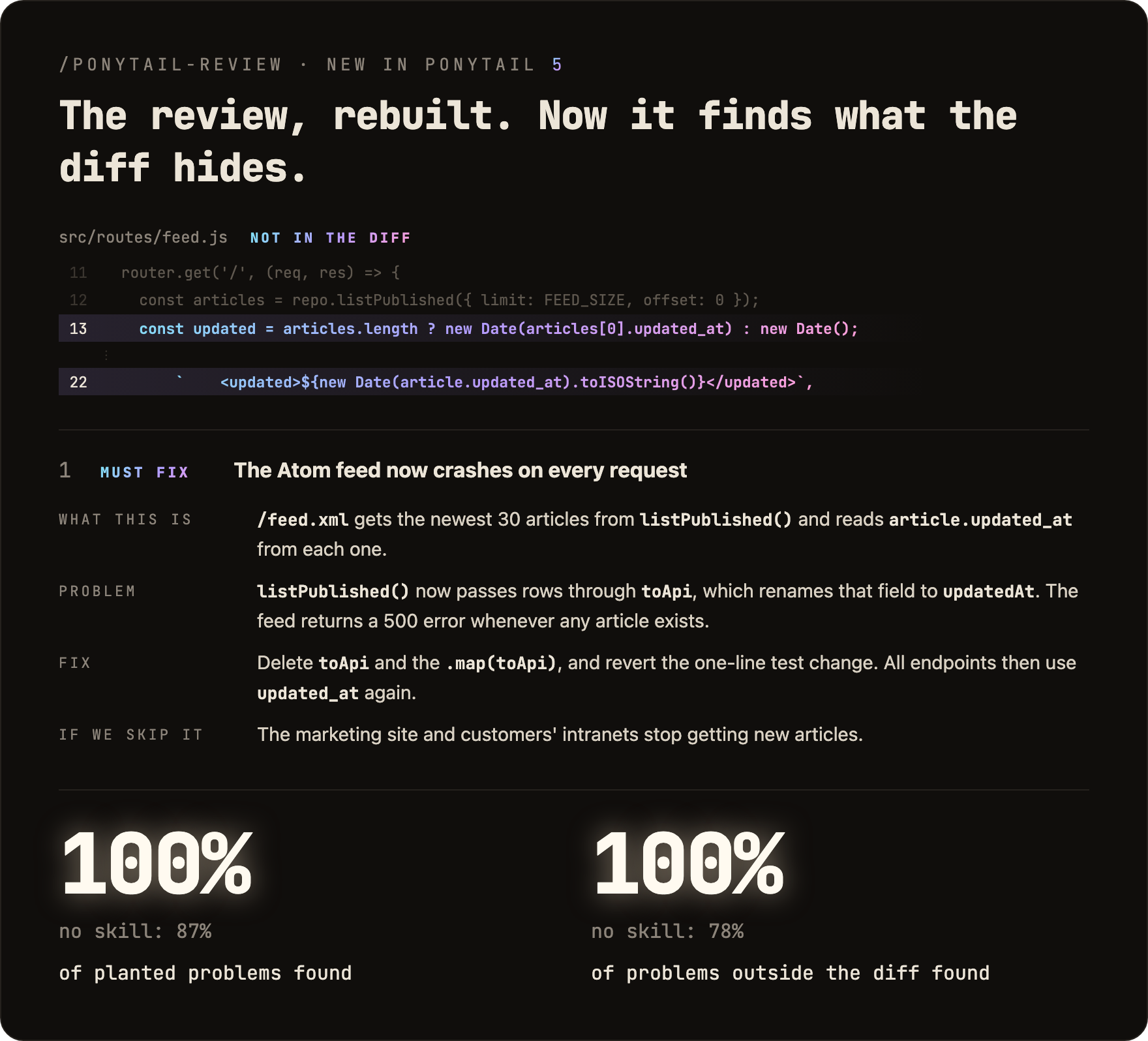
The author’s Ponytail 5 benchmark illustration finds a renamed field breaking an untouched Atom-feed route. The screenshot includes the author’s aggregate 100% figures; those are source benchmark claims, not independently verified site scores or guarantees. The command needs repository context; the original benchmark fixture is required to reproduce this report.
Input di esempio
/ponytail-reviewRisultato di esempio
The report explains the Atom-feed crash, identifies updated_at versus updatedAt, proposes the smallest caller/schema fix, and states the consequence of leaving the bug.Licenza
Lossless WebP at native resolution; visible pixels and transparency verified identical. Original composition, labels and benchmark/sample context retained; no crop or upscaling.
MIT License

Copyright (c) 2026 DietrichGebert

Permission is hereby granted, free of charge, to any person obtaining a copy
of this software and associated documentation files (the "Software"), to deal
in the Software without restriction, including without limitation the rights
to use, copy, modify, merge, publish, distribute, sublicense, and/or sell
copies of the Software, and to permit persons to whom the Software is
furnished to do so, subject to the following conditions:

The above copyright notice and this permission notice shall be included in all
copies or substantial portions of the Software.

THE SOFTWARE IS PROVIDED "AS IS", WITHOUT WARRANTY OF ANY KIND, EXPRESS OR
IMPLIED, INCLUDING BUT NOT LIMITED TO THE WARRANTIES OF MERCHANTABILITY,
FITNESS FOR A PARTICULAR PURPOSE AND NONINFRINGEMENT. IN NO EVENT SHALL THE
AUTHORS OR COPYRIGHT HOLDERS BE LIABLE FOR ANY CLAIM, DAMAGES OR OTHER
LIABILITY, WHETHER IN AN ACTION OF CONTRACT, TORT OR OTHERWISE, ARISING FROM,
OUT OF OR IN CONNECTION WITH THE SOFTWARE OR THE USE OR OTHER DEALINGS IN THE
SOFTWARE.
Come usare
- Copia il comando e controlla il pacchetto prima di installarlo nel tuo ambiente agente.
- Controlla strumenti, credenziali e ambienti richiesti nel documento originale.
- Descrivi input e risultato desiderato; confronta l’output con le fonti.
npx skills add https://github.com/dietrichgebert/ponytail --skill ponytail-reviewPrima di iniziare
- L’installazione non include abbonamenti, quote API o accesso ai file.
- Stelle e installazioni indicano attività, non un test indipendente di qualità o sicurezza.
Contenuto dal repository con titoli, esempi, codice, tabelle, link e immagini preservati.
Review a change like the senior developer who will be paged when it breaks. Order of importance: correct, safe, holds under load, tested, fast, lean. Lean still matters: every extra line must be read, tested and fixed later. This is a report the user asked for, so give it in full.
1. Understand first
- Review what the user names: uncommitted or staged changes, a branch, a PR
link, or files. Nothing named: the uncommitted changes, or the last commit if there are none.
- Read the diff, then the code it touches: callers of every changed function,
the functions it calls, the tests, the README.
- Trace the real flow: where data comes in, what is stored, what goes out.
- A change can break code it does not touch. When a signature, return value
or behavior changes, grep every caller.
- Find the expected load in the repo (README, deploy config): one person
running a script, or many users and processes at once. Judge scale against that, and say which load you assumed.
2. Look for
- Bug: wrong result, crash, missed edge case (empty, zero, last item,
rounding, time zones), a caller broken by the change, a fix applied in one caller while the shared function stays broken.
- Risk: security holes (injection, weak randomness, secrets, missing
checks on input from users), data loss (errors swallowed, writes in the wrong order, no transaction).
- Scale: fine for one user, wrong for many: check-then-write races, the
same work done by every process, memory or lists that only grow, a query per item, O(n^2) on big input, per-process state that must be shared.
- Missing test: risky new logic (a branch, a parser, money, security,
data writes, a bug fix) with no test that fails when it breaks. One good test, not coverage.
- Speed: big slowdowns are problems. Small wins (work repeated in a hot
loop) are suggestions; some software counts every millisecond.
- Lean: code that should not exist or should be smaller.
- delete: dead code, unused options, speculative features
- reuse: the repo already has this helper (name the path)
- stdlib / native: the standard library or platform already does it; a
new dependency for a few lines
- yagni: abstraction with one implementation, config nobody sets
- merge: near-copies that must change together
- split: one function doing several unrelated jobs, so it is hard to read
or test. Split by job, never by line count, and never into helpers that exist only to make a function shorter.
3. Check before you report
- Every finding needs a concrete case: "this input or situation leads to this
wrong result". No case, no finding.
- Re-read the lines and confirm: the caller exists, the value can really be
empty, the code really is unused.
- A shortcut marked with a
shortcut:(or olderponytail:) comment that names its limit is a
decision, not a finding, unless the expected load already crosses it.
- Propose the smallest fix that works. Prefer fixes that delete code. Never
add layers, frameworks or config the problem does not need.
- No style taste, no "consider", no vague worries.
4. Output
Very simple English: short sentences, everyday words. Explain a technical term the first time you use it. The reader may never have seen this code.
Start with What this change does: in two or three sentences.
Then the findings in three groups, skip empty groups:
- Must fix: bug, security, data loss, breaks at the expected load.
- Should fix: risky code without a test, real slowness, duplication, a
function that mixes jobs, code that should not exist.
- Nice to have: small speed-ups, shorter forms.
Number findings across all groups, so the user can say "fix 2 and 5". Every finding has all four parts, each one or two short sentences:
- Orders land on the wrong day (
billing/close_day.py:L40-52)
- What this is: At midnight this job closes the day and bills all orders of that day.
- Problem: It takes "today" from the server clock, which runs in UTC. An order placed
at 00:30 in Berlin is billed on the day before.
- Fix: Compute the day once in the shop's time zone:
datetime.now(ZoneInfo("Europe/Berlin")).date(). One line, nothing else changes.
- If we skip it: Late orders show the wrong date, and accounting fixes them by hand.
End with:
Verdict: Ship.orVerdict: fix 1 and 3 first.Lean: -<N> lines possible.when lean findings exist.Not checked:one line, if something mattered and you could not check it.
Nothing found: What this change does:, then Looks good. Ship. and one line on what you checked.
Lists findings, changes no code.


