原文
GPT Image 2.5 · en
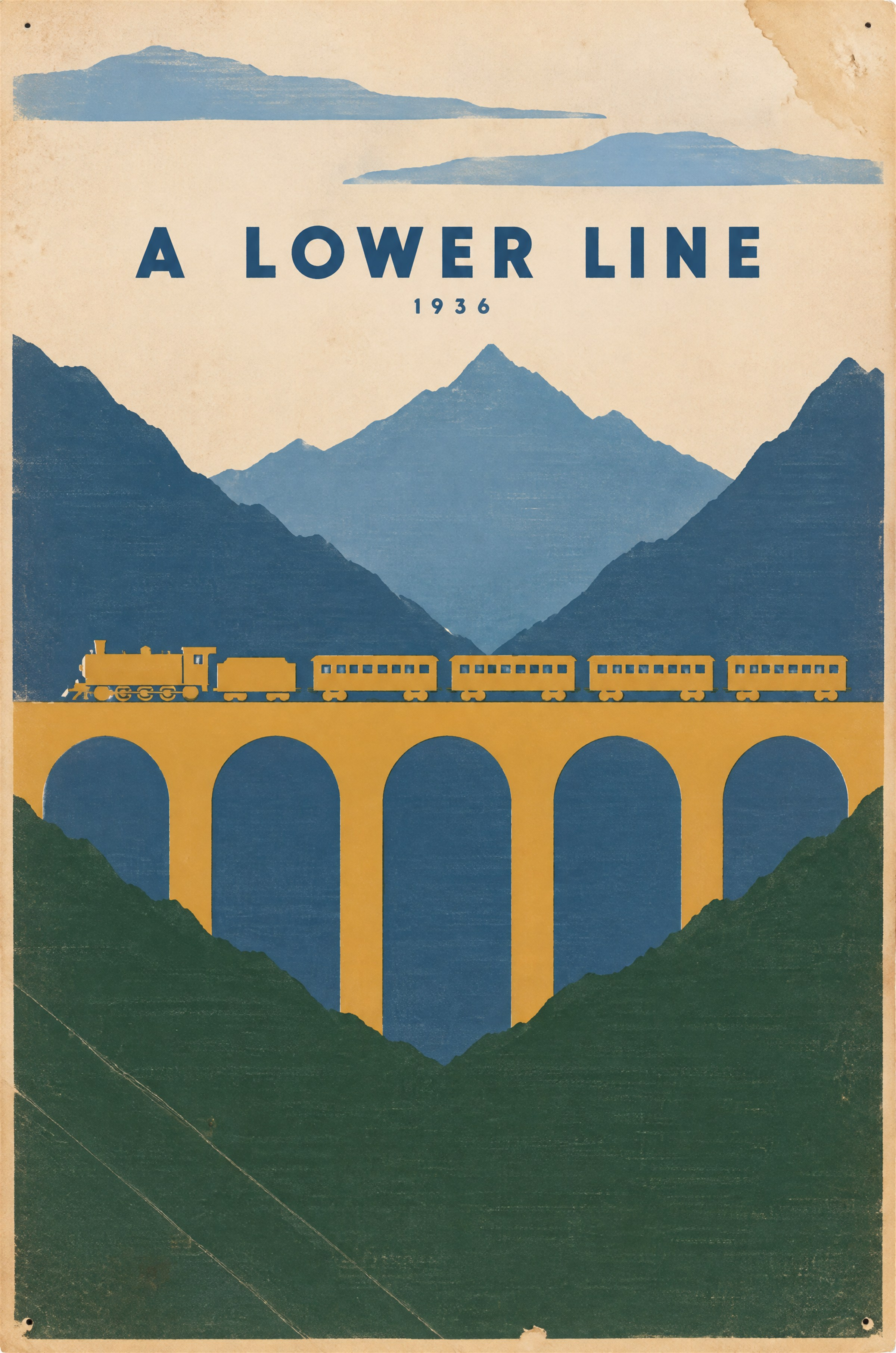
A 1936 travel poster, 2:3 portrait, designed as a four-colour silkscreen print on aged poster stock and seen
perfectly flat and straight on — this is the printed sheet, not a photograph of one on a wall.

COMPOSITION
A steep mountain valley seen head-on, arranged in three flat bands. The lower band is the valley floor, a single
flat dark green. Above it, a tall viaduct crosses the full width on five arches, drawn as one flat ochre shape
with the arches cut out as negative space. On the viaduct, a passenger train in profile running left to right:
locomotive, tender and four carriages, reduced to their simplest readable silhouettes with no interior detail
and no visible windows, only a row of small rectangles along the carriages. Behind and above the viaduct, three
peaks rise in two flat blues, the nearer one darker. The sky is the paper colour left bare, with two long
horizontal clouds as single flat shapes. Vertical composition: the train sits on the upper third, the valley
floor occupies the lower quarter, and the peaks fill the space between.

TEXT — render exactly these two strings, each appearing once
"A LOWER LINE"
"1936"
Set "A LOWER LINE" in a bold geometric sans, all capitals, generously letter-spaced, centred in the band of
sky below the peaks; its width is about two thirds of the sheet's width. Set "1936" much smaller in the same
typeface, centred directly beneath it, at about one sixth of the title's height. No other text anywhere: no
route names, no station names, no prices, no small print, no printer's marks.

PRINT CHARACTER — deliberately imperfect
Four flat inks only: ochre, deep green, two blues, plus the paper. Each colour sits in its own solid shape with
hard edges and no gradients, no shading and no halftones. Registration is very slightly out on one or two
plates, so a thin sliver of paper shows along the left edge of the train's ochre and along the top edge of one
blue peak — under one millimetre and never enough to look broken. Ink is slightly uneven within a shape where
the screen was thin, with fine horizontal streaks visible in the largest flat areas. The paper is aged: a warm
off-white with light foxing at the corners, two soft handling creases running diagonally across the lower left,
a small water stain at the upper right that has very slightly lifted the blue, and a tiny nibbled loss at the
bottom edge. Four pinholes, one in each corner, sit just inside the margin.

CONSTRAINTS
No illustration style other than flat silkscreen: no painterly edges, no airbrush, no glow, no photo texture,
no 3D shading, no drop shadows. Do not add people, birds, trees with individual leaves, rocks, rivers, road
signs or a border. Do not paraphrase, re-case, hyphenate or translate the two strings, and do not add a
year, a place name or a slogan. No mockup: no wall, no frame, no shadow behind the sheet, no perspective tilt,
no tape or pins other than the four pinholes.
使い方
- パラメータを含む元のプロンプト全体をコピーします。
- 被写体、文字、構図を自分の要件に置き換えます。
- 対応する外部ツールで使用し、利用条件と結果を確認します。
開始前の確認
- 参考画像の要否を確認してください。互換モデルの表示は、そのモデルでの生成実績を意味しません。
- 名前、数値、画像内の文字を確認します。モデルの版で結果は変わります。