
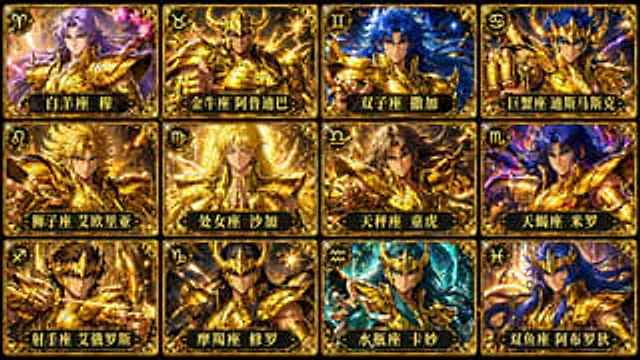
Generate a 12-grid card image of the 12 Golden Saints from Saint Seiya, with each card featuring its corresponding Chinese name, 4 cards per row, in a 16:9 aspect ratio.
Explora prompts reales y ejemplos generados. Encuentra inspiración para tu próxima misión creativa y copia gratis el prompt completo.
Generate a 12-grid card image of the 12 Golden Saints from Saint Seiya, with each card featuring its corresponding Chinese name, 4 cards per row, in a 16:9 aspect ratio.
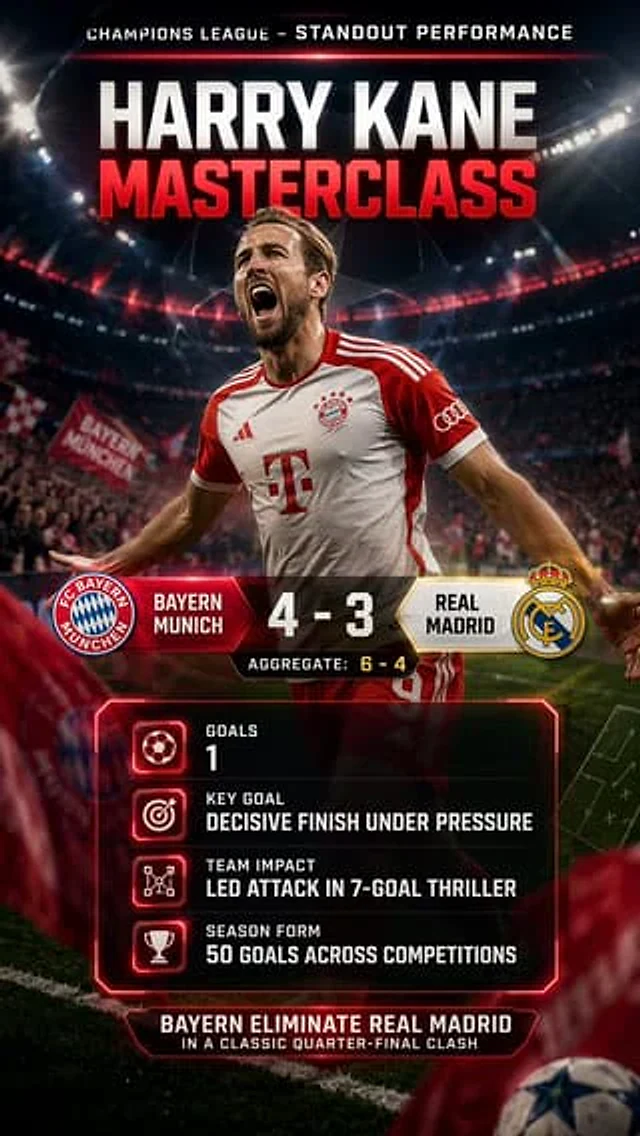
Search the web for {argument name="performance description" default="this week’s standout individual performance in Champion’s League"}, using exact stats and game summary, {argument name="colors" default="bold team colors"}, legible score breakdown, and generate a {argument name="card type" default="Highlight card"}.

GPT-Image-2 prompt: please automatically generate a top-tier concept poster / infographic-style movie poster centered around {argument name="theme" default="ranking of emperors in Chinese history"}. Require the AI to automatically derive and uniformly design the entire following visual system based on this theme, without my extra specification: - Core subject (automatically judge suitability for people, products, architecture, artifacts, symbols, scenes, or abstract imagery) - Bottom supporting structure - Hovering symbols or spiritual symbols above - Scene wrapping elements - Metaphor system - Color hierarchy - Material contrast - Lighting logic - Title, subtitle, and auxiliary copy - Brand sense and high-end expression The final frame must be: a shocking, precise, unified, cinematic, ultra-high detail conceptual key visual poster suitable for high-end printing. [Overall Style] Ultra-realistic 3D commercial CGI rendering, merging cinematic lighting, luxury visual language, futuristic concept design, and epic composition. The image must have a "single main visual core," not messy, not like a collage, and not like a regular e-commerce poster. [Automatic Derivation Rules] AI must automatically decide based on the [theme]: 1. Core visual metaphor 2. Subject type and posture 3. Form of supporting structure 4. Form of suspended elements 5. Scene shell and spatial atmosphere 6. Main, auxiliary, and emphasis colors 7. Material combinations 8. Text temperament and layout style [Composition Rules] - Absolute sense of premium quality - Strong central order, overall unity - Allows for axial symmetry or epic composition near the central axis - Clear visual gravity, forming clear levels from top to bottom - Edge negative space is clean, restrained, and has room to breathe [Visual Quality] - Ultra-high detail - Clear volumetric light - Authentic materials - Natural reflection, refraction, shadows, fog, and depth of field - Overall standard of high-end brand campaign key visual / luxury invitation poster / conceptual editorial poster [Typography System] - Overall 90% visual, 10% text - AI automatically generates the most matching main title and subtitle based on the [theme] - Title must be concise, sharp, and powerful - Text should be as minimal and accurate as possible; do not stack words [Signature Requirement] Naturally add the author signature in the bottom corner: @a9quant
GPT-Image-2 prompt: please automatically generate a top-tier concept poster / infographic-style movie poster centered around {argument name="theme" default="ranking of emperors in Chinese history"}. Require the AI to automatically derive and uniformly design the entire following visual system based on this theme, without my extra specification: - Core subject (automatically judge suitability for people, products, architecture, artifacts, symbols, scenes, or abstract imagery) - Bottom supporting structure - Hovering symbols or spiritual symbols above - Scene wrapping elements - Metaphor system - Color hierarchy - Material contrast - Lighting logic - Title, subtitle, and auxiliary copy - Brand sense and high-end expression The final frame must be: a shocking, precise, unified, cinematic, ultra-high detail conceptual key visual poster suitable for high-end printing. [Overall Style] Ultra-realistic 3D commercial CGI rendering, merging cinematic lighting, luxury visual language, futuristic concept design, and epic composition. The image must have a "single main visual core," not messy, not like a collage, and not like a regular e-commerce poster. [Automatic Derivation Rules] AI must automatically decide based on the [theme]: 1. Core visual metaphor 2. Subject type and posture 3. Form of supporting structure 4. Form of suspended elements 5. Scene shell and spatial atmosphere 6. Main, auxiliary, and emphasis colors 7. Material combinations 8. Text temperament and layout style [Composition Rules] - Absolute sense of premium quality - Strong central order, overall unity - Allows for axial symmetry or epic composition near the central axis - Clear visual gravity, forming clear levels from top to bottom - Edge negative space is clean, restrained, and has room to breathe [Visual Quality] - Ultra-high detail - Clear volumetric light - Authentic materials - Natural reflection, refraction, shadows, fog, and depth of field - Overall standard of high-end brand campaign key visual / luxury invitation poster / conceptual editorial poster [Typography System] - Overall 90% visual, 10% text - AI automatically generates the most matching main title and subtitle based on the [theme] - Title must be concise, sharp, and powerful - Text should be as minimal and accurate as possible; do not stack words [Signature Requirement] Naturally add the author signature in the bottom corner: @a9quant

GPT-Image-2 prompt: please automatically generate a top-tier concept poster / infographic-style movie poster centered around {argument name="theme" default="ranking of emperors in Chinese history"}. Require the AI to automatically derive and uniformly design the entire following visual system based on this theme, without my extra specification: - Core subject (automatically judge suitability for people, products, architecture, artifacts, symbols, scenes, or abstract imagery) - Bottom supporting structure - Hovering symbols or spiritual symbols above - Scene wrapping elements - Metaphor system - Color hierarchy - Material contrast - Lighting logic - Title, subtitle, and auxiliary copy - Brand sense and high-end expression The final frame must be: a shocking, precise, unified, cinematic, ultra-high detail conceptual key visual poster suitable for high-end printing. [Overall Style] Ultra-realistic 3D commercial CGI rendering, merging cinematic lighting, luxury visual language, futuristic concept design, and epic composition. The image must have a "single main visual core," not messy, not like a collage, and not like a regular e-commerce poster. [Automatic Derivation Rules] AI must automatically decide based on the [theme]: 1. Core visual metaphor 2. Subject type and posture 3. Form of supporting structure 4. Form of suspended elements 5. Scene shell and spatial atmosphere 6. Main, auxiliary, and emphasis colors 7. Material combinations 8. Text temperament and layout style [Composition Rules] - Absolute sense of premium quality - Strong central order, overall unity - Allows for axial symmetry or epic composition near the central axis - Clear visual gravity, forming clear levels from top to bottom - Edge negative space is clean, restrained, and has room to breathe [Visual Quality] - Ultra-high detail - Clear volumetric light - Authentic materials - Natural reflection, refraction, shadows, fog, and depth of field - Overall standard of high-end brand campaign key visual / luxury invitation poster / conceptual editorial poster [Typography System] - Overall 90% visual, 10% text - AI automatically generates the most matching main title and subtitle based on the [theme] - Title must be concise, sharp, and powerful - Text should be as minimal and accurate as possible; do not stack words [Signature Requirement] Naturally add the author signature in the bottom corner: @a9quant

{ "type": "sports match infographic poster", "theme": "UEFA Champions League", "background": "dark blue and purple cosmic sky, glowing blue hexagonal lines, illuminated stadium reflecting on water at bottom", "header": { "logo": "UEFA Champions League", "title": "{argument name=\"stage\" default=\"HALBFINALE\"}", "subtitle": "DAS ZIEL: {argument name=\"location\" default=\"BUDAPEST 2026\"}", "venue": "PUSKÁS ARÉNA" }, "matchup": { "player_left": "{argument name=\"team 1 player\" default=\"Harry Kane\"} in red FC Bayern kit", "player_right": "{argument name=\"team 2 player\" default=\"Ousmane Dembélé\"} in blue PSG kit", "center_logos": "FC Bayern München and Paris Saint-Germain with VS", "date_box": "calendar icon, MITTWOCH, {argument name=\"date\" default=\"06.05.2026\"}" }, "facts_section": { "title": "FACTS", "count": 5, "items": [ "Trophy icon: DIE KÖNIGSKLASSE 2025/26", "Bar chart icon: KANE IN TOPFORM", "Lightning bolt icon: DEMBÉLÉ ÜBERFLIEGER", "Two people icon: BISHER 14 DUELLE", "Stadium icon: BUDAPEST RUFT" ] }, "footer": { "trophy": "Champions League trophy on right", "stadium_image": "Puskás Aréna at night", "tagline": "EIN TRAUM. EIN ZIEL. EIN TITEL.", "bottom_text": "ROAD TO BUDAPEST 2026" } }
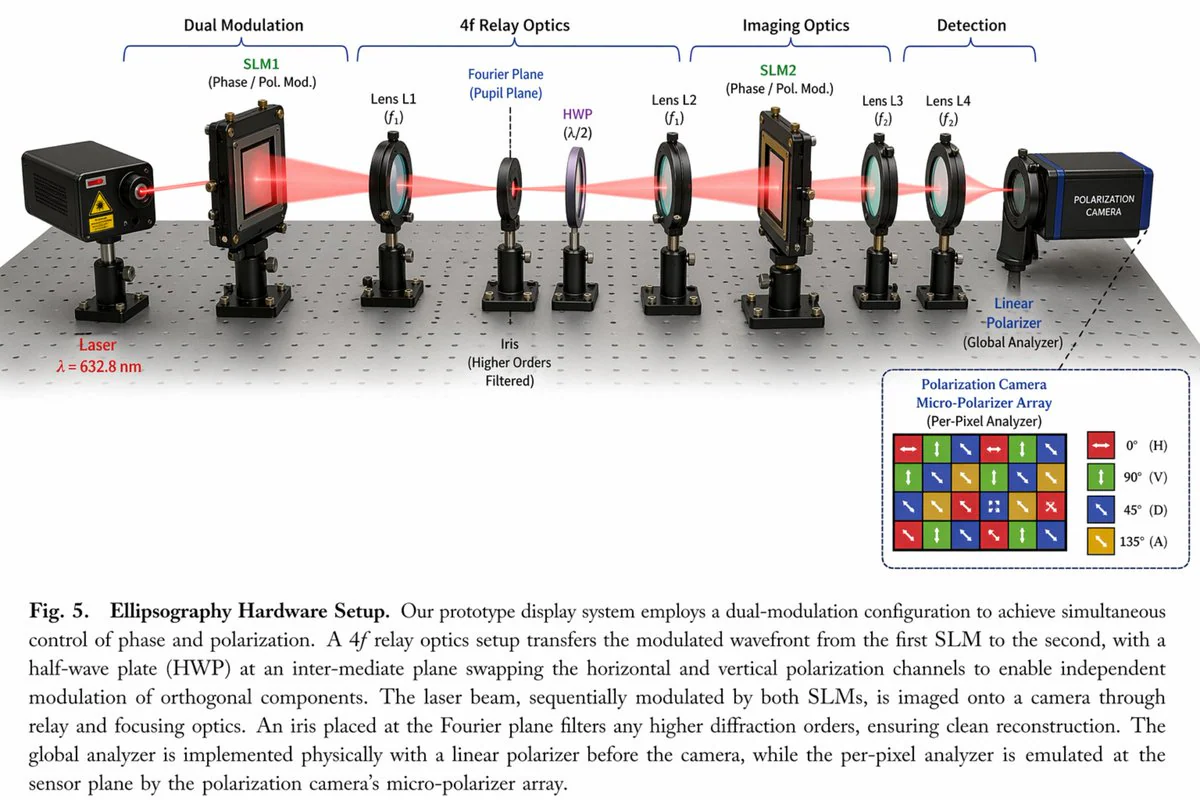
{ "type": "scientific optical setup diagram", "main_setup": { "base": "optical breadboard table with grid of mounting holes", "beam": "red laser beam passing horizontally through all components", "top_grouping_brackets": [ "{argument name=\"first component group\" default=\"Dual Modulation\"}", "4f Relay Optics", "Imaging Optics", "Detection" ], "components_left_to_right": [ { "name": "Laser", "label": "{argument name=\"laser wavelength\" default=\"λ = 632.8 nm\"}", "appearance": "black rectangular box" }, { "name": "SLM1", "label": "(Phase / Pol. Mod.)", "appearance": "black square device on post" }, { "name": "Lens L1", "label": "(f1)", "appearance": "lens in black ring mount" }, { "name": "Iris", "label": "Fourier Plane (Pupil Plane) / (Higher Orders Filtered)", "appearance": "black ring mount with dashed line above" }, { "name": "HWP", "label": "(λ/2)", "appearance": "purple-tinted optic in black ring mount" }, { "name": "Lens L2", "label": "(f1)", "appearance": "lens in black ring mount" }, { "name": "SLM2", "label": "(Phase / Pol. Mod.)", "appearance": "black square device on post" }, { "name": "Lens L3", "label": "(f2)", "appearance": "lens in black ring mount" }, { "name": "Lens L4", "label": "(f2)", "appearance": "lens in black ring mount" }, { "name": "Linear Polarizer", "label": "(Global Analyzer)", "appearance": "lens in black ring mount" }, { "name": "Polarization Camera", "label": "POLARIZATION CAMERA", "appearance": "blue and black box camera" } ] }, "inset_diagram": { "position": "bottom right, dashed border", "title": "{argument name=\"inset title\" default=\"Polarization Camera Micro-Polarizer Array\"} (Per-Pixel Analyzer)", "visuals": "4x4 grid of colored squares with white directional arrows", "legend_count": 4, "legend_labels": [ "red right-arrow 0° (H)", "green up-arrow 90° (V)", "blue diagonal-arrow 45° (D)", "yellow diagonal-arrow 135° (A)" ] }, "bottom_caption": { "figure_number": "Fig. 5.", "title": "{argument name=\"setup title\" default=\"Ellipsography Hardware Setup.\"}", "description": "{argument name=\"figure caption\" default=\"Our prototype display system employs a dual-modulation configuration to achieve simultaneous control of phase and polarization. A 4f relay optics setup transfers the modulated wavefront...\"}" } }
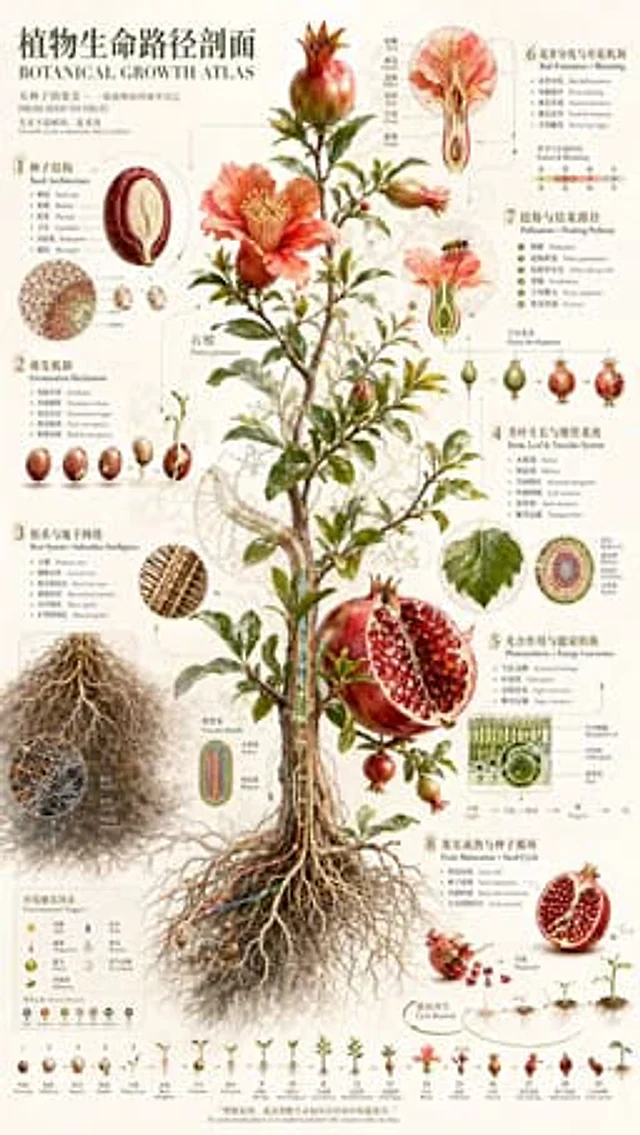
{ "type": "scientific botanical infographic poster", "subject": "{argument name=\"plant species\" default=\"Pomegranate (Punica granatum)\"}", "style": "vintage botanical illustration mixed with modern infographic design, highly detailed, {argument name=\"color palette\" default=\"earthy greens, deep reds, parchment background\"}", "header": { "main_title": "{argument name=\"main title\" default=\"植物生命路径剖面\"}", "english_title": "{argument name=\"english title\" default=\"BOTANICAL GROWTH ATLAS\"}", "subtitle": "从种子到果实,一株植物如何展开自己 / FROM SEED TO FRUIT" }, "centerpiece": "full plant showing extensive root system, woody stem, green leaves, blooming red flowers, and ripe fruits including one halved to show seeds", "layout": { "numbered_sections": [ { "number": 1, "title": "种子结构 / Seed Architecture", "content": "cross-section of a single seed with 6 labeled parts" }, { "number": 2, "title": "萌发机制 / Germination Mechanism", "content": "sequence of 5 sprouting seeds showing radicle emergence" }, { "number": 3, "title": "根系与地下网络 / Root System + Subsurface Intelligence", "content": "detailed root network with 2 circular microscopic cross-sections showing vascular bundles and hyphae" }, { "number": 4, "title": "茎叶生长与维管系统 / Stem, Leaf & Vascular System", "content": "leaf detail and circular stem cross-section with 5 labeled layers" }, { "number": 5, "title": "光合作用与能量转换 / Photosynthesis + Energy Conversion", "content": "3D cellular cross-section of a leaf showing mesophyll and chloroplasts, plus a chemical equation diagram" }, { "number": 6, "title": "花芽分化与开花机制 / Bud Formation + Blooming", "content": "detailed flower cross-section showing stamen and ovary, plus a 4-season timeline" }, { "number": 7, "title": "授粉与结果路径 / Pollination + Fruiting Pathway", "content": "bee approaching a flower cross-section, followed by a sequence of 5 stages of ovary development into a fruit" }, { "number": 8, "title": "果实成熟与种子循环 / Fruit Maturation + Seed Cycle", "content": "ripe fruit breaking open, seeds dispersing downwards to a new sprout" } ], "additional_elements": [ { "position": "bottom left", "title": "环境触发因素 / Environmental Triggers", "content": "grid of 6 weather/environmental icons and 6 nutrient element icons (N, P, K, Ca, Mg, Fe)" }, { "position": "bottom edge", "title": "Growth Timeline", "content": "linear sequence of 19 small plant icons showing the complete life cycle from seed to mature plant" } ], "footer_quote": "{argument name=\"bottom quote\" default=\"理解植物,就是理解生命如何在时间中构建秩序。\"}" } }
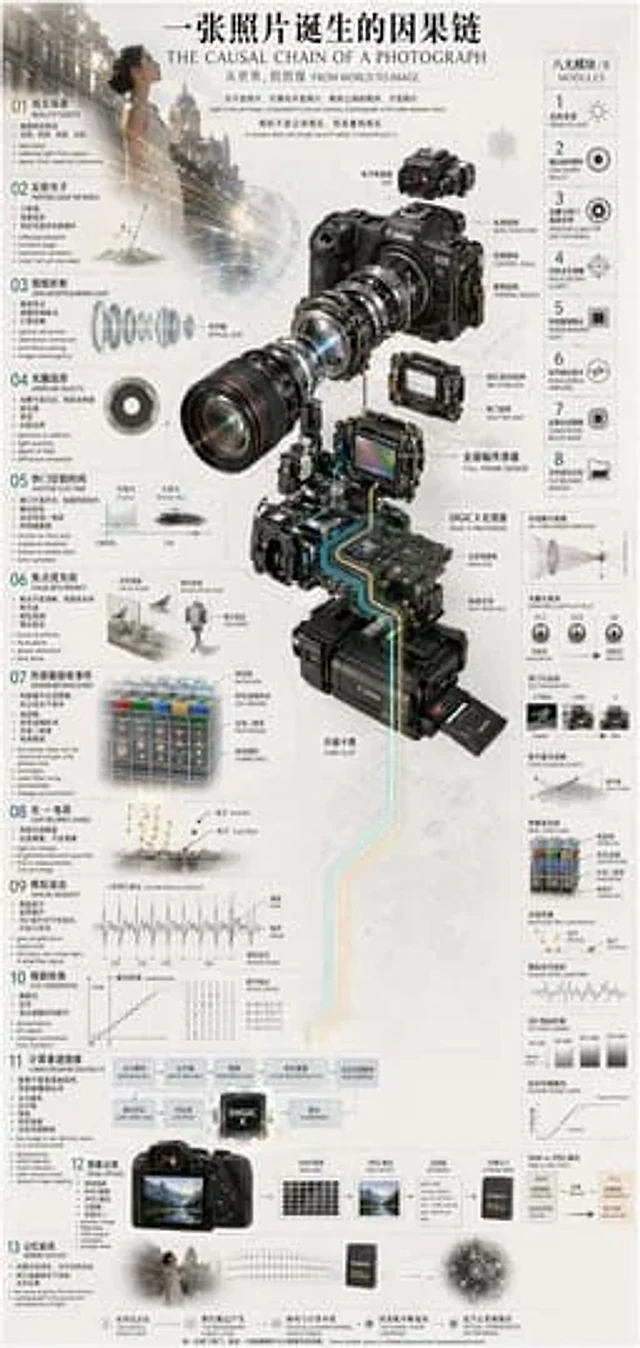
{ "type": "technical infographic", "subject": "{argument name=\"subject matter\" default=\"digital photography process\"}", "header": { "title": "{argument name=\"main title\" default=\"一张照片诞生的因果链 THE CAUSAL CHAIN OF A PHOTOGRAPH\"}", "subtitle": "从世界,到图像 FROM WORLD TO IMAGE" }, "centerpiece": { "description": "Exploded isometric view of a modern mirrorless camera", "model": "{argument name=\"camera model\" default=\"Canon EOS R5\"}", "labeled_parts_count": 12, "labeled_parts": [ "EVF", "Body Structure", "Control Dials", "Thermal Design", "Optical Axis", "IBIS Stabilizer", "Shutter Unit", "Full-Frame Sensor", "{argument name=\"processor name\" default=\"DIGIC X Processor\"}", "Main PCB", "High-Speed Bus", "Card Slot" ] }, "layout": { "left_column": { "description": "Chronological causal chain", "count": 13, "steps": [ "01 REALITY EXISTS", "02 PHOTONS LEAVE THE WORLD", "03 LENS ACCEPTS & BENDS LIGHT", "04 APERTURE SELECTS", "05 SHUTTER CUTS TIME", "06 FOCUS SETS PRIORITY", "07 SENSOR RECEIVES EVENT", "08 LIGHT BECOMES CHARGE", "09 ANALOG READOUT", "10 A/D CONVERSION", "11 COMPUTATION RECONSTRUCTS", "12 IMAGE APPEARS", "13 MEMORY OUTLIVES" ] }, "right_column": { "title": "八大模块 / 8 MODULES", "count": 8, "modules": [ "1 ORIGIN OF LIGHT", "2 LENS SHAPES REALITY", "3 APERTURE & SHUTTER EDIT THE WORLD", "4 FOCUS DECIDES CLARITY", "5 SENSOR MEASURES LIGHT", "6 SIGNAL BORN & AMPLIFIED", "7 COMPUTATION BUILDS IMAGE", "8 FILE BECOMES MEMORY" ] }, "side_diagrams": { "count": 7, "descriptions": [ "Ray cone & image formation", "Aperture & depth of field", "Shutter & motion", "Focal plane & clarity", "Pixel structure", "Photoelectric conversion", "Analog signal waveform" ] }, "footer": { "count": 5, "description": "Philosophical summary points" } }, "style": "technical, precise, wireframe elements, glowing data lines, photorealistic camera components, clean typography, dual-language" }
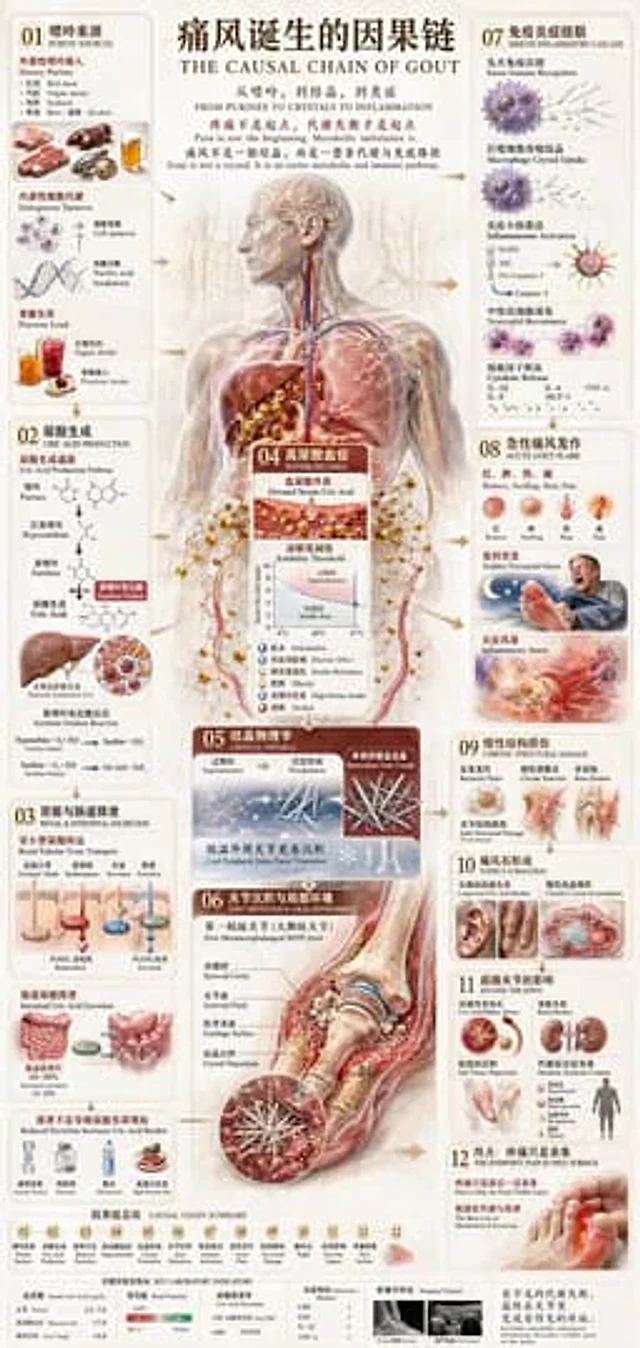
{ "type": "comprehensive medical infographic", "style": "highly detailed 3D medical illustration, clinical white background, clean typography", "header": { "title_cn": "{argument name=\"main title\" default=\"痛风诞生的因果链\"}", "title_en": "{argument name=\"english title\" default=\"THE CAUSAL CHAIN OF GOUT\"}", "subtitle": "Pain is not the beginning. Metabolic imbalance is.", "top_right_sequence": { "count": 6, "labels": ["Metabolism", "Transport", "Crystallization", "Immunity", "Inflammation", "Damage"] } }, "centerpiece": { "description": "{argument name=\"central figure\" default=\"transparent anatomical human body showing liver, kidneys, and vascular system\"}", "details": "pathway highlighted in {argument name=\"highlight color\" default=\"glowing red\"} descending to the foot" }, "layout": { "left_column": [ { "id": "01", "title": "Purine Sources", "elements": 6, "labels": ["Red meat", "Organ meats", "Seafood", "Beer", "Endogenous", "Fructose"] }, { "id": "02", "title": "Uric Acid Production", "elements": 2, "labels": ["Chemical pathway", "Liver"] }, { "id": "03", "title": "Renal & Intestinal Excretion", "elements": 2, "labels": ["Kidney nephron", "Intestines"] }, { "id": "04", "title": "Hyperuricemia", "elements": 2, "labels": ["Blood vial", "Solubility graph"] } ], "center_overlay": [ { "id": "05", "title": "Crystal Physics", "elements": 3, "labels": ["Supersaturation beaker", "Precipitation beaker", "Molecular structure"] }, { "id": "06", "title": "Joint Deposition & Local Environment", "elements": 1, "labels": ["First MTP joint cross-section"] } ], "right_column": [ { "id": "07", "title": "Immune Inflammatory Cascade", "elements": 4, "labels": ["Macrophage", "Inflammasome", "Neutrophil", "Cytokines"] }, { "id": "08", "title": "Acute Gout Flare", "elements": 1, "labels": ["Inflamed foot"] }, { "id": "09", "title": "Chronic Structural Damage", "elements": 1, "labels": ["Bone erosion joint"] }, { "id": "10", "title": "Tophus Formation", "elements": 2, "labels": ["Hand tophi", "Foot tophi"] }, { "id": "11", "title": "Beyond the Joint", "elements": 2, "labels": ["Kidney stones", "Systemic burden"] } ], "bottom_row": [ { "id": "12", "title": "Pain Is the Final Signal", "elements": 7, "labels": ["Increased Purine", "Overproduction", "Reduced Excretion", "Hyperuricemia", "Crystal Formation", "Immune Activation", "Man in pain"] } ] }, "theme": "{argument name=\"disease focus\" default=\"gout and uric acid crystallization\"}" }
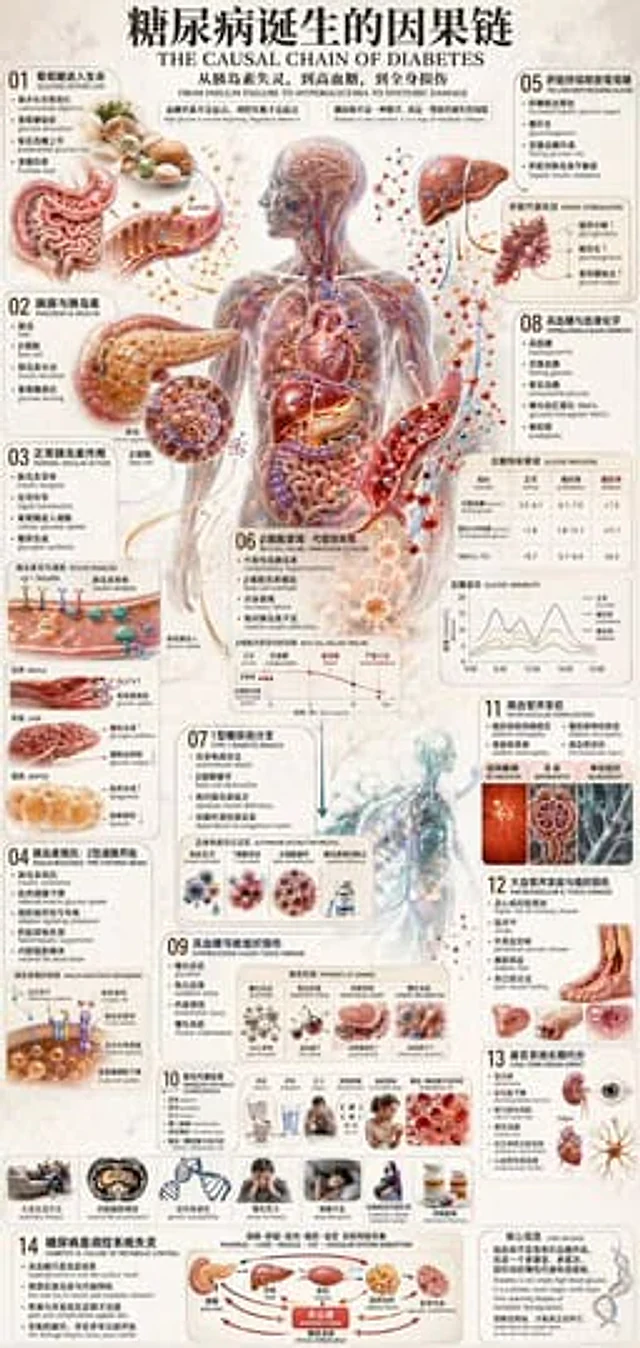
{ "type": "medical infographic poster", "style": "highly detailed anatomical illustrations, clean structured layout, scientific diagrammatic style", "color_palette": "{argument name=\"color palette\" default=\"medical red, blue, beige, and anatomical flesh tones\"}", "language": "{argument name=\"language\" default=\"bilingual Chinese and English\"}", "header": { "main_title": "{argument name=\"main title\" default=\"糖尿病诞生的因果链\"}", "english_title": "{argument name=\"english title\" default=\"THE CAUSAL CHAIN OF DIABETES\"}", "subtitle": "从胰岛素失灵,到高血糖,到全身损伤" }, "layout": { "centerpiece": "{argument name=\"central subject\" default=\"transparent human body showing circulatory system and internal organs\"}", "sections_count": 14, "sections": [ { "id": "01", "title": "葡萄糖进入生命", "visuals": ["stomach and intestines"] }, { "id": "02", "title": "胰腺与胰岛素", "visuals": ["pancreas", "beta cell"] }, { "id": "03", "title": "正常胰岛素作用", "visuals": ["receptor signaling diagram", "muscle, liver, adipose icons"] }, { "id": "04", "title": "胰岛素抵抗: 2型通路开始", "visuals": ["receptor blockage diagram", "7 lifestyle icons"] }, { "id": "05", "title": "肝脏持续释放葡萄糖", "visuals": ["liver"] }, { "id": "06", "title": "β细胞衰竭: 代偿到失败", "visuals": ["beta-cell decline line chart"] }, { "id": "07", "title": "1型糖尿病分支", "visuals": ["autoimmune destruction diagram"] }, { "id": "08", "title": "高血糖与血液化学", "visuals": ["blood vessel with glucose", "glucose indicators table", "glucose variability chart"] }, { "id": "09", "title": "高血糖导致组织损伤", "visuals": ["4 pathways of damage diagrams"] }, { "id": "10", "title": "急性代谢后果", "visuals": ["7 symptom icons"] }, { "id": "11", "title": "微血管并发症", "visuals": ["eye", "kidney", "nerve cross-section"] }, { "id": "12", "title": "大血管并发症与组织损伤", "visuals": ["heart", "brain", "diabetic foot"] }, { "id": "13", "title": "器官系统长期代价", "visuals": ["text list"] }, { "id": "14", "title": "糖尿病是调控系统失灵", "visuals": ["metabolic control flowchart"] } ], "footer": { "core_message": "核心信息 CORE MESSAGE" } } }
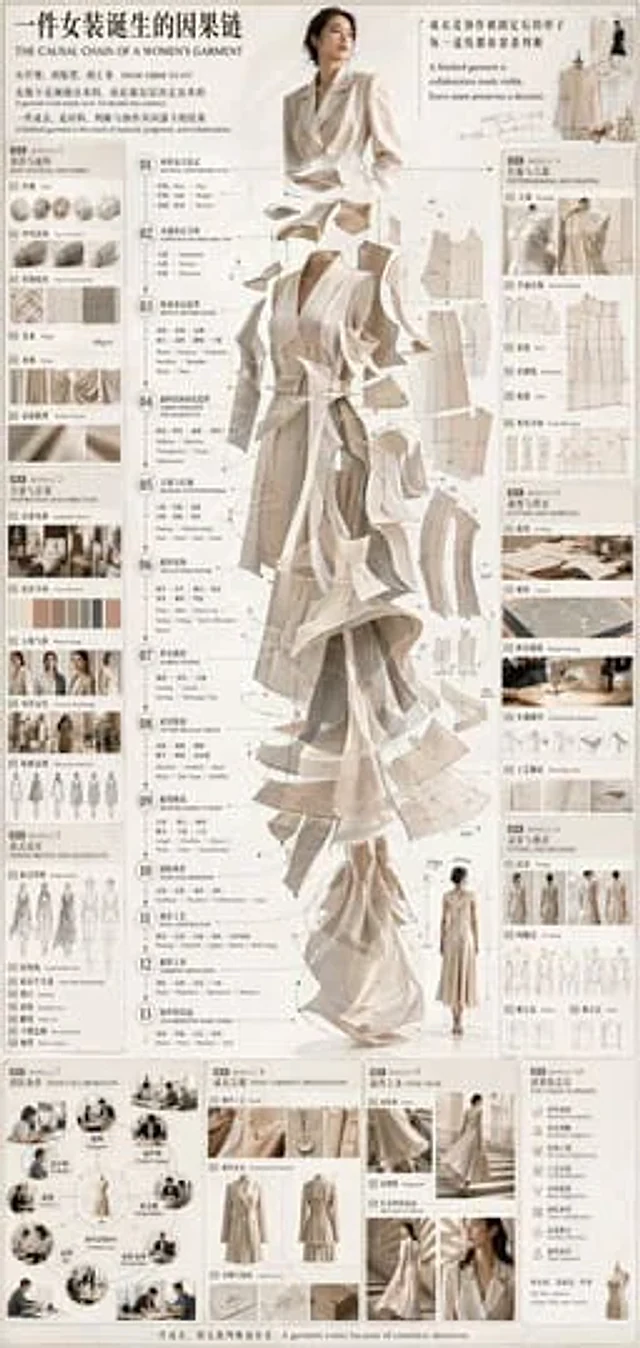
{ "type": "fashion design process infographic", "title": "{argument name=\"main title\" default=\"一件女装诞生的因果链 THE CAUSAL CHAIN OF A WOMEN'S GARMENT\"}", "subtitle": "从纤维,到版型,到上身 FROM FIBER TO FIT", "style": { "aesthetic": "elegant editorial, technical fashion illustration, highly detailed", "color_palette": "{argument name=\"color palette\" default=\"beige, cream, and neutral tones\"}" }, "layout": { "centerpiece": { "description": "Exploded-view illustration of a {argument name=\"garment type\" default=\"women's trench coat dress\"} showing cascading layers of fabric, pattern pieces, and stitching lines. Top shows a model wearing the finished garment.", "central_list": { "count": 13, "type": "numbered steps with pointer lines", "labels": ["01 Material", "02 Inspiration", "03 Sketch", "04 Fabric", "05 Draping", "06 Pattern", "07 Sewing", "08 Fitting", "09 Revision", "10 Team", "11 Construction", "12 Garment", "13 Collaboration"] } }, "left_column": [ { "module": "MODULE 1: RAW MATERIAL AND FABRIC", "count": 6, "items": ["Fiber", "Yarn Structure", "Fabric Construction", "Weight", "Drape", "Surface Texture"] }, { "module": "MODULE 2: INSPIRATION AND DIRECTION", "count": 5, "items": ["Inspiration Source", "Color Direction", "Woman Image", "Occasion Positioning", "Silhouette Intention"] }, { "module": "MODULE 3: DESIGN SKETCH AND SILHOUETTE", "count": 7, "items": ["Design Sketch", "Construction Line", "Front Back Relationship", "Neckline", "Shoulder Line", "Waist Line", "Hem Proportion"] } ], "right_column": [ { "module": "MODULE 4: PATTERNMAKING AND DRAPING", "count": 6, "items": ["Draping", "Patternmaking", "Dart", "Panel Line", "Ease", "Grain Direction"] }, { "module": "MODULE 5: CUTTING AND SAMPLING", "count": 5, "items": ["Cutting", "Layout", "Sample Sewing", "Construction Sequence", "Technique Test"] }, { "module": "MODULE 6: FITTING AND REVISION", "count": 4, "items": ["Fitting", "Fit Issues", "Before", "After"] } ], "bottom_row": [ { "module": "MODULE 7: TEAM COLLABORATION", "count": 8, "items": ["Designer", "Patternmaker", "Fabric Buyer", "Sample Maker", "Merchandiser", "QC", "Feedback Loop", "Model"] }, { "module": "MODULE 8: FINAL GARMENT PRESENTATION", "count": 3, "items": ["Details", "Finished Front & Back", "Labels & Care"] }, { "module": "MODULE 9: FINAL WEAR", "count": 3, "items": ["Drape", "Proportion", "Movement in Motion"] }, { "module": "MODULE 10: THE CHAIN SUMMARY", "count": 8, "items": ["Material Foundation", "Aesthetic Judgment", "Structural Engineering", "Craft Realization", "Body Negotiation", "Team Collaboration", "Iterative Revision", "Final Garment"] } ], "footer": "{argument name=\"footer text\" default=\"一件成衣,因无数判断而存在 A garment exists because of countless decisions.\"}" } }

{"type":"infographic poster","style":"cute flat vector illustration, cozy, warm, soft shading, {argument name=\"color palette\" default=\"pastel Morandi colors, soft pinks, purples, and warm tones\"}","character":"{argument name=\"character description\" default=\"young woman with shoulder-length brown hair wearing a pinkish-purple shirt\"}","layout":{"structure":"4 rows, 3 columns. Top row is a merged header. Rows 2-4 contain 9 individual panels.","header":{"title":"{argument name=\"main title\" default=\"情绪不好了?\"}","subtitle":"{argument name=\"subtitle\" default=\"8个让你瞬间变好的方法\"}","sub_subtitle":"写给焦虑的你,快来看看","visual":"character hugging herself, surrounded by yellow sparkles and hearts"},"grid_panels":[{"id":1,"title":"1. 深呼吸","text":"调节神经,缓解紧张情绪。","visual":"character with eyes closed, smiling, surrounded by clouds"},{"id":2,"title":"2. 去户外散步","text":"接触自然,让心静下来。","visual":"character walking outdoors among green trees and bushes"},{"id":3,"title":"3. 写情绪日记","text":"把烦恼写下,大脑会更轻松。","visual":"character sitting at a desk writing in a notebook with a pen, floating hearts"},{"id":4,"title":"4. 抱抱自己","text":"给予自己温暖和安慰。","visual":"character hugging herself with eyes closed, floating hearts"},{"id":5,"title":"5. 听听音乐","text":"让舒缓的旋律治愈心灵。","visual":"character wearing large white headphones, eyes closed, floating colorful music notes"},{"id":6,"title":"6. 找人倾诉","text":"分享你的烦恼,让压力释放。","visual":"character holding a smartphone, talking to another similar-looking girl, floating hearts"},{"id":7,"title":"7. 看看天空","text":"感受天空的辽阔,让心情变好。","visual":"character looking up at a blue sky with white clouds and sparkles"},{"id":8,"title":"8. 冥想","text":"专注于呼吸,找回内心的宁静。","visual":"an open notebook, a pen, and a pink flower on a desk"},{"id":9,"title":"none","text":"{argument name=\"footer text\" default=\"转发收藏,每天都要关爱自己!\"}","visual":"character sitting cross-legged in a meditation pose, eyes closed, with a glowing halo behind her head"}]}}
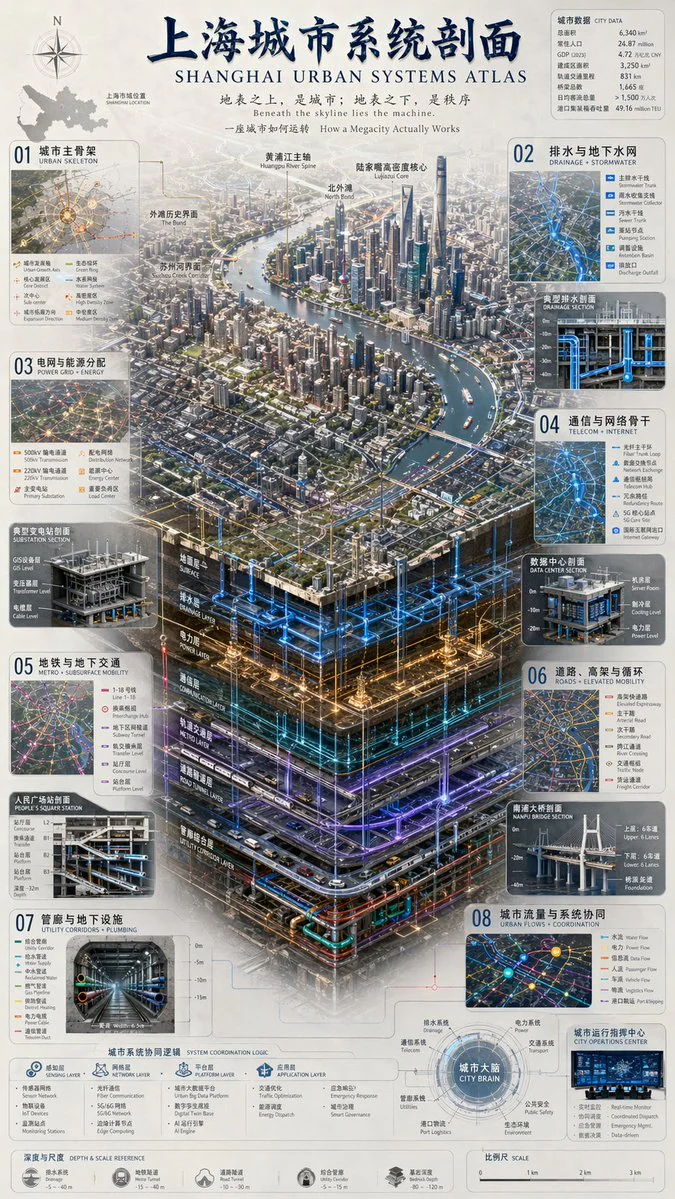
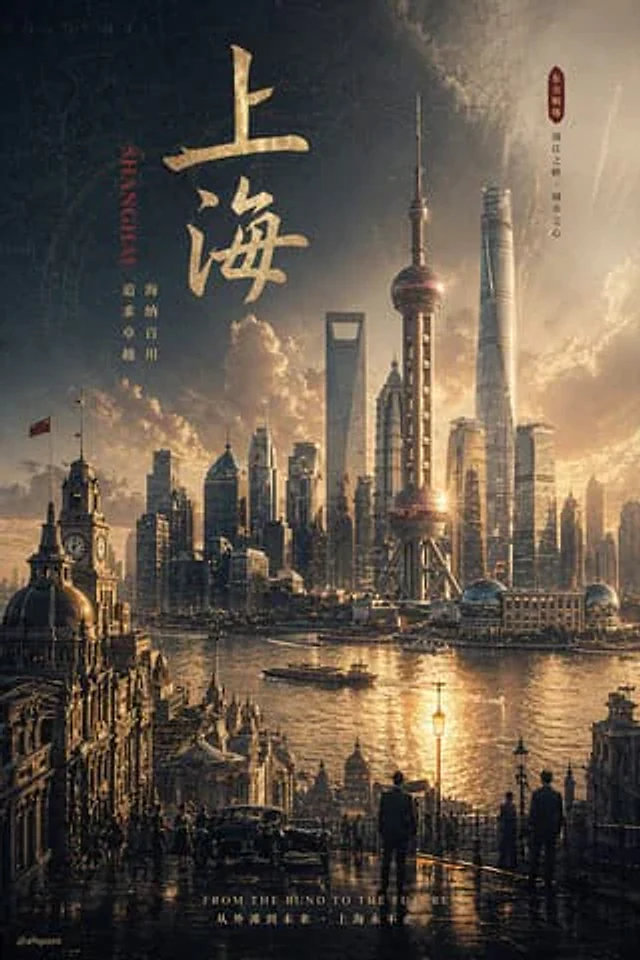
{ "type": "complex urban systems atlas infographic", "style": "{argument name=\"color palette\" default=\"dark background with glowing blue, gold, and purple accents\"}, highly detailed technical illustration, 3D isometric cutaway", "header": { "title": "{argument name=\"chinese city name\" default=\"上海\"}城市系统剖面 {argument name=\"english city name\" default=\"SHANGHAI\"} URBAN SYSTEMS ATLAS", "subtitles": [ "地表之上,是城市;地表之下,是秩序 {argument name=\"english subtitle\" default=\"Beneath the skyline lies the machine.\"}", "一座城市如何运转 How a Megacity Actually Works" ] }, "layout": { "top_left": "Compass rose and city map labeled '上海市域位置 SHANGHAI LOCATION'", "top_right": "Data table titled '城市数据 CITY DATA' with 7 rows of statistics", "centerpiece": { "description": "{argument name=\"centerpiece style\" default=\"highly detailed 3D isometric cutaway render\"} of a megacity river landscape", "layers": [ "地面层 SURFACE", "排水层 DRAINAGE LAYER", "电力层 POWER LAYER", "通信层 COMMUNICATION LAYER", "轨道交通层 METRO LAYER", "道路隧道层 ROAD TUNNEL LAYER", "管廊综合层 UTILITY CORRIDOR LAYER" ] }, "side_panels": [ { "id": "01", "title": "城市主骨架 URBAN SKELETON", "elements": "Map with 8 legend items" }, { "id": "02", "title": "排水与地下水网 DRAINAGE + STORMWATER", "elements": "Cross-section diagram '典型排水剖面 DRAINAGE SECTION' with 5 legend items" }, { "id": "03", "title": "电网与能源分配 POWER GRID + ENERGY", "elements": "Cross-section diagram '典型变电站剖面 SUBSTATION SECTION' with 6 legend items" }, { "id": "04", "title": "通信与网络骨干 TELECOM + INTERNET", "elements": "Cross-section diagram '数据中心剖面 DATA CENTER SECTION' with 6 legend items" }, { "id": "05", "title": "地铁与地下交通 METRO + SUBSURFACE MOBILITY", "elements": "Cross-section diagram '人民广场站剖面 PEOPLE'S SQUARE STATION' with 6 legend items" }, { "id": "06", "title": "道路、高架与循环 ROADS + ELEVATED MOBILITY", "elements": "Cross-section diagram '南浦大桥剖面 NANPU BRIDGE SECTION' with 6 legend items" }, { "id": "07", "title": "管廊与地下设施 UTILITY CORRIDORS + PLUMBING", "elements": "Cross-section diagram '综合管廊 UTILITY CORRIDOR' with 8 legend items" }, { "id": "08", "title": "城市流量与系统协同 URBAN FLOWS + COORDINATION", "elements": "Map diagram '城市运行指挥中心 CITY OPERATIONS CENTER' with 6 legend items" } ], "bottom_panels": { "system_logic": { "title": "城市系统协同逻辑 SYSTEM COORDINATION LOGIC", "steps": 4, "labels": ["感知层 SENSING LAYER", "网络层 NETWORK LAYER", "平台层 PLATFORM LAYER", "应用层 APPLICATION LAYER"] }, "city_brain": { "title": "城市大脑 CITY BRAIN", "central_node": 1, "peripheral_nodes": 8 }, "references": { "depth_scale": { "title": "深度与尺度 DEPTH & SCALE REFERENCE", "icons": 5 }, "map_scale": { "title": "比例尺 SCALE", "markers": 4 } } } } }
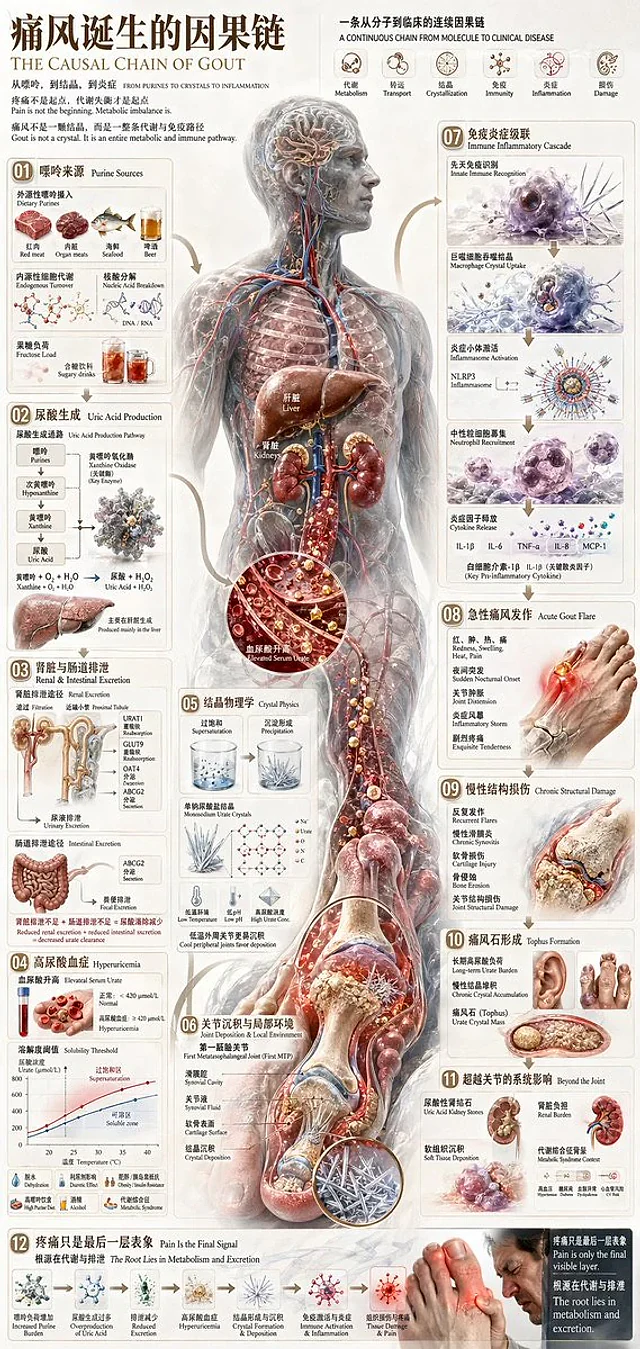
{ "type": "comprehensive medical infographic", "style": "highly detailed 3D medical illustration, clinical white background, clean typography", "header": { "title_cn": "{argument name=\"main title\" default=\"痛风诞生的因果链\"}", "title_en": "{argument name=\"english title\" default=\"THE CAUSAL CHAIN OF GOUT\"}", "subtitle": "Pain is not the beginning. Metabolic imbalance is.", "top_right_sequence": { "count": 6, "labels": ["Metabolism", "Transport", "Crystallization", "Immunity", "Inflammation", "Damage"] } }, "centerpiece": { "description": "{argument name=\"central figure\" default=\"transparent anatomical human body showing liver, kidneys, and vascular system\"}", "details": "pathway highlighted in {argument name=\"highlight color\" default=\"glowing red\"} descending to the foot" }, "layout": { "left_column": [ { "id": "01", "title": "Purine Sources", "elements": 6, "labels": ["Red meat", "Organ meats", "Seafood", "Beer", "Endogenous", "Fructose"] }, { "id": "02", "title": "Uric Acid Production", "elements": 2, "labels": ["Chemical pathway", "Liver"] }, { "id": "03", "title": "Renal & Intestinal Excretion", "elements": 2, "labels": ["Kidney nephron", "Intestines"] }, { "id": "04", "title": "Hyperuricemia", "elements": 2, "labels": ["Blood vial", "Solubility graph"] } ], "center_overlay": [ { "id": "05", "title": "Crystal Physics", "elements": 3, "labels": ["Supersaturation beaker", "Precipitation beaker", "Molecular structure"] }, { "id": "06", "title": "Joint Deposition & Local Environment", "elements": 1, "labels": ["First MTP joint cross-section"] } ], "right_column": [ { "id": "07", "title": "Immune Inflammatory Cascade", "elements": 4, "labels": ["Macrophage", "Inflammasome", "Neutrophil", "Cytokines"] }, { "id": "08", "title": "Acute Gout Flare", "elements": 1, "labels": ["Inflamed foot"] }, { "id": "09", "title": "Chronic Structural Damage", "elements": 1, "labels": ["Bone erosion joint"] }, { "id": "10", "title": "Tophus Formation", "elements": 2, "labels": ["Hand tophi", "Foot tophi"] }, { "id": "11", "title": "Beyond the Joint", "elements": 2, "labels": ["Kidney stones", "Systemic burden"] } ], "bottom_row": [ { "id": "12", "title": "Pain Is the Final Signal", "elements": 7, "labels": ["Increased Purine", "Overproduction", "Reduced Excretion", "Hyperuricemia", "Crystal Formation", "Immune Activation", "Man in pain"] } ] }, "theme": "{argument name=\"disease focus\" default=\"gout and uric acid crystallization\"}" }
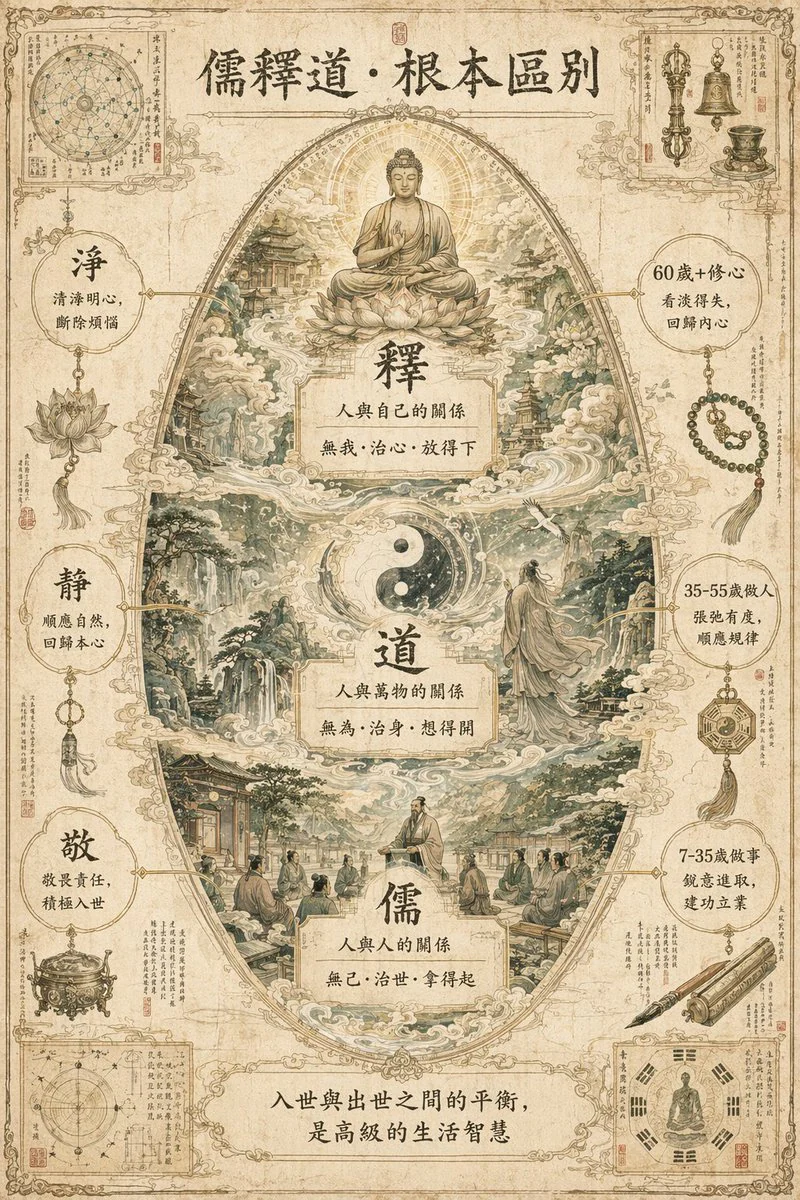
A breathtaking and extremely complex world-building infographic masterpiece conceptualizing the "{argument name="theme" default="Fundamental Differences between Confucianism, Buddhism, and Taoism"}", designed as a profound {argument name="style" default="ancient Oriental mythological manuscript"}. Background: Pure white vintage textured canvas with a light beige aged parchment base color, subtle frayed edges, and water stain textures. Core Layout: Central vision uses a grand "vertical egg-shaped layered structure", with Buddhism, Taoism, and Confucianism layers from top to bottom. Margins: Four corners are decorated with fine micro-illustrations featuring ancient observation notes, ritual implements, and runes. Colors: Low-saturation sage green, light gold, and off-white as main tones; overall light and soft without harsh high-saturation colors. Details: Architectural lines, landscape brushwork, lotus patterns, and cloud layers are clearly visible and exquisitely detailed. Seamless Fusion: The three layers transition naturally through clouds and flowing water; the Buddhist halo, Taoist Taiji mist, and Confucian scholarly aura connect seamlessly. Style: Classical ink line art + low-saturation digital watercolor, with a light Chinese-style ancient book manuscript texture. Text Annotations: Authentic Traditional Chinese characters in a mottled vintage Song typeface. Each annotation includes a short title + a line of poetic description, connected to corresponding details by dark gold hair-thin lines with no overlapping pointers. Aspect Ratio: {argument name="aspect ratio" default="3:4"} vertical format, independent and complete. Title Area (Top): `儒釋道·根本區別` (Confucianism, Buddhism, Taoism: Fundamental Differences) Central Layer Labels: Top "Buddhism": `釋`, `Relationship between man and self`, `Selflessness, governing the heart, letting go` Middle "Taoism": `道`, `Relationship between man and all things`, `Non-action, governing the body, being open-minded` Bottom "Confucianism": `儒`, `Relationship between man and man`, `No ego, governing the world, taking responsibility` Side Annotations: Left: `Purity`: pure heart and clear mind, cutting off troubles; `Stillness`: following nature, returning to the original heart; `Respect`: respecting responsibility, active involvement in society. Right: `60+ Spiritual Cultivation`: looking lightly at gain/loss; `35-55 Conduct`: living with flexibility, following laws; `7-35 Actions`: forging ahead, building careers. Bottom Summary: `The balance between being in the world and being out of the world is high-level life wisdom.`
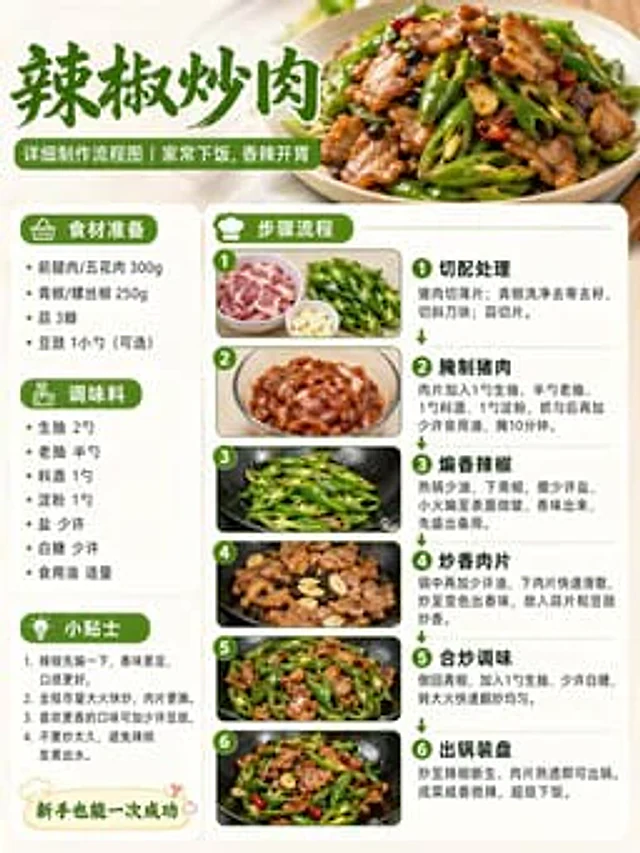
Help me create a detailed production flowchart for the dish {argument name="dish name" default="Fried Pork with Chili"}, in a realistic style, suitable for Xiaohongshu image-text proportions.
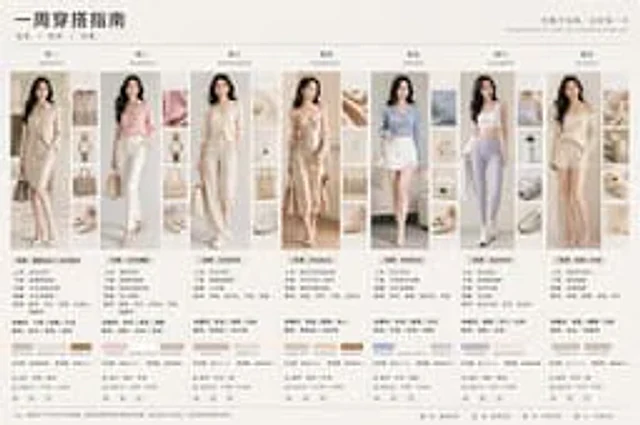
{ "type": "7-day fashion lookbook infographic", "header": { "title": "{argument name=\"main title\" default=\"一周穿搭指南\"}", "subtitle": "{argument name=\"style keywords\" default=\"温柔 | 靓丽 | 优雅\"}", "slogan_cn": "优雅不设限,自信每一天", "slogan_en": "{argument name=\"english slogan\" default=\"ELEGANCE HAS NO LIMIT, BE CONFIDENT EVERY DAY\"}" }, "subject": "{argument name=\"subject description\" default=\"young elegant Asian woman\"}", "layout": { "columns": 7, "column_elements": [ "day_header", "main_portrait", "4_detail_thumbnails", "outfit_specs", "keywords_colors", "3_color_swatches", "star_ratings", "fabric_price", "4_season_icons" ], "days": [ { "day": "周一 (MONDAY)", "outfit": "beige blazer suit", "scene": "场景:重要会议 / 正式商务" }, { "day": "周二 (TUESDAY)", "outfit": "pink blazer suit", "scene": "场景:日常通勤" }, { "day": "周三 (WEDNESDAY)", "outfit": "cream knit cardigan set", "scene": "场景:生活休闲" }, { "day": "周四 (THURSDAY)", "outfit": "champagne slip dress", "scene": "场景:外出私会" }, { "day": "周五 (FRIDAY)", "outfit": "blue knit top, white skirt", "scene": "场景:休闲社交" }, { "day": "周六 (SATURDAY)", "outfit": "white sports bra, purple leggings", "scene": "场景:运动休闲" }, { "day": "周日 (SUNDAY)", "outfit": "beige lounge knitwear", "scene": "场景:居家 / 约会" } ] }, "footer": { "tips": "{argument name=\"footer tips\" default=\"Tips: 根据天气与场合灵活调整,配饰是提升整体造型的关键;保持自信与舒适,才是穿搭的最终目的。\"}", "legend": [ "春: 春季适用", "夏: 夏季适用", "秋: 秋季适用", "冬: 冬季适用" ] } }
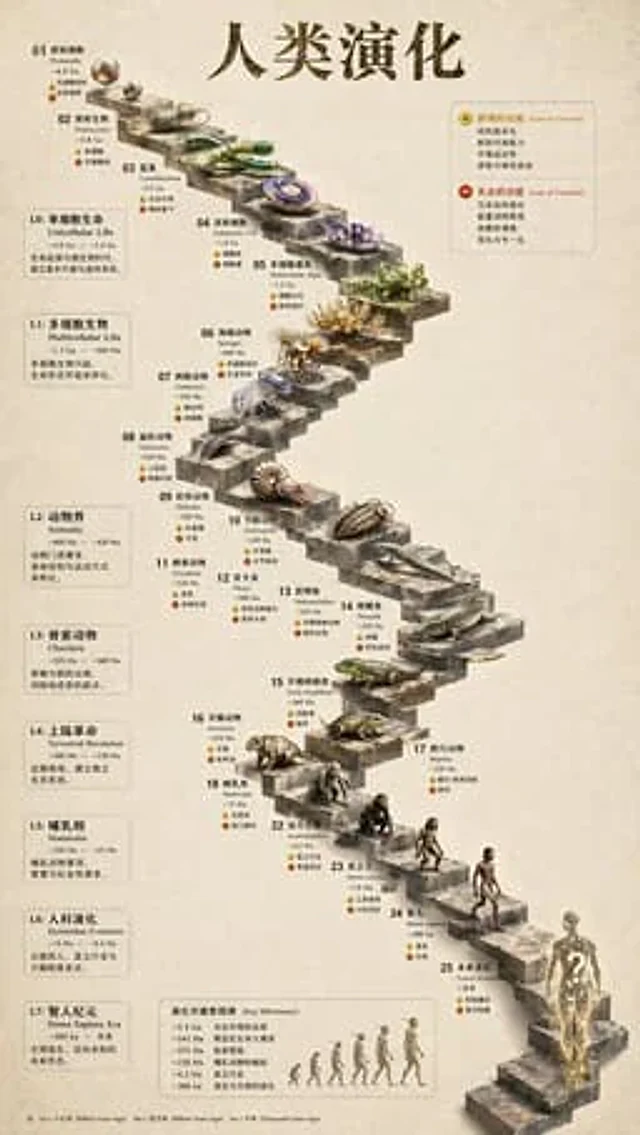
{ "type": "evolutionary timeline infographic", "instruction": "Using REFERENCE_0 as a structural base, transform the flat vector design into a highly realistic 3D infographic. Replace the smooth ramps with distinct stone steps and upgrade all organisms to photorealistic 3D models.", "style": { "background": "{argument name=\"background style\" default=\"vintage textured parchment paper\"}", "staircase": "{argument name=\"staircase material\" default=\"realistic textured stone blocks\"}", "subjects": "{argument name=\"organism style\" default=\"highly detailed photorealistic 3D renders\"}" }, "layout": { "main_title": "{argument name=\"main title\" default=\"人类演化\"}", "sections": [ { "position": "left sidebar", "count": 8, "labels": ["L0: 单细胞生命", "L1: 多细胞生物", "L2: 动物界", "L3: 脊索动物", "L4: 上陆革命", "L5: 哺乳纲", "L6: 人科演化", "L7: 智人纪元"] }, { "position": "top right", "title": "获得的功能 / 失去的功能", "description": "Legend with plus and minus icons" }, { "position": "bottom center", "title": "演化关键里程碑", "count": 6, "description": "Timeline with a silhouette graphic of 6 figures showing ape-to-human evolution" } ], "centerpiece": { "description": "Winding stone staircase with 25 numbered steps featuring specific organisms.", "count": 25, "notable_elements": [ "Step 07: Jellyfish", "Step 09: Ammonite", "Step 10: Trilobite", "Step 24: Walking human", "Step 25: {argument name=\"future evolution concept\" default=\"glowing cosmic silhouette with a question mark\"}" ] } } }
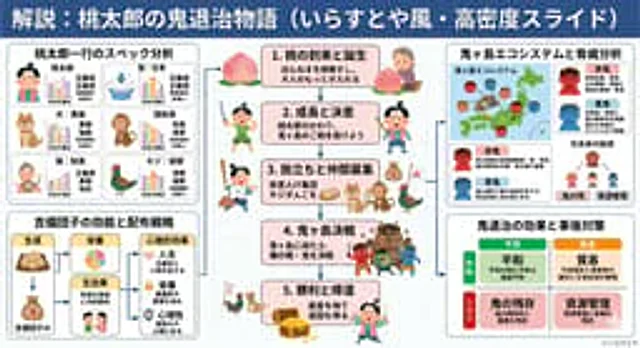
Create an explanatory slide ({argument name="format" default="ponchi-e diagram"}) for {argument name="theme" default="Momotaro"} that fuses the gentle atmosphere of "Irasutoya" with the overwhelming information density of "Kasumigaseki slides".
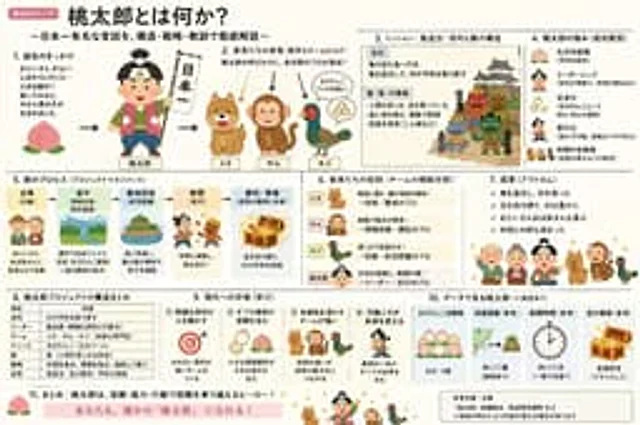
Create an explanatory slide ({argument name="format" default="ponchi-e diagram"}) for {argument name="theme" default="Momotaro"} that fuses the gentle atmosphere of "Irasutoya" with the overwhelming information density of "Kasumigaseki slides".
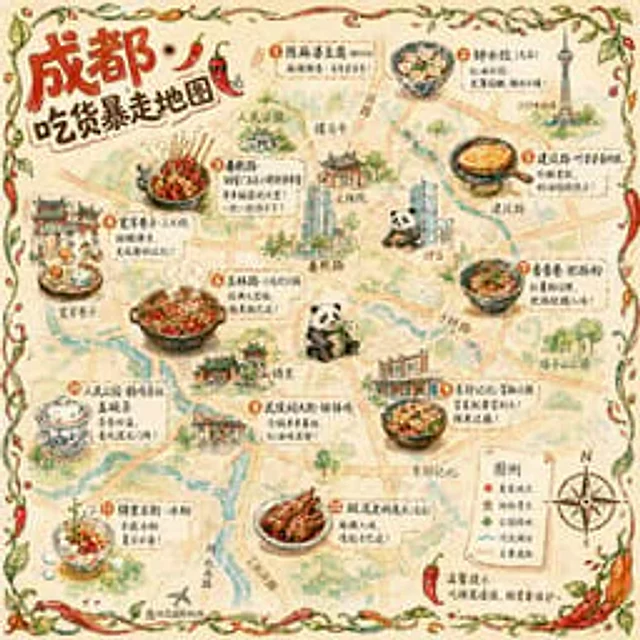
{ "type": "illustrated map infographic", "style": "{argument name=\"art style\" default=\"watercolor and ink hand-drawn illustration on vintage parchment\"}", "title_section": { "text": "{argument name=\"city name\" default=\"成都\"} {argument name=\"map title\" default=\"吃货暴走地图\"}", "mascot": "cartoon red chili pepper wearing sunglasses and giving a thumbs up" }, "border": "{argument name=\"border decoration\" default=\"vine of green leaves and red chili peppers\"}", "layout": { "background": "textured beige parchment paper with yellow roads, blue rivers, and green park areas", "sections": [ { "title": "landmarks", "count": 6, "illustrations": ["traditional pavilion", "traditional monastery", "modern skyscraper with climbing panda", "tall TV tower", "traditional gate", "industrial buildings"], "labels": ["人民公园", "文殊院", "IFS", "339电视塔", "宽窄巷子", "东郊记忆"] }, { "title": "food_spots", "count": 12, "illustrations": ["mapo tofu", "dumplings in chili oil", "skewers in pot", "sticky rice balls", "egg baking cake", "nine-grid hotpot", "sweet potato noodles", "cold skewers", "spicy mixed dish", "covered tea bowl", "ice jelly dessert", "spicy rabbit heads"], "labels": ["1 陈麻婆豆腐", "2 钟水饺", "3 春熙路", "4 宽窄巷子·三大炮", "5 建设路·叶婆婆蛋烘糕", "6 玉林路·小龙坎火锅", "7 香香巷·肥肠粉", "8 武侯祠大街·钵钵鸡", "9 东郊记忆·冒椒火辣", "10 人民公园·鹤鸣茶社", "11 锦里古街·冰粉", "12 双流老妈兔头"] }, { "title": "图例", "position": "bottom-right", "count": 5, "items": ["red dot", "green house", "green tree", "blue line", "yellow double line"], "labels": ["美食地点", "地标景点", "公园绿地", "河流湖泊", "主要道路"] } ], "centerpiece": "giant panda sitting and eating bamboo", "bottom_right_extras": ["vintage compass rose with N, S, E, W", "disclaimer text '温馨提示:吃辣需谨慎,肠胃要保护~' with a red chili pepper icon"] } }
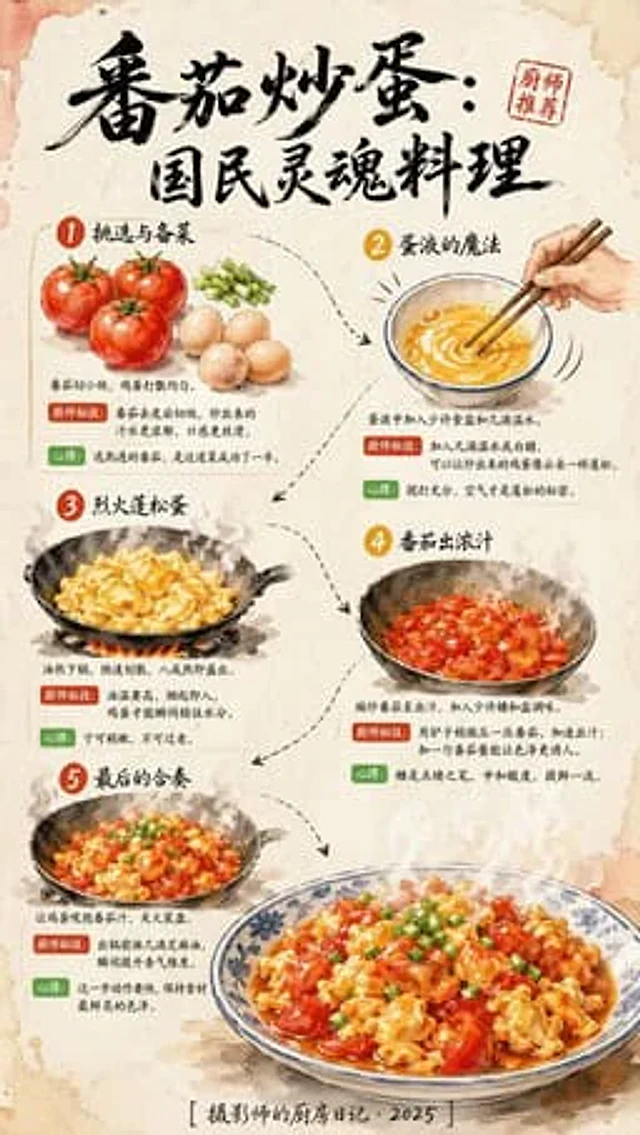
视觉设计规格描述:画幅比 9:16(竖版手机信息图);背景纹理为具有呼吸感的米色手工纸(Handmade Washi Paper),带微小纤维纹理,边角有轻微水渍晕染;配色方案为熟番茄红(#E23A28)、初榨橄榄油金黄(#F2C94C)、嫩草绿(#6FCF97)、碳黑墨线;排版逻辑为顶端大标题、中间 Z 字形流线、底部全景成品、留白艺术化处理。食谱内容策划:1)顶部标题《番茄炒蛋:国民灵魂料理》,手绘书法体,侧边盖红色“厨师推荐”微型印章。2)步骤区块(Z 动线排版):步骤1 挑选与备菜(左上):三个番茄、四枚土鸡蛋、一簇葱花;说明:番茄切小块,鸡蛋打散均匀;厨师秘技:番茄去皮后切块,汁水更浓郁,口感更丝滑;心得:选熟透番茄,成功一半。步骤2 蛋液的魔法(右上):手持筷子快速搅动蛋液,泛起气泡与动感线;说明:加少许盐和几滴温水;厨师秘技:加温水或白醋,鸡蛋更蓬松;心得:搅打充分,空气是蓬松秘密。步骤3 烈火蓬松蛋(左中):铁锅中蛋液迅速膨胀如云朵,水彩表现热气;说明:油热下锅,快速划散,八成熟盛出;厨师秘技:油温高,烟起即入,瞬间锁水;心得:宁可稍嫩,不可过老。步骤4 番茄出浓汁(右中):番茄翻滚,边缘半融化,亮红汤汁流淌;说明:煸炒至出汁,加少许糖和盐;厨师秘技:铲子轻压加速出汁,可加一勺番茄酱提色;心得:糖中和酸度、提鲜。步骤5 最后的合奏(左下):鸡蛋回锅与番茄汁交织,撒葱花;说明:让鸡蛋吸饱番茄汁,关火装盘;厨师秘技:出锅前滴几滴芝麻油提香;心得:动作要快,保持鲜亮色泽。3)底部成品插图:青花边陶瓷深盘装满番茄炒蛋,红亮汁水包裹金黄大块鸡蛋,葱花点缀,水彩渲染半透明酱汁质感,边缘有袅袅热气;视觉感:看了就想立刻盛一碗大米饭。4)底部中央署名:[ 摄影师的厨房日记 · 2025 ]。
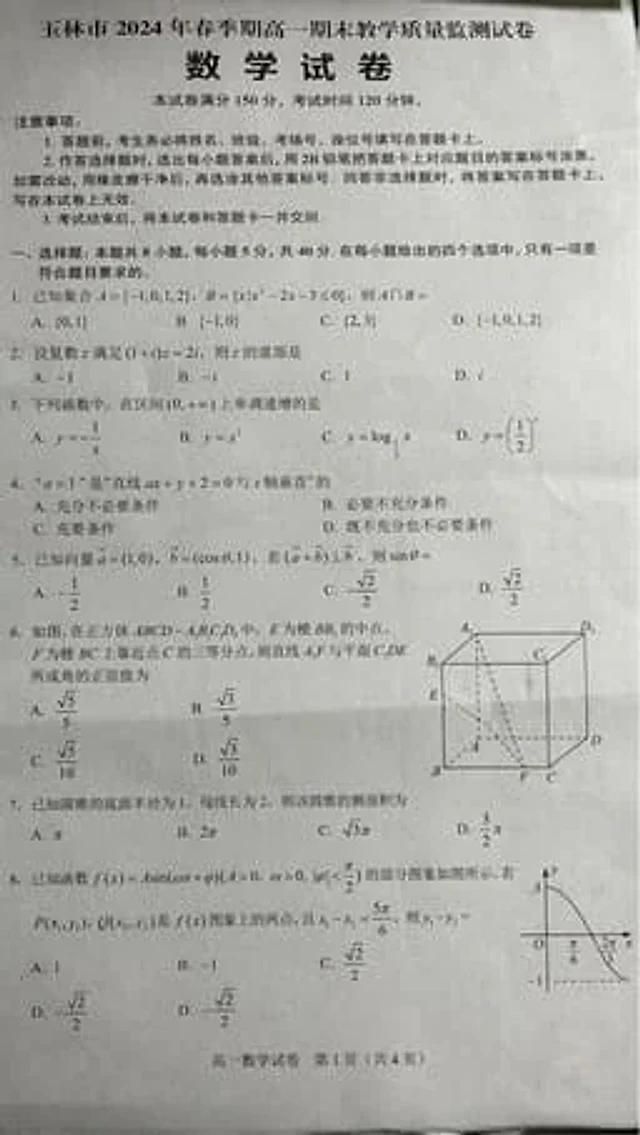
A realistic photo of a Chinese high school math exam paper, printed inblack and white on slightly gray paper, titled “数学试卷”, with multiplechoice questions and math formulas, including a small 3D geometrycube diagram. The paper is photographed casually with asmartphone, slightly tilted, with uneven lighting, soft shadows, andminor blur. The text is in Chinese with a mix of bold title font andstandard serif body font. Realistic paper texture, exam layout,authentic classroom test sheet style.
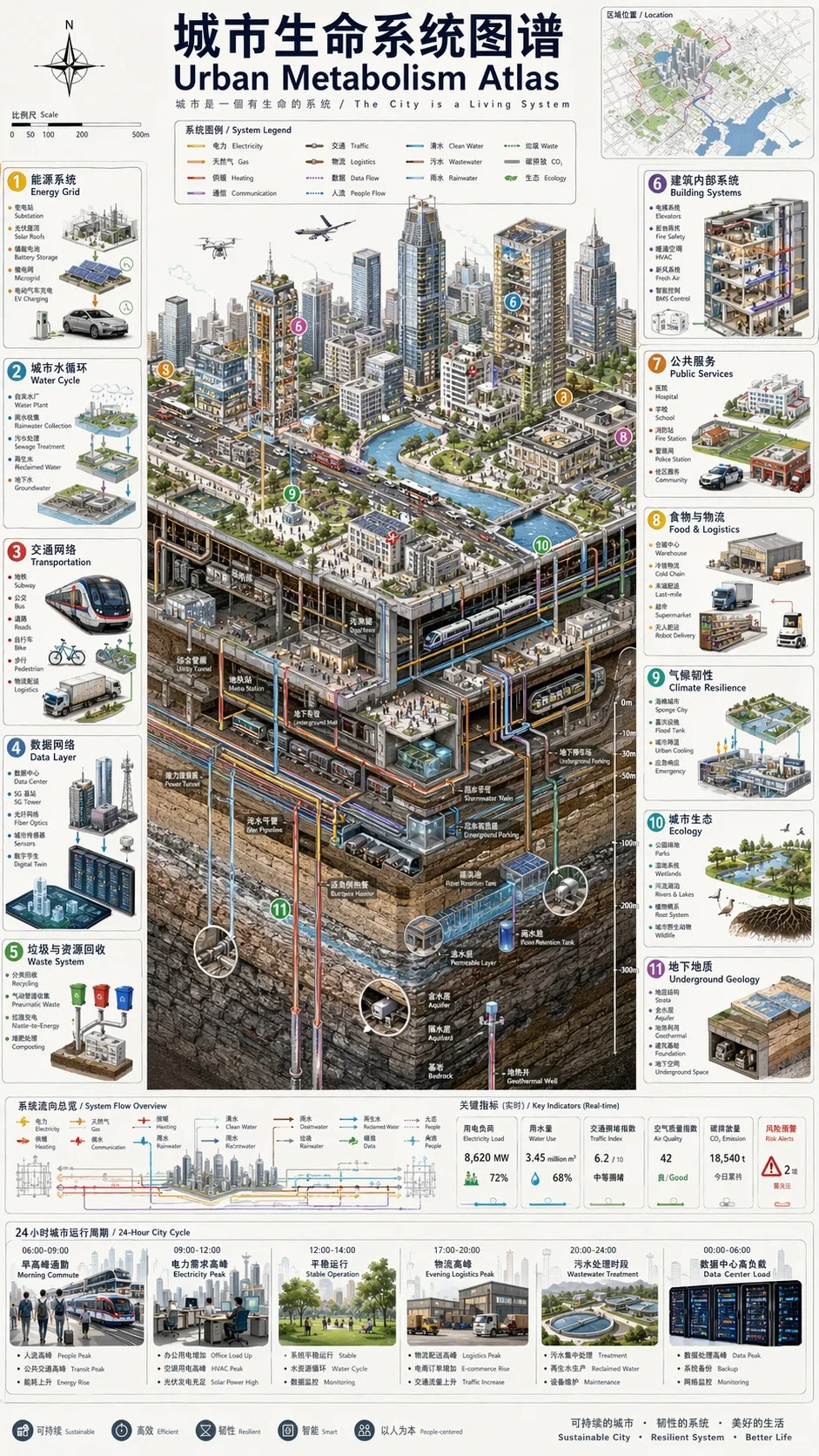
Vertical 9:16 isometric cutaway infographic "城市生命系统图谱 / Urban Metabolism Atlas". Smart city from sky to bedrock: skyscrapers, streets, subway, utility tunnels, water/sewage/gas/heating pipes, fiber, data center, flood tanks, aquifers, geothermal wells, bedrock. Color-coded flows for power/water/data/traffic/waste. 12 numbered panels bilingual CN/EN: 能源/水循环/交通/数据/垃圾/建筑/公共服务/ 物流/气候韧性/生态/地质/治理看板. 24h timeline at bottom. Style: engineering white paper + scientific atlas, light paper bg, crisp lines, 8K. No cyberpunk, no gibberish text, must show both above AND below ground.
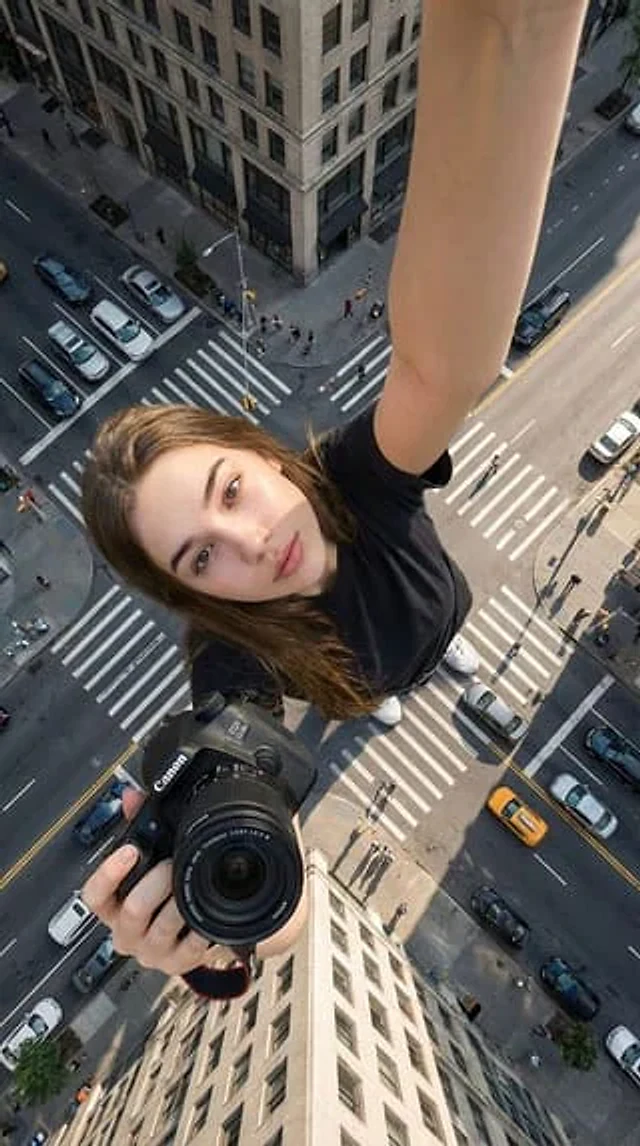
[中文] { "type": "图像生成提示词", "language": "zh", "style": "超现实电影感自拍摄影", "aspect_ratio": "9:16", "identity_preservation": { "use_reference_image": true, "strict_identity_lock": true, "alter_face": false, "alter_skin": false, "alter_hair": false, "alter_gender": false, "notes": "保留上传参考图像中完全一致的脸部特征、皮肤纹理、头发、眼镜、年龄和性别。禁止合成皮肤或雕塑感。" }, "subject": { "gender": "女性", "capture_method": "由主体本人拍摄的自拍", "pose": { "selfie_arm": { "description": "一只手臂完全伸直并完全向上伸展,手持拍摄自拍的相机", "visibility": "手臂在画面中清晰可见、笔直且占主导地位", "camera_visibility": "自拍相机设备本身不得在画面中出现" }, "product_arm": { "description": "另一只手臂完全伸向相机,手持附带的佳能相机", "importance": "产品最靠近相机并在视觉上占主导地位" }, "head": { "tilt": "头部向自拍相机微微倾斜" }, "expression": "自然放松的面部表情" }, "body_visibility": "从头到脚全身可见", "feet": "双脚清晰接触路面" }, "composition": { "perspective": "胸部高度的自然自拍视角", "camera_angle": "极端俯拍角度,相机位于主体正上方并直视下方", "layer_depth": [ "产品(最靠近相机)", "脸部", "全身", "城市环境(背景)" ] }, "scale_and_perspective": { "effect": "强制透视", "subject_scale": "女性呈现极度巨大", "buildings_scale": "建筑物显得小得多,最高不超过她的膝盖", "dominance": "主体在视觉上完全主导整个场景", "realism": "激发规模感同时保持物理可信" }, "environment": { "location": "真实城市十字路口", "elements": [ "人行横道", "道路标线", "交通标志", "汽车", "自行车", "真实人类尺度的行人" ], "setting": "地面层城市环境" }, "lighting": { "type": "自然日光", "conditions": "晴朗或轻度多云天空", "shadows": "柔和且真实", "restrictions": "禁止奇幻或戏剧性照明" }, "product_rules": { "usage": "完全按提供的上传佳能产品使用", "distortion": "无", "logo": "保持不变", "appearance": "仅有自然反射和真实高光" }, "camera_quality": { "realism": "最大照片真实感", "depth": "前景、主体与背景清晰分离", "artifacts": "无" }, "constraints": [ "禁止AI艺术感", "禁止塑料或雕塑皮肤", "禁止扭曲脸部或身体", "禁止多余肢体或错误解剖", "禁止文字或水印", "禁止可见自拍相机设备" ], "output_goal": "创作一张超现实电影感自拍图像:女性使用其确切参考身份,从极端俯拍视角在真实城市人行横道拍摄,具备强制透视比例、自然日光,并将佳能相机产品明显持向镜头。" } [English] { "type": "image_generation_prompt", "language": "en", "style": "hyper-realistic cinematic selfie photography", "aspect_ratio": "9:16", "identity_preservation": { "use_reference_image": true, "strict_identity_lock": true, "alter_face": false, "alter_skin": false, "alter_hair": false, "alter_gender": false, "notes": "Preserve identical facial features, skin texture, hair, glasses, age, and gender from the uploaded reference image. No synthetic skin or sculptural look." }, "subject": { "gender": "female", "capture_method": "selfie taken by the subject herself", "pose": { "selfie_arm": { "description": "one arm fully straight and completely extended upward holding the camera that takes the selfie", "visibility": "arm clearly visible, straight and dominant in frame", "camera_visibility": "the selfie camera device itself must NOT be visible in the frame" }, "product_arm": { "description": "the other arm fully extended toward the camera holding the attached Canon camera", "importance": "product is closest to the camera and visually dominant" }, "head": { "tilt": "slightly tilted toward the selfie camera" }, "expression": "natural and relaxed facial expression" }, "body_visibility": "full body visible from head to toe", "feet": "feet clearly touching the road surface" }, "composition": { "perspective": "natural selfie perspective at chest height", "camera_angle": "extreme top-down angle, camera above the subject looking directly downward", "layer_depth": [ "product (closest to camera)", "face", "full body", "city environment (background)" ] }, "scale_and_perspective": { "effect": "forced perspective", "subject_scale": "the woman appears extremely giant", "buildings_scale": "buildings appear much smaller, reaching no higher than her knees", "dominance": "the subject visually dominates the entire scene", "realism": "inspiring scale while remaining physically believable" }, "environment": { "location": "real urban intersection", "elements": [ "pedestrian crosswalk", "road markings", "traffic signs", "cars", "bicycles", "pedestrians at realistic human scale" ], "setting": "ground-level urban environment" }, "lighting": { "type": "natural daylight", "conditions": "clear or lightly cloudy sky", "shadows": "soft and realistic", "restrictions": "no fantasy or dramatic lighting" }, "product_rules": { "usage": "use the uploaded Canon product exactly as provided", "distortion": "none", "logo": "unchanged", "appearance": "natural reflections and realistic highlights only" }, "camera_quality": { "realism": "maximum photorealism", "depth": "clear separation of foreground, subject, and background", "artifacts": "none" }, "constraints": [ "No AI-art look", "No plastic or sculpted skin", "No distortion of face or body", "No extra limbs or incorrect anatomy", "No text or watermarks", "No visible selfie camera device" ], "output_goal": "Create a hyper-realistic cinematic selfie image of a woman using her exact reference identity, captured from an extreme top-down perspective in a real urban crosswalk, with forced perspective scale, natural daylight, and a Canon camera product prominently held toward the lens." }

Cinematic fitness campaign, oversized dumbbell placed diagonally like a statement prop, female model in red performance wear and white shorts seated on one side of the dumbbell, one leg bent, one extended, minimal black studio, reflective floor, bold word “STRENGTH” behind in large typography, sharp lighting, ultra-clean composition, luxury sports aesthetic, 1:1.

Use the single uploaded photo as the only visual reference. Transform the person into an adorable hand-drawn 2D children’s storybook character, while keeping their identity immediately recognizable. Preserve exactly from the photo: - Facial features and skin tone - Real hairstyle, length, texture, and color - Exact clothing, colors, patterns, and layering - Glasses, jewelry, headwear, bags, and all visible accessories Do not invent or copy hairstyles, outfits, accessories, braids, pigtails, bows, bonnets, or headscarves from any reference artwork. ### Character Use an oversized rounded head, tiny compact body, short arms, narrow shoulders, soft rounded silhouette, and cute childlike proportions. Keep the head visually dominant. Avoid realistic anatomy. ### Face Simplify into tiny dot/oval eyes, minimal nose, tiny smiling mouth, rounded cheeks, and soft peach/pink blush. Keep recognizable facial characteristics. No realistic eyes, detailed lips, anime features, glossy 3D rendering, or heavy shading. ### Hair & Clothing Recreate the exact hairstyle and outfit from the uploaded photo, simplified into chunky hand-drawn shapes. Preserve important colors, patterns, jewelry, glasses, and other recognizable details. ### Style Handmade 2D picture-book aesthetic using soft gouache, wax crayon, colored pencil, and dry pastel. Use slightly irregular dark-brown linework, subtle paper grain, uneven pigment, soft brush marks, and imperfect painted edges. Avoid clean vector art, CGI, anime, or photorealism. ### Composition Square 1:1 portrait, chest/waist-up, centered and facing mostly forward, with balanced negative space. Use a relaxed, charming pose. ### Background Simple warm mustard, butter yellow, ochre, or cream background with subtle paper texture. No scenery, objects, text, borders, or distractions. Final feeling: the same person lovingly redrawn as an extremely cute, warm, wholesome, nostalgic, handcrafted children’s-book character—same identity, same hair, same clothes, same accessories, completely simplified and adorable.
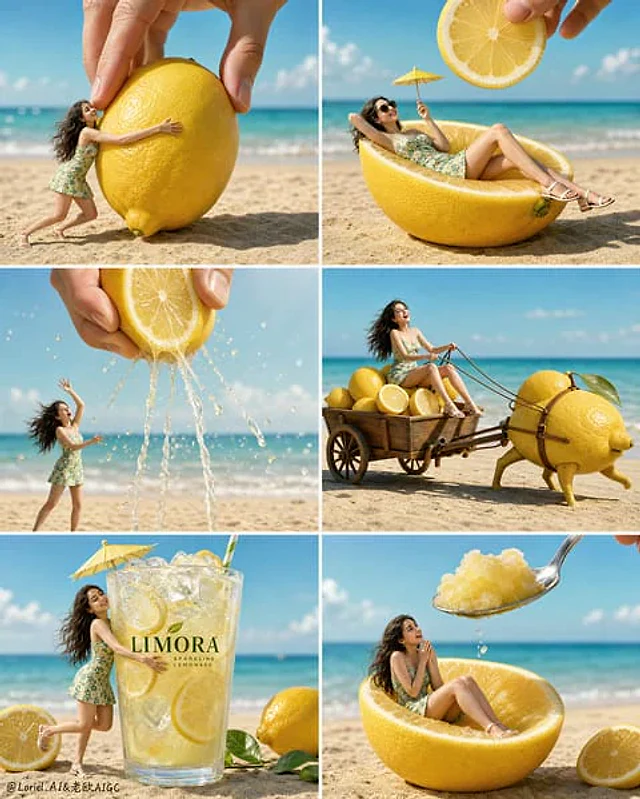
Create a Cannes-level premium summer beverage campaign poster for a fictional lemon drink brand called "LIMORA", using a strict 2-column by 3-row grid layout with six perfectly aligned panels. Preserve the exact structural logic of the composition: each panel shows the same tiny ultra-realistic young woman on a bright sandy beach interacting with oversized lemons, lemon slices, lemon juice, or the final branded drink, while selected panels include a giant realistic human hand entering from above. The full poster must feel like one unified high-end advertising storyboard in motion, where the eye flows continuously from fresh citrus fruit to crafted beverage desire. The lemon product world must remain the absolute visual hero across all six panels. Overall composition: Use a clean six-panel grid with thin white dividers, equal panel proportions, consistent horizon line, consistent beach-ocean background, and unified lighting. Every panel should feel self-contained yet rhythmically connected, as if six consecutive scenes from the same luxury summer commercial were frozen at their most iconic moments. Keep the miniature woman and the oversized lemon-related object centered in each frame, with the sea softly blurred in the background and the sand sharply rendered in the foreground. The full page must read instantly from a distance, with strong commercial clarity and polished editorial control. Orbit visual flow: Design the entire set around one strong circulation of motion from panel 1 to panel 6. The action should escalate visually: touch, recline, squeeze, travel, embrace, taste. Use repeating directional rhythms in hair movement, arm gestures, leg angles, juice droplets, spoon angle, lemon slice placement, straw tilt, and the position of the entering hand so the eye naturally sweeps across the poster in a flowing wave. Build subtle diagonal energy inside every panel, making the citrus world feel alive, breezy, sparkling, and in motion. The whole set should feel like summer energy orbiting around the brand’s lemon drink. Narrative panel sequence: Panel 1: the tiny woman hugs a giant whole lemon on the sand while a giant adult hand descends from above, delicately positioning the lemon. Her pose is lively and slightly off-balance, as if the scene has just begun. Panel 2: she reclines elegantly inside a halved lemon as though it were a luxury beach chaise, wearing dark sunglasses and holding a tiny parasol drink pick, while a floating lemon slice is lowered from above like a radiant citrus sun. Panel 3: a giant hand squeezes a vertically cut lemon from above, sending translucent juice streams and droplets downward in a sparkling arc. The woman reacts dynamically beneath it, arms raised, body tilted, caught in the middle of the citrus action. Panel 4: she rides in a small refined wooden cart piled with lemons, being pulled by a whimsical premium lemon-shaped creature or rolling lemon harness. The cart must feel physically grounded, artisanal, and stylish rather than cartoonish. Panel 5: the hero climax panel. A tall branded LIMORA lemonade glass dominates the frame, packed with ice cubes, lemon slices, pale sparkling liquid, condensation, a fresh green straw, and a refined cocktail umbrella. The tiny woman hugs the cold glass joyfully, and this panel must be the strongest product-selling moment in the entire composition. Panel 6: she sits inside a halved lemon while a large polished spoon descends from above carrying glossy lemon sorbet or crushed lemon ice, creating a final delicious serving beat with playful anticipation. Hero product focus: The real hero is the lemon beverage system: whole citrus fruit, sliced fruit, squeezed juice, ice, sparkling drink, sorbet, and premium serving details. Every lemon must feel hyper-real, fragrant, sunlit, juicy, and tactile, with detailed skin pores, subtle waxy oil sheen, translucent membranes, wet cut surfaces, and bright natural citrus pulp. The branded glass in panel 5 must be the most visually dominant product object in the set, with crystal-clear glass, refined original English branding reading "LIMORA", elegant condensation, premium ice refraction, and luminous pale-yellow drink clarity. Character design: Depict one recurring ultra-realistic miniature young woman across all six panels, wearing the same fitted green floral mini dress and white sandals, with long dark wavy hair and naturally expressive features. She must look like a real scaled-down human placed into a surreal oversized citrus world. Keep anatomy coherent and believable in every frame: correct head-to-body proportion, realistic shoulders, collarbones, arms, waist, hips, thighs, knees, calves, ankles, and feet, with perfectly formed hands and five fingers clearly visible. Her expressions should shift panel by panel: surprised delight, relaxed confidence, playful alarm, exhilaration, joyful refreshment, amused anticipation. Skin must remain photorealistic with pores, natural tonal shifts, faint knee and elbow texture, realistic skin elasticity, and no plastic AI beauty finish. Lighting: Use bright premium seaside daylight with a soft upper-left sun direction and gentle atmospheric diffusion. Maintain luminous fresh summer lighting across all six scenes, with short, soft-edged shadows and crisp dimensional highlights. Juice droplets, lemon pulp, ice cubes, spoon edges, sunglasses, glass rim, and condensation should all catch clean sparkling highlights. Lighting must feel luxurious, refreshing, and physically consistent from panel to panel. Materials: Lemons: ultra-detailed peel pores, subtle dimpling, natural rind thickness, glistening wet pulp, believable cut translucency, realistic juice behavior. Drink glass: high-clarity premium glass, accurate refraction, heavy base, condensation beads, crisp logo print, ice transparency, sparkling carbonated liquid feel. Sorbet and juice: glossy, semi-translucent, cold, wet, appetizing, physically accurate. Dress: lightweight summer cotton with tiny green floral print, natural wrinkles, fabric tension, and wind-responsive edges. Hair and skin: realistic strands, fine flyaways, natural shine, believable skin texture. Large hand: realistic adult fingers, soft skin compression, natural nails, coherent scale perspective. Cart and props: refined warm wood grain, polished wheels, believable joints and harness elements. Beach environment: fine sunlit sand with miniature footprints and pressure marks, soft shoreline blur, clean turquoise sea with pale foam. Color system: Build the palette around lemon yellow, fresh citrus green, turquoise sea, pale sky blue, warm beach beige, crisp white highlights, and restrained natural skin tones. Yellow must remain the dominant hero color, supported by green and turquoise. Keep the image bright, appetizing, summery, clean, and internationally commercial. Avoid random accent colors. Typography and branding: Do not copy any text from the sample. Keep typography minimal and original. Place refined English branding only on the hero glass and optionally a tiny campaign line below the full grid, such as: "LIMORA — Bright in Motion". Typography must feel premium, modern, minimal, and secondary to the visual storytelling. Art direction: Hyper-real premium surreal advertising photography, luxury FMCG campaign, storyboard energy, elegant humor, cinematic micro-world illusion, high-end beverage styling, global summer launch poster, polished magazine-grade finish, sharp product realism, strong narrative rhythm, premium brand coherence. Negative prompt: copied text, Chinese text, existing brand names, cartoon style, toy-like figure, grotesque oversized head, deformed anatomy, extra fingers, missing fingers, fused fingers, twisted wrists, broken limbs, distorted feet, AI plastic skin, over-smoothed skin, fake citrus texture, unrealistic juice physics, muddy lemon pulp, cloudy glass, weak product focus, inconsistent lighting, inconsistent horizon, messy grid, cluttered props, meme aesthetic, cheap humor, childish illustration, low-resolution detail, oversaturated colors, dead black patches, distorted giant hand perspective
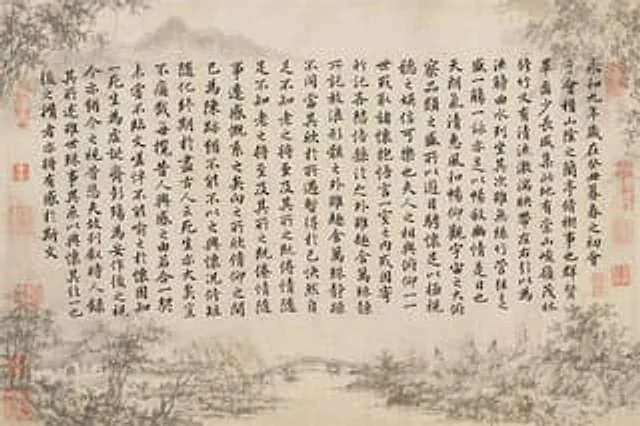
[中文] 结合王羲之的《兰亭集序》里的内容,生成一副书法帖图片,要求图片背景符合《兰亭集序》的意境,背景图可以使用蒙版,前景是《兰亭集序》 [English] Combining the content from Wang Xizhi's "Lantingji Xu", generate a calligraphy copy image, requiring the image background to match the artistic conception of "Lantingji Xu", the background image can use a mask, the foreground is "Lantingji Xu"
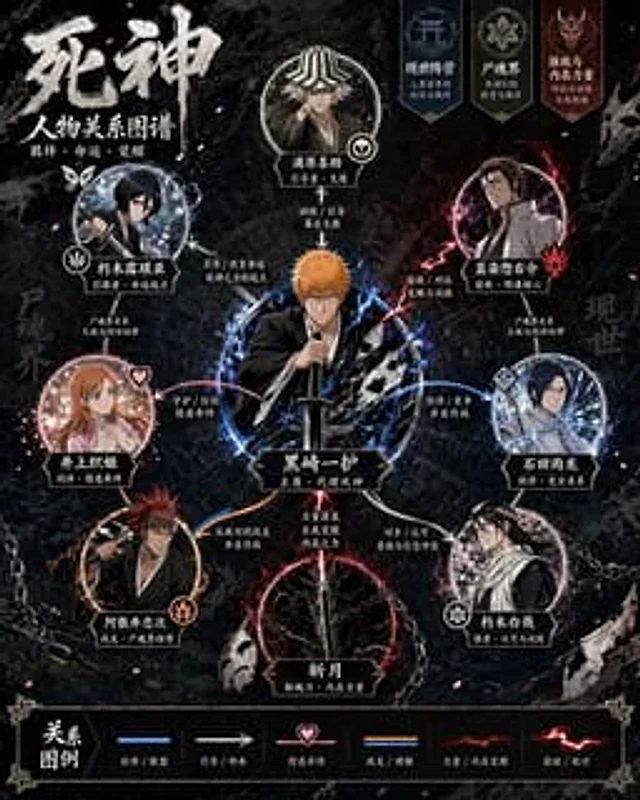
Please generate a high-design character relationship map poster based on {argument name="theme" default="Demon Slayer"}. This image should not be a simple illustration, but a character relationship map that combines information visualization, narrative structure, poster design sense, and stylistic fidelity. Please automatically complete the following: - Identify the work and core settings corresponding to the theme - Extract the most representative 6–12 key characters, not exceeding 15 if necessary - Identify and display key character relationships, including blood ties, romance, friendship, alliances, hostility, master-disciple, etc. - Automatically choose a composition method based on the work's characteristics, such as protagonist-centered, dual-core confrontation, faction-based, family tree, or chronological evolution - Automatically refine the work's style DNA, including color, worldview symbols, textures, mood, typography, and representative elements - Transform these stylistic elements into an overall visual design for the relationship map, rather than simply copying an official poster - Use different colors, line types, and arrows to distinguish different relationships, ensuring clear lines and layers without clutter - Make core characters most prominent, followed by important characters, and subordinate characters weakened to form a clear visual hierarchy - Ensure every character name is legible, with identity or faction labels if necessary The final product should satisfy: - Immediate understanding of character hierarchy and key relationships - Obvious alignment with the original work's temperament and setting - Combines the clarity of an infographic with the premium design of a poster - Unified, exquisite, complete, and suitable for social media sharing or poster display - Avoids a cheap flowchart feel, messy piling, and information overload.
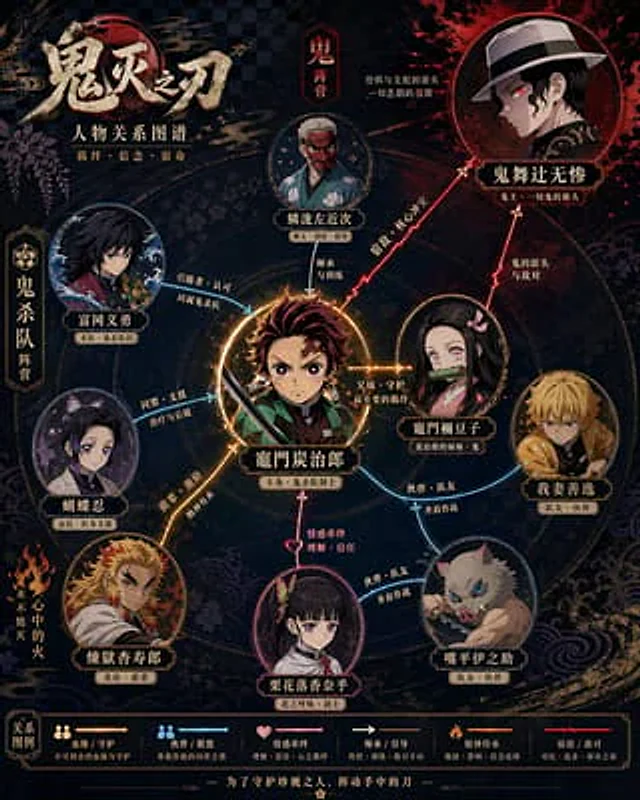
Please generate a high-design character relationship map poster based on {argument name="theme" default="Demon Slayer"}. This image should not be a simple illustration, but a character relationship map that combines information visualization, narrative structure, poster design sense, and stylistic fidelity. Please automatically complete the following: - Identify the work and core settings corresponding to the theme - Extract the most representative 6–12 key characters, not exceeding 15 if necessary - Identify and display key character relationships, including blood ties, romance, friendship, alliances, hostility, master-disciple, etc. - Automatically choose a composition method based on the work's characteristics, such as protagonist-centered, dual-core confrontation, faction-based, family tree, or chronological evolution - Automatically refine the work's style DNA, including color, worldview symbols, textures, mood, typography, and representative elements - Transform these stylistic elements into an overall visual design for the relationship map, rather than simply copying an official poster - Use different colors, line types, and arrows to distinguish different relationships, ensuring clear lines and layers without clutter - Make core characters most prominent, followed by important characters, and subordinate characters weakened to form a clear visual hierarchy - Ensure every character name is legible, with identity or faction labels if necessary The final product should satisfy: - Immediate understanding of character hierarchy and key relationships - Obvious alignment with the original work's temperament and setting - Combines the clarity of an infographic with the premium design of a poster - Unified, exquisite, complete, and suitable for social media sharing or poster display - Avoids a cheap flowchart feel, messy piling, and information overload.

Please generate a high-design character relationship map poster based on {argument name="theme" default="Demon Slayer"}. This image should not be a simple illustration, but a character relationship map that combines information visualization, narrative structure, poster design sense, and stylistic fidelity. Please automatically complete the following: - Identify the work and core settings corresponding to the theme - Extract the most representative 6–12 key characters, not exceeding 15 if necessary - Identify and display key character relationships, including blood ties, romance, friendship, alliances, hostility, master-disciple, etc. - Automatically choose a composition method based on the work's characteristics, such as protagonist-centered, dual-core confrontation, faction-based, family tree, or chronological evolution - Automatically refine the work's style DNA, including color, worldview symbols, textures, mood, typography, and representative elements - Transform these stylistic elements into an overall visual design for the relationship map, rather than simply copying an official poster - Use different colors, line types, and arrows to distinguish different relationships, ensuring clear lines and layers without clutter - Make core characters most prominent, followed by important characters, and subordinate characters weakened to form a clear visual hierarchy - Ensure every character name is legible, with identity or faction labels if necessary The final product should satisfy: - Immediate understanding of character hierarchy and key relationships - Obvious alignment with the original work's temperament and setting - Combines the clarity of an infographic with the premium design of a poster - Unified, exquisite, complete, and suitable for social media sharing or poster display - Avoids a cheap flowchart feel, messy piling, and information overload.
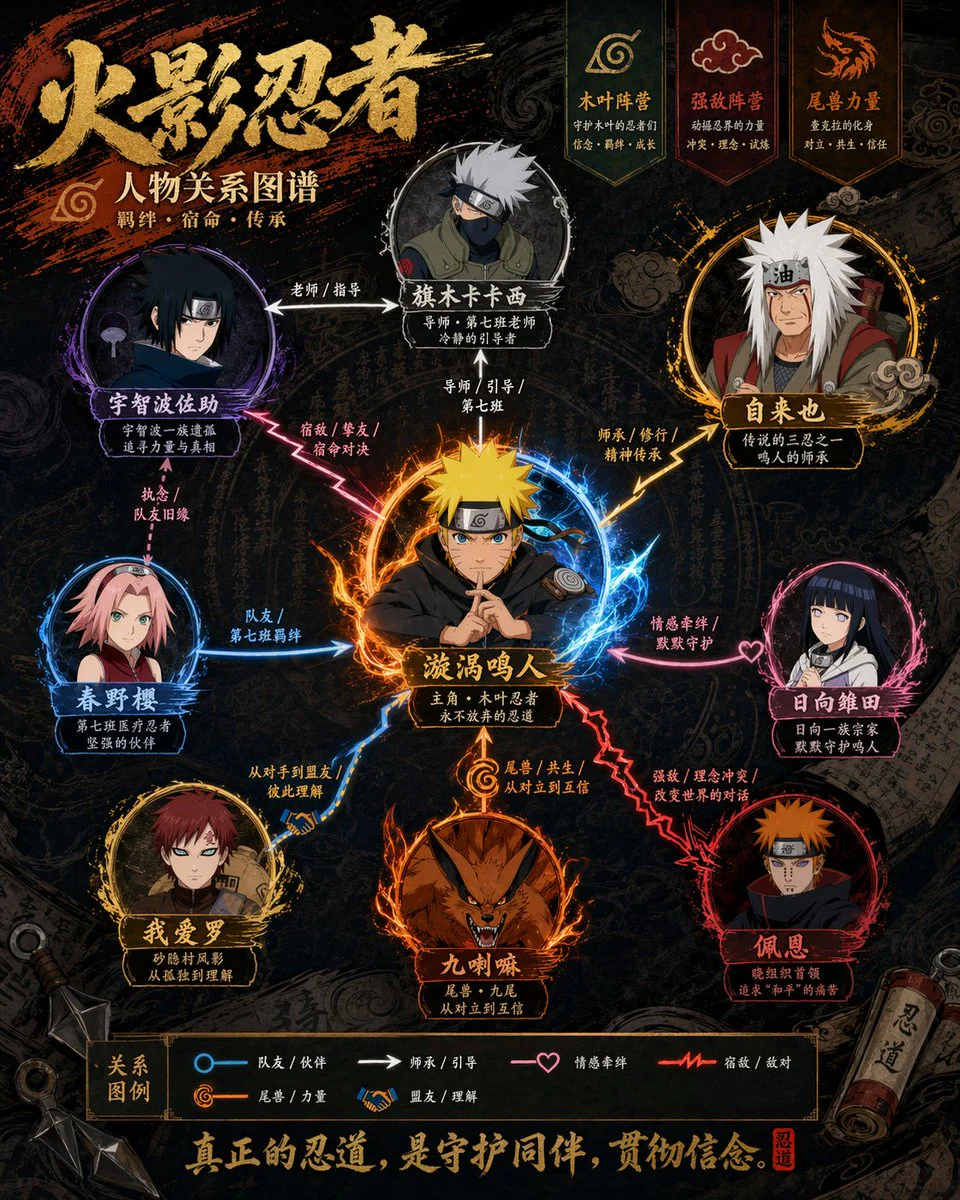
Please generate a high-design character relationship map poster based on {argument name="theme" default="Demon Slayer"}. This image should not be a simple illustration, but a character relationship map that combines information visualization, narrative structure, poster design sense, and stylistic fidelity. Please automatically complete the following: - Identify the work and core settings corresponding to the theme - Extract the most representative 6–12 key characters, not exceeding 15 if necessary - Identify and display key character relationships, including blood ties, romance, friendship, alliances, hostility, master-disciple, etc. - Automatically choose a composition method based on the work's characteristics, such as protagonist-centered, dual-core confrontation, faction-based, family tree, or chronological evolution - Automatically refine the work's style DNA, including color, worldview symbols, textures, mood, typography, and representative elements - Transform these stylistic elements into an overall visual design for the relationship map, rather than simply copying an official poster - Use different colors, line types, and arrows to distinguish different relationships, ensuring clear lines and layers without clutter - Make core characters most prominent, followed by important characters, and subordinate characters weakened to form a clear visual hierarchy - Ensure every character name is legible, with identity or faction labels if necessary The final product should satisfy: - Immediate understanding of character hierarchy and key relationships - Obvious alignment with the original work's temperament and setting - Combines the clarity of an infographic with the premium design of a poster - Unified, exquisite, complete, and suitable for social media sharing or poster display - Avoids a cheap flowchart feel, messy piling, and information overload.
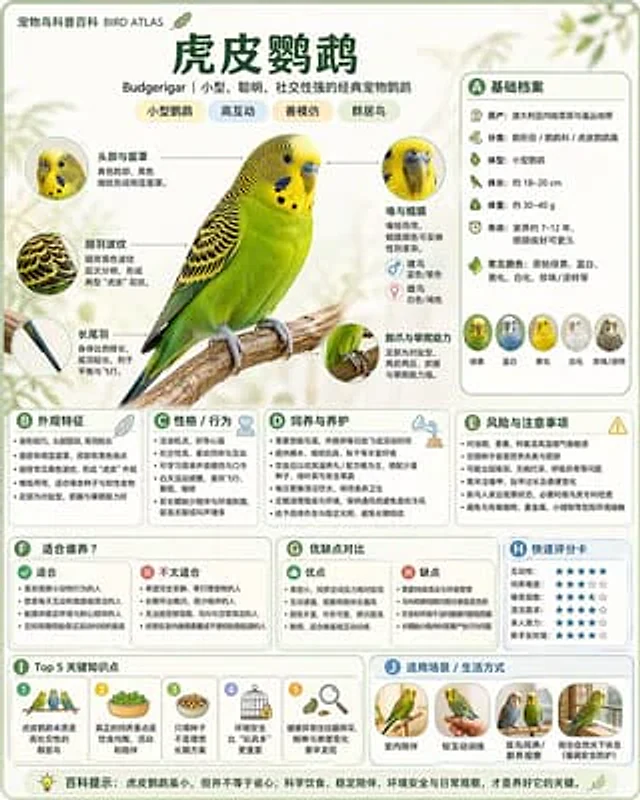
Please generate a high-quality vertical "Popular Science Encyclopedia Image" based on {argument name="theme" default="animals"}. This image is not a regular poster or a simple illustration, but a modular popular science infographic that possesses a sense of "illustration book, encyclopedia, information structure, and collectability." The overall style should reference a combination of high-end natural history illustrations, modern encyclopedia pages, lifestyle knowledge cards, and highly shareable social media infographics. Please include in the frame: - A clear and beautiful main visual of the subject - Several magnified details of local characteristics - Multiple rounded modular information sections - Clear title hierarchies and key labels - Concise yet rich encyclopedic content - Visual ratings, key point summaries, or Top 5 modules Content columns should be automatically adapted based on the theme, prioritized from these directions: basic profile, classification information, appearance characteristics, habits/ecology, formation mechanism/structure, growth or use conditions, care or maintenance suggestions, risks and precautions, suitable audience or scenarios, pros and cons comparison, and quick rating cards. Visual requirements: Light-colored clean background, soft color palette, light shadows, exquisite small icons, rounded information boxes, neat layout, high information density but not crowded, good reading experience. The overall result must look like a real science encyclopedia card suitable for publishing, reading, collecting, and serialized production, rather than an advertisement. Please do not make it a regular commercial promotional poster. Highlight the features of "knowledge organization + modular information + illustration-style display."
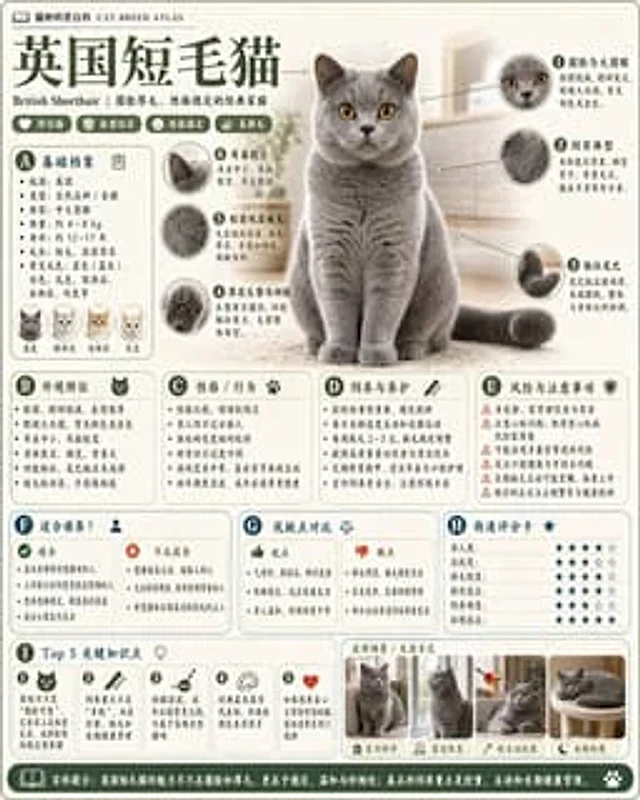
Please generate a high-quality vertical "Popular Science Encyclopedia Image" based on {argument name="theme" default="animals"}. This image is not a regular poster or a simple illustration, but a modular popular science infographic that possesses a sense of "illustration book, encyclopedia, information structure, and collectability." The overall style should reference a combination of high-end natural history illustrations, modern encyclopedia pages, lifestyle knowledge cards, and highly shareable social media infographics. Please include in the frame: - A clear and beautiful main visual of the subject - Several magnified details of local characteristics - Multiple rounded modular information sections - Clear title hierarchies and key labels - Concise yet rich encyclopedic content - Visual ratings, key point summaries, or Top 5 modules Content columns should be automatically adapted based on the theme, prioritized from these directions: basic profile, classification information, appearance characteristics, habits/ecology, formation mechanism/structure, growth or use conditions, care or maintenance suggestions, risks and precautions, suitable audience or scenarios, pros and cons comparison, and quick rating cards. Visual requirements: Light-colored clean background, soft color palette, light shadows, exquisite small icons, rounded information boxes, neat layout, high information density but not crowded, good reading experience. The overall result must look like a real science encyclopedia card suitable for publishing, reading, collecting, and serialized production, rather than an advertisement. Please do not make it a regular commercial promotional poster. Highlight the features of "knowledge organization + modular information + illustration-style display."
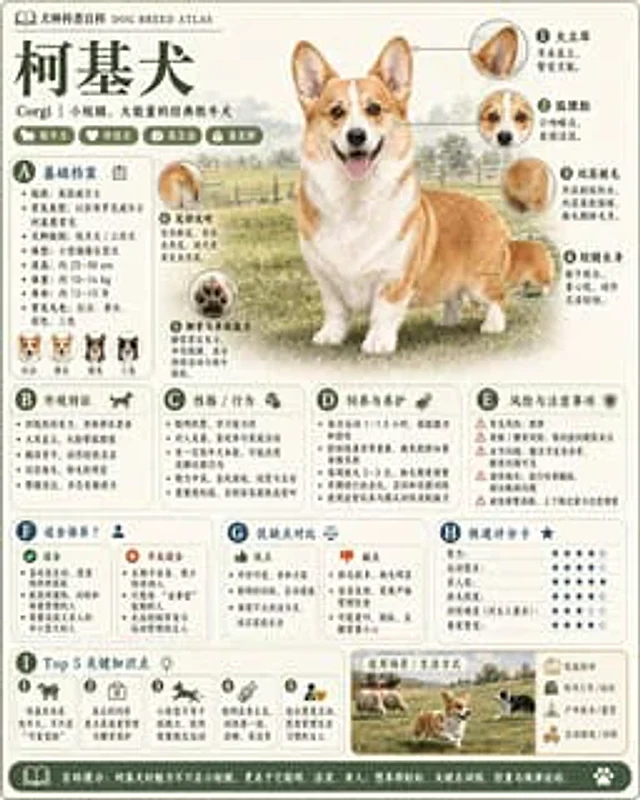
Please generate a high-quality vertical "Popular Science Encyclopedia Image" based on {argument name="theme" default="animals"}. This image is not a regular poster or a simple illustration, but a modular popular science infographic that possesses a sense of "illustration book, encyclopedia, information structure, and collectability." The overall style should reference a combination of high-end natural history illustrations, modern encyclopedia pages, lifestyle knowledge cards, and highly shareable social media infographics. Please include in the frame: - A clear and beautiful main visual of the subject - Several magnified details of local characteristics - Multiple rounded modular information sections - Clear title hierarchies and key labels - Concise yet rich encyclopedic content - Visual ratings, key point summaries, or Top 5 modules Content columns should be automatically adapted based on the theme, prioritized from these directions: basic profile, classification information, appearance characteristics, habits/ecology, formation mechanism/structure, growth or use conditions, care or maintenance suggestions, risks and precautions, suitable audience or scenarios, pros and cons comparison, and quick rating cards. Visual requirements: Light-colored clean background, soft color palette, light shadows, exquisite small icons, rounded information boxes, neat layout, high information density but not crowded, good reading experience. The overall result must look like a real science encyclopedia card suitable for publishing, reading, collecting, and serialized production, rather than an advertisement. Please do not make it a regular commercial promotional poster. Highlight the features of "knowledge organization + modular information + illustration-style display."
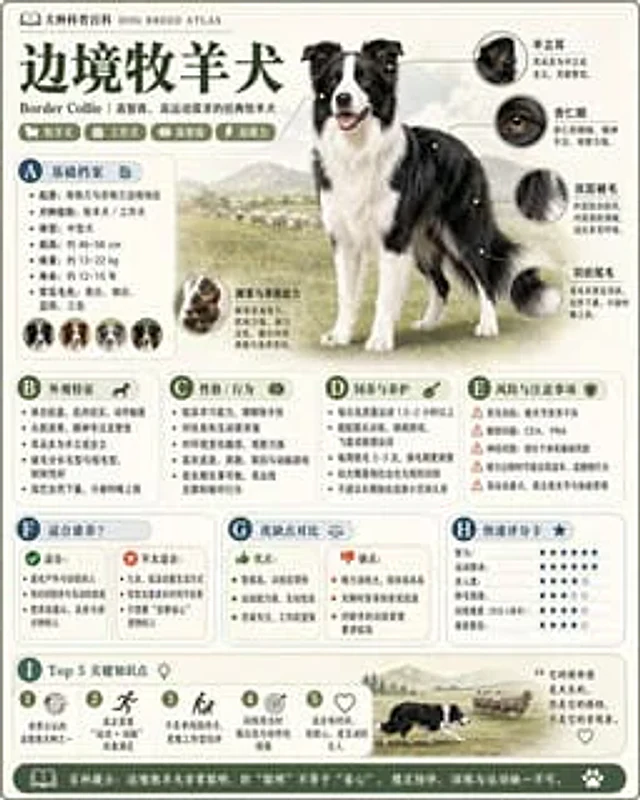
Please generate a high-quality vertical "Popular Science Encyclopedia Image" based on {argument name="theme" default="animals"}. This image is not a regular poster or a simple illustration, but a modular popular science infographic that possesses a sense of "illustration book, encyclopedia, information structure, and collectability." The overall style should reference a combination of high-end natural history illustrations, modern encyclopedia pages, lifestyle knowledge cards, and highly shareable social media infographics. Please include in the frame: - A clear and beautiful main visual of the subject - Several magnified details of local characteristics - Multiple rounded modular information sections - Clear title hierarchies and key labels - Concise yet rich encyclopedic content - Visual ratings, key point summaries, or Top 5 modules Content columns should be automatically adapted based on the theme, prioritized from these directions: basic profile, classification information, appearance characteristics, habits/ecology, formation mechanism/structure, growth or use conditions, care or maintenance suggestions, risks and precautions, suitable audience or scenarios, pros and cons comparison, and quick rating cards. Visual requirements: Light-colored clean background, soft color palette, light shadows, exquisite small icons, rounded information boxes, neat layout, high information density but not crowded, good reading experience. The overall result must look like a real science encyclopedia card suitable for publishing, reading, collecting, and serialized production, rather than an advertisement. Please do not make it a regular commercial promotional poster. Highlight the features of "knowledge organization + modular information + illustration-style display."
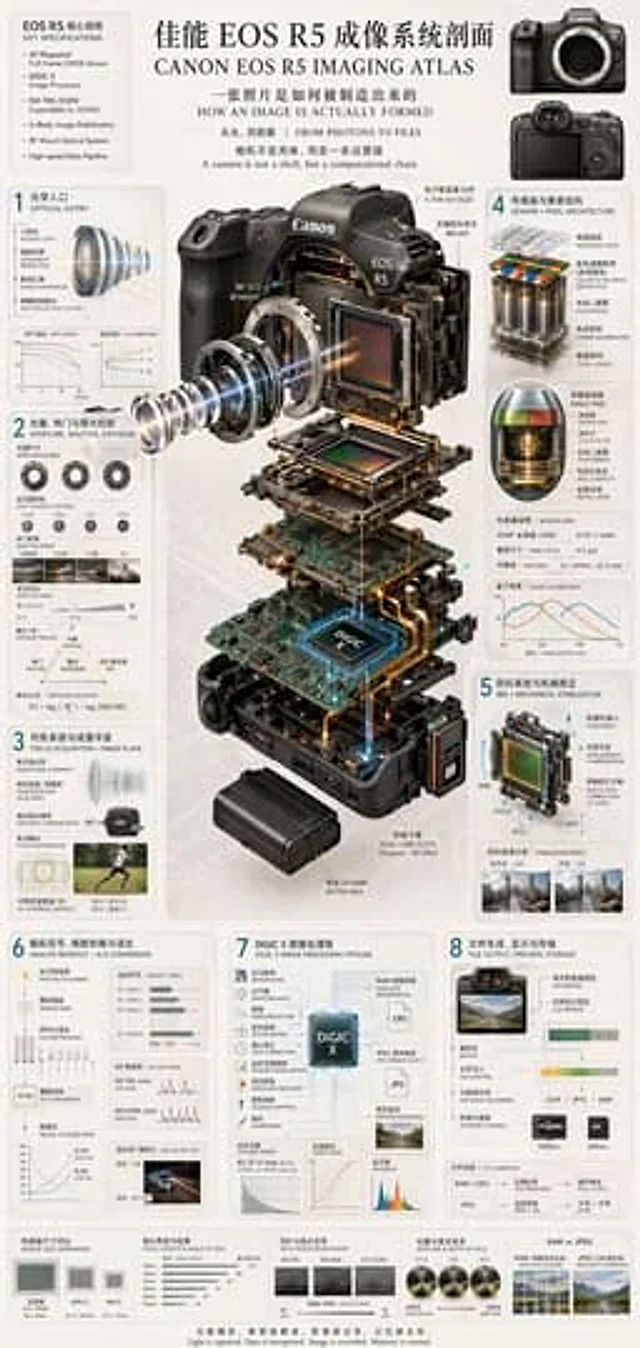
{ "type": "technical infographic and exploded view diagram", "header": { "title": "{argument name=\"main title\" default=\"佳能 EOS R5 成像系统剖面 CANON EOS R5 IMAGING ATLAS\"}", "subtitles": [ "一张照片是如何被制造出来的 HOW AN IMAGE IS ACTUALLY FORMED", "从光,到数据 | FROM PHOTONS TO FILES", "相机不是壳体,而是一条运算链 A camera is not a shell, but a computational chain" ], "top_left_box": { "title": "EOS R5 核心规格 KEY SPECIFICATIONS", "bullet_points_count": 6 }, "top_right_images": { "count": 2, "description": "front and back views of the camera body" } }, "centerpiece": { "description": "highly detailed 3D exploded view of the {argument name=\"camera model\" default=\"Canon EOS R5\"} camera, showing internal components separated vertically", "components_visible": [ "lens mount", "lens elements with glowing blue light rays", "image sensor", "motherboard with glowing {argument name=\"processor name\" default=\"DIGIC X\"} chip", "battery pack", "dual card slots", "electronic viewfinder (EVF)" ] }, "layout": { "numbered_sections": [ { "number": 1, "title": "光学入口 OPTICAL ENTRY", "elements": ["lens cross-section with light rays", "2 line graphs"] }, { "number": 2, "title": "光圈、快门与曝光控制 APERTURE, SHUTTER, EXPOSURE", "elements": ["3 aperture blade diagrams", "4 shutter speed example photos", "depth of field diagram", "exposure triangle diagram"] }, { "number": 3, "title": "对焦系统与成像平面 FOCUS ACQUISITION + IMAGE PLANE", "elements": ["lens alignment diagram", "AF coverage photo of a runner"] }, { "number": 4, "title": "传感器与像素结构 SENSOR + PIXEL ARCHITECTURE", "elements": ["3D pixel array diagram", "single pixel cross-section diagram", "sensor spec table", "quantum efficiency graph"] }, { "number": 5, "title": "防抖系统与机械稳定 IBIS + MECHANICAL STABILIZATION", "elements": ["sensor shift mechanism diagram with yaw/pitch/roll axes", "2 stabilization effect comparison photos"] }, { "number": 6, "title": "模拟信号、模数转换与读出 ANALOG READOUT + A/D CONVERSION", "elements": ["signal flowchart", "3 readout timing graphs", "signal-to-noise ratio graph", "rolling shutter example photo of a car"] }, { "number": 7, "title": "DIGIC X 图像处理链 DIGIC X IMAGE PROCESSING PIPELINE", "elements": ["processing flowchart with central chip", "dynamic range graph", "tone curve graph", "histogram"] }, { "number": 8, "title": "文件生成、显示与存储 FILE OUTPUT, PREVIEW, STORAGE", "elements": ["file output flowchart", "2 storage card icons", "file workflow diagram"] } ], "bottom_comparisons": { "count": 5, "labels": [ "传感器尺寸对比 SENSOR SIZE COMPARISON", "镜头焦距与视角 FOCAL LENGTH & ANGLE OF VIEW", "ISO 与噪点关系 ISO & NOISE RELATIONSHIP", "光圈与景深关系 APERTURE & DEPTH OF FIELD", "RAW vs JPEG" ] }, "footer": "{argument name=\"footer quote\" default=\"光被捕获,数据被解读,影像被记录,记忆被永恒。 Light is captured. Data is interpreted. Image is recorded. Memory is eternal.\"}" }, "style": "clean, technical, highly detailed, photorealistic components, blueprint-style annotations, light gray background, precise typography" }
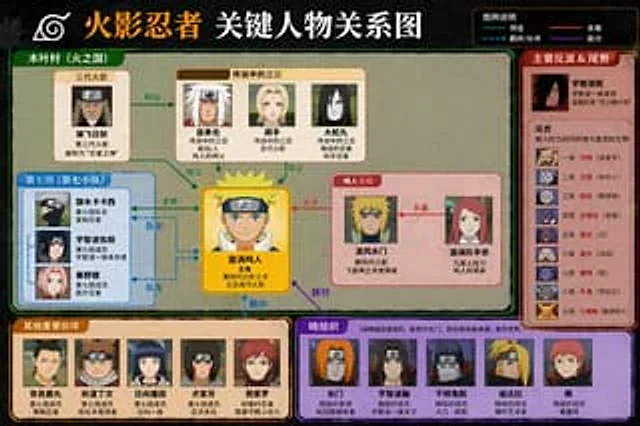
[中文] 请你生成 《XXX》 的关键人物关系图。 [English] Please generate a key character relationship diagram for "XXX".

A photorealistic, high-resolution commercial photograph of a {argument name="car model and color" default="bright blue Alpine A110 R sports car"} parked in the foreground inside a massive aircraft hangar. The car features a black carbon fiber hood, black roof, black alloy wheels, and a front license plate reading "{argument name="license plate text" default="A110 R"}". Directly behind the car, dominating the background, is a {argument name="airplane model" default="white Airbus A320 commercial airliner"} with a blue tail. The hangar has a highly polished, reflective concrete floor that mirrors the car and plane. To the left, a sign on the metal wall reads "{argument name="hangar sign text" default="HANGAR 05 MAINTENANCE"}". The hangar doors are wide open, revealing a bright, overcast sky and a distant cityscape. The lighting is soft and cinematic, highlighting the sleek aerodynamic curves of both vehicles.
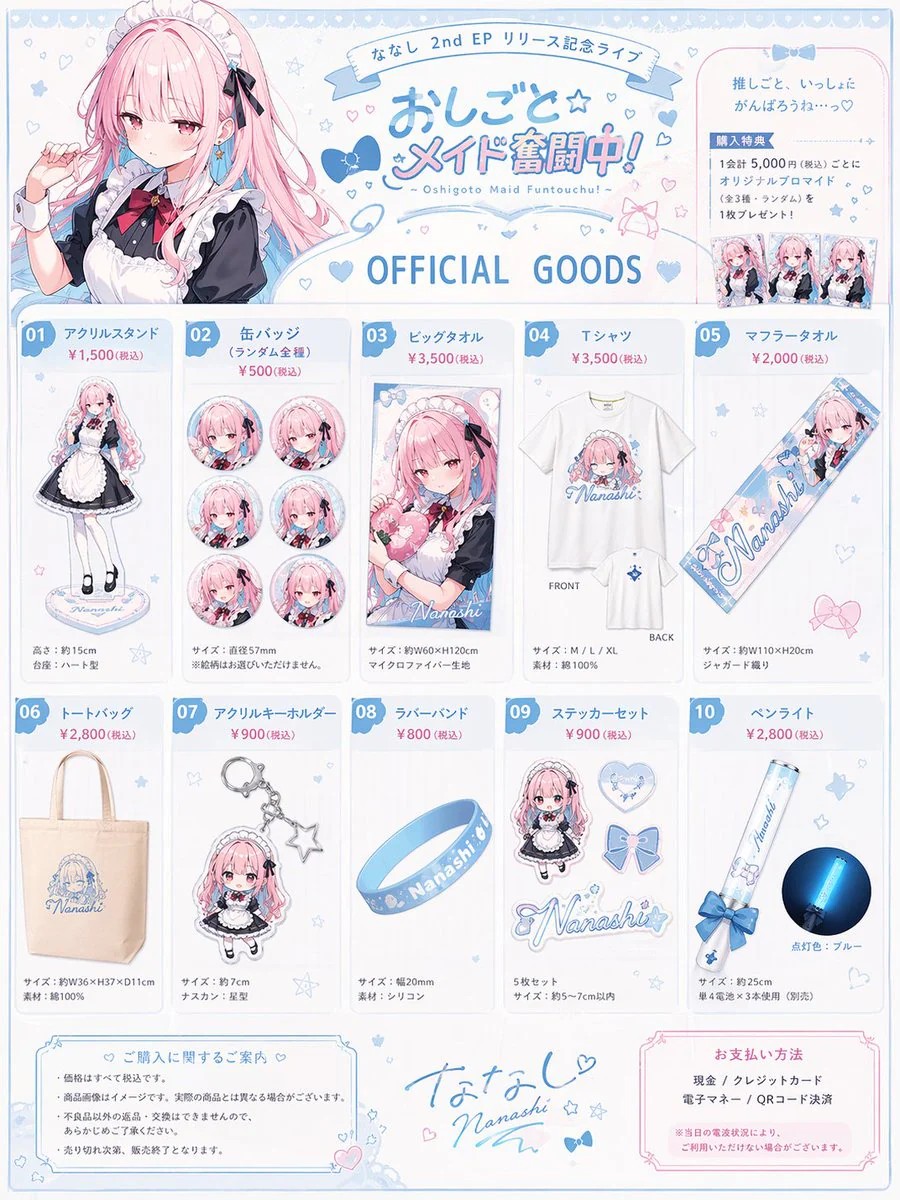
{ "type": "anime idol merchandise catalog flyer", "theme_colors": "{argument name=\"theme color\" default=\"pastel blue and pink\"}", "character": { "name": "{argument name=\"character name\" default=\"ななし\"}", "appearance": "anime girl, long {argument name=\"hair color\" default=\"pink\"} hair, blue eyes", "attire": "{argument name=\"outfit\" default=\"black and white maid outfit with a red bow tie\"} and blue hair ribbons" }, "layout": { "header": { "left": "upper body portrait of the character looking slightly to the side", "center": { "top_banner": "ななし 2nd EP リリース記念ライブ", "main_title": "{argument name=\"event title\" default=\"おしごと☆メイド奮闘中!\"}", "subtitle": "~ Oshigoto Maid Funtouchu! ~", "section_header": "OFFICIAL GOODS" }, "right": "purchase bonus info box containing 3 small rectangular photo prints" }, "merchandise_grid": [ { "id": "01", "name": "アクリルスタンド", "description": "full body acrylic stand of the character" }, { "id": "02", "name": "缶バッジ", "description": "set of 6 circular can badges featuring different facial expressions" }, { "id": "03", "name": "ビッグタオル", "description": "large rectangular towel showing the character holding a heart pillow" }, { "id": "04", "name": "Tシャツ", "description": "white t-shirt showing FRONT with character graphic and BACK with small logo" }, { "id": "05", "name": "マフラータオル", "description": "long narrow muffler towel with character art and logo" }, { "id": "06", "name": "トートバッグ", "description": "canvas tote bag with blue logo" }, { "id": "07", "name": "アクリルキーホルダー", "description": "chibi character acrylic keychain with a star-shaped clasp" }, { "id": "08", "name": "ラバーバンド", "description": "blue silicone wristband with logo" }, { "id": "09", "name": "ステッカーセット", "description": "set of 4 visible stickers: chibi character, heart, ribbon bow, and logo" }, { "id": "10", "name": "ペンライト", "description": "blue glowing concert penlight" } ], "footer": { "left": "purchase notes and guidelines box", "center": "character signature 'Nanashi' with hand-drawn hearts and stars", "right": "payment methods box" } } }

A candid, realistic photograph of a young {argument name="subject aesthetic" default="goth"} woman with pale skin, long straight black hair with bangs, heavy black eyeliner, and black lipstick. She has a {argument name="expression" default="deadpan"} expression, looking directly at the camera while sitting on a children's coin-operated {argument name="ride type" default="unicorn"} ride. She is wearing a black lace-trimmed tank top, black arm warmers, layered necklaces including a choker, black lace tights, and chunky black platform boots with buckles. A large black shoulder bag hangs from her arm. The ride is a white unicorn with a pink mane, gold horn, and purple hooves, mounted on a purple base with a small sticker reading "{argument name="ride cost" default="50¢ PER RIDE"}". The setting is outside a store with a tan cinderblock wall. To the left is a glass door reflecting a person, a brown trash can, and a white sign with red text reading "{argument name="sign text" default="NO PARKING FIRE LANE"}". To the right is a blue vending machine. Overcast, natural daylight.
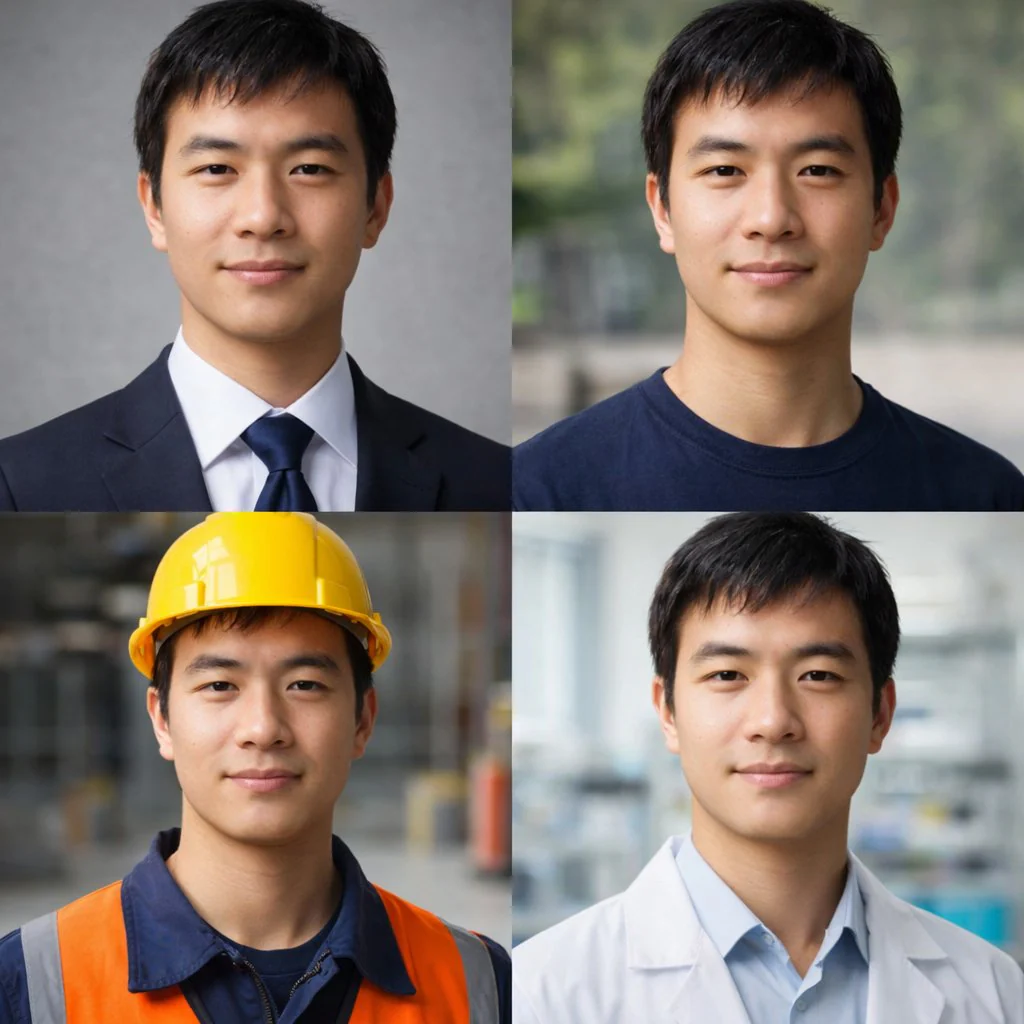
{ "type": "2x2 portrait grid", "subject": "{argument name=\"subject description\" default=\"young adult East Asian male with short black hair and a slight smile\"}", "style": "photorealistic, high-resolution, professional lighting, consistent facial identity across all panels", "layout": { "format": "2x2 grid", "panel_count": 4, "panels": [ { "position": "top-left", "description": "{argument name=\"profession 1\" default=\"Corporate professional wearing a dark navy suit, white shirt, and blue tie against a gray textured background\"}" }, { "position": "top-right", "description": "{argument name=\"profession 2\" default=\"Casual attire wearing a dark blue crew neck t-shirt against a blurred outdoor park background\"}" }, { "position": "bottom-left", "description": "{argument name=\"profession 3\" default=\"Construction worker wearing a yellow hard hat, navy blue work shirt, and bright orange high-visibility vest against a blurred warehouse background\"}" }, { "position": "bottom-right", "description": "{argument name=\"profession 4\" default=\"Medical professional wearing a white lab coat over a light blue collared shirt against a blurred laboratory background\"}" } ] } }
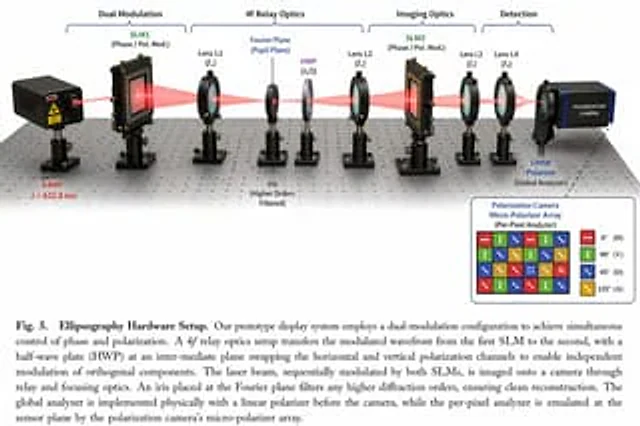
{ "type": "scientific hardware diagram", "layout": { "main_scene": "3D render of an optical table with a red laser beam passing through 11 aligned optical components mounted on black posts.", "top_brackets": [ {"label": "Dual Modulation", "span": "SLM1"}, {"label": "4f Relay Optics", "span": "Lens L1 to Lens L2"}, {"label": "Imaging Optics", "span": "SLM2 to Lens L4"}, {"label": "Detection", "span": "Camera"} ], "optical_components_left_to_right": [ {"name": "Laser", "labels": ["Laser", "λ = {argument name=\"laser wavelength\" default=\"632.8 nm\"}"]}, {"name": "SLM1", "labels": ["SLM1", "(Phase / Pol. Mod.)"]}, {"name": "Lens L1", "labels": ["Lens L1", "(f1)"]}, {"name": "Iris", "labels": ["Fourier Plane", "(Pupil Plane)", "Iris", "(Higher Orders Filtered)"]}, {"name": "HWP", "labels": ["HWP", "(λ/2)"]}, {"name": "Lens L2", "labels": ["Lens L2", "(f1)"]}, {"name": "SLM2", "labels": ["SLM2", "(Phase / Pol. Mod.)"]}, {"name": "Lens L3", "labels": ["Lens L3", "(f2)"]}, {"name": "Lens L4", "labels": ["Lens L4", "(f2)"]}, {"name": "Linear Polarizer", "labels": ["Linear", "-Polarizer", "(Global Analyzer)"]}, {"name": "Polarization Camera", "labels": ["POLARIZATION CAMERA"]} ], "inset_box": { "position": "bottom right", "title": "Polarization Camera Micro-Polarizer Array (Per-Pixel Analyzer)", "grid": "4x4 grid of colored squares with directional arrows", "legend_count": 4, "legend_items": [ "Red square, horizontal arrow, 0° (H)", "Green square, vertical arrow, 90° (V)", "Blue square, diagonal arrow, 45° (D)", "Yellow square, diagonal arrow, 135° (A)" ] }, "bottom_caption": { "figure_prefix": "{argument name=\"figure number\" default=\"Fig. 5.\"}", "title": "{argument name=\"system name\" default=\"Ellipsography Hardware Setup.\"}", "text": "Paragraph of scientific text explaining the dual-modulation configuration, 4f relay optics, and polarization camera." } } }
A realistic photograph of a whiteboard with a highly detailed {argument name="marker color" default="green"} dry-erase marker drawing of {argument name="subject" default="a samurai with a messy topknot and facial hair, hands clasped in prayer"}. The character is drawn in a {argument name="art style" default="detailed manga sketch"} style, shown in profile with eyes closed, wearing a traditional kimono with a katana tucked into his belt. To the left of the character, handwritten text in all-caps reads "{argument name="text line 1" default="VAGABOND"}" with "{argument name="text line 2" default="MUSASHI"}" written directly below it. The whiteboard has a glossy surface with realistic light reflections and glare on the left side, and a thin metallic frame is visible at the bottom edge, giving the impression of an authentic classroom or office environment.