

Ver en acción
Meeting Insights Analyzer: preview specific communication feedback
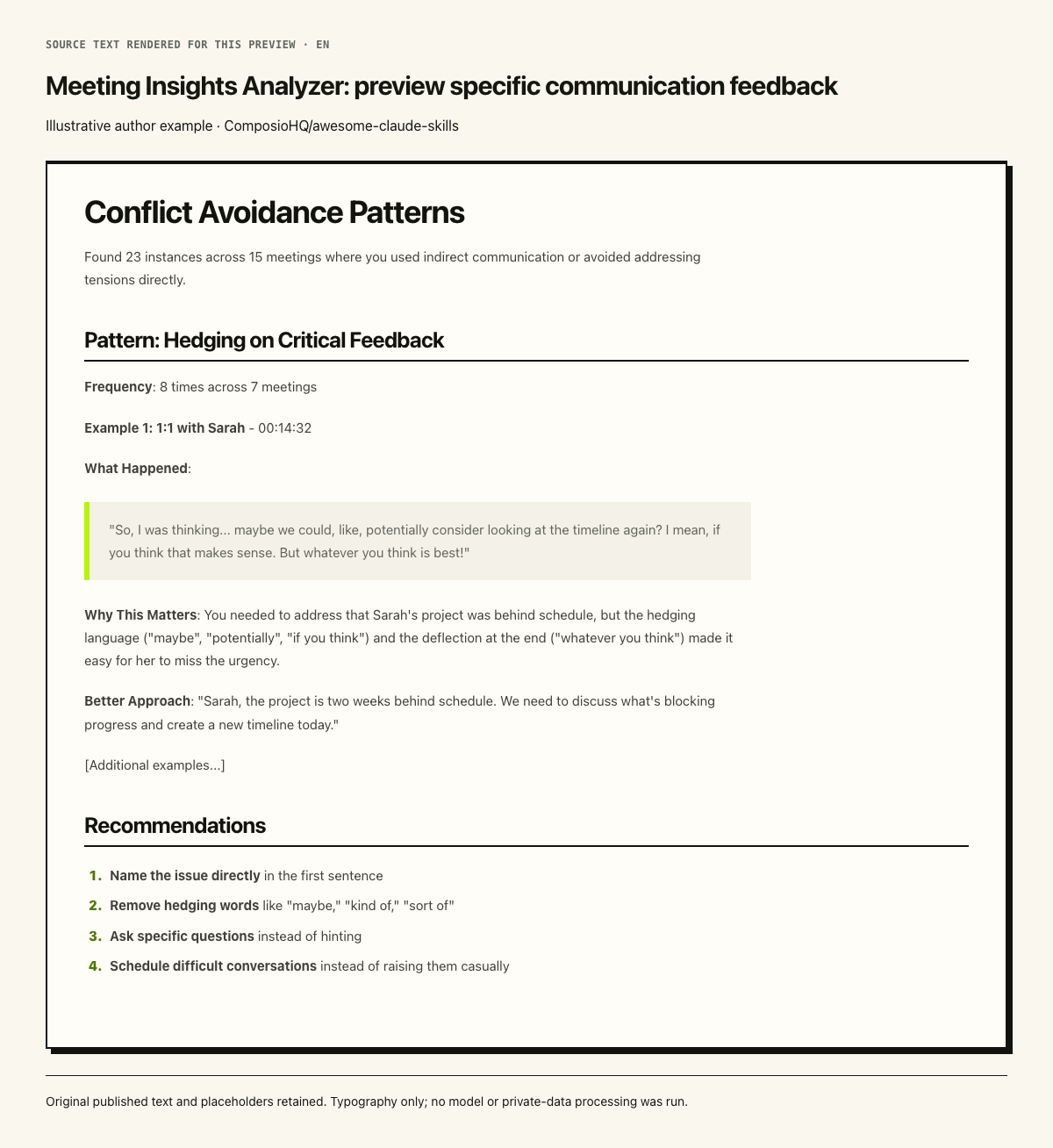
The source’s published excerpt identifies hedging language and suggests a more direct response. Names, timestamps and counts are illustrative author data; the original “[Additional examples...]” marker remains visible, so this is not a complete 23-instance report. No private recordings, transcripts or personal behavior were analyzed by this site. The preview image renders this same original text for reading; it is not an upstream screenshot or a newly generated result.
Entrada de ejemplo
I download all of my meeting recordings and put them in a folder. Tell me all the times I've subtly avoided conflict.Resultado de ejemplo
# Conflict Avoidance Patterns

Found 23 instances across 15 meetings where you used indirect
communication or avoided addressing tensions directly.

## Pattern: Hedging on Critical Feedback

**Frequency**: 8 times across 7 meetings

**Example 1: 1:1 with Sarah** - 00:14:32

**What Happened**:
> "So, I was thinking... maybe we could, like, potentially
> consider looking at the timeline again? I mean, if you
> think that makes sense. But whatever you think is best!"

**Why This Matters**:
You needed to address that Sarah's project was behind schedule,
but the hedging language ("maybe", "potentially", "if you think")
and the deflection at the end ("whatever you think") made it easy
for her to miss the urgency.

**Better Approach**:
"Sarah, the project is two weeks behind schedule. We need to
discuss what's blocking progress and create a new timeline
today."

[Additional examples...]

## Recommendations

1. **Name the issue directly** in the first sentence
2. **Remove hedging words** like "maybe," "kind of," "sort of"
3. **Ask specific questions** instead of hinting
4. **Schedule difficult conversations** instead of raising them casuallyLicencia
Complete selected source blocks retained verbatim; boundaries and omitted wider context are described in the summary. Original Skill documents remain unchanged below. Author-provided illustrative numbers, placeholders and labels are not site measurements. No source instructions, scripts, model inference, file operations, company tools or API requests were executed. The pinned root README explicitly grants Apache-2.0 by default; each selected folder contains only SKILL.md and no override/NOTICE. The complete official license text is retained with whitespace/Markdown escaping normalized. Preview derivative: the exact published output excerpt is rendered with this site’s existing Markdown renderer and reading styles, with an added source-text/illustrative-example label. PNG to WebP is lossless with identical decoded RGBA pixels. No original text changed, no cropping, retouching or upscaling. Original media URL identifies the source Markdown document, not an upstream image.
Pinned README default license scope (selected folders contain no license override or NOTICE):

This repository is licensed under the Apache License 2.0.

Individual skills may have different licenses - please check each skill's folder for specific licensing information.

Full Apache License 2.0 from https://www.apache.org/licenses/LICENSE-2.0.txt (Markdown escapes and whitespace normalized):

Apache License Version 2.0, January 2004 http://www.apache.org/licenses/ TERMS AND CONDITIONS FOR USE, REPRODUCTION, AND DISTRIBUTION

1. Definitions. "License" shall mean the terms and conditions for use, reproduction, and distribution as defined by Sections 1 through 9 of this document. "Licensor" shall mean the copyright owner or entity authorized by the copyright owner that is granting the License. "Legal Entity" shall mean the union of the acting entity and all other entities that control, are controlled by, or are under common control with that entity. For the purposes of this definition, "control" means (i) the power, direct or indirect, to cause the direction or management of such entity, whether by contract or otherwise, or (ii) ownership of fifty percent (50%) or more of the outstanding shares, or (iii) beneficial ownership of such entity. "You" (or "Your") shall mean an individual or Legal Entity exercising permissions granted by this License. "Source" form shall mean the preferred form for making modifications, including but not limited to software source code, documentation source, and configuration files. "Object" form shall mean any form resulting from mechanical transformation or translation of a Source form, including but not limited to compiled object code, generated documentation, and conversions to other media types. "Work" shall mean the work of authorship, whether in Source or Object form, made available under the License, as indicated by a copyright notice that is included in or attached to the work (an example is provided in the Appendix below). "Derivative Works" shall mean any work, whether in Source or Object form, that is based on (or derived from) the Work and for which the editorial revisions, annotations, elaborations, or other modifications represent, as a whole, an original work of authorship. For the purposes of this License, Derivative Works shall not include works that remain separable from, or merely link (or bind by name) to the interfaces of, the Work and Derivative Works thereof. "Contribution" shall mean any work of authorship, including the original version of the Work and any modifications or additions to that Work or Derivative Works thereof, that is intentionally submitted to Licensor for inclusion in the Work by the copyright owner or by an individual or Legal Entity authorized to submit on behalf of the copyright owner. For the purposes of this definition, "submitted" means any form of electronic, verbal, or written communication sent to the Licensor or its representatives, including but not limited to communication on electronic mailing lists, source code control systems, and issue tracking systems that are managed by, or on behalf of, the Licensor for the purpose of discussing and improving the Work, but excluding communication that is conspicuously marked or otherwise designated in writing by the copyright owner as "Not a Contribution." "Contributor" shall mean Licensor and any individual or Legal Entity on behalf of whom a Contribution has been received by Licensor and subsequently incorporated within the Work.

2. Grant of Copyright License. Subject to the terms and conditions of this License, each Contributor hereby grants to You a perpetual, worldwide, non-exclusive, no-charge, royalty-free, irrevocable copyright license to reproduce, prepare Derivative Works of, publicly display, publicly perform, sublicense, and distribute the Work and such Derivative Works in Source or Object form.

3. Grant of Patent License. Subject to the terms and conditions of this License, each Contributor hereby grants to You a perpetual, worldwide, non-exclusive, no-charge, royalty-free, irrevocable (except as stated in this section) patent license to make, have made, use, offer to sell, sell, import, and otherwise transfer the Work, where such license applies only to those patent claims licensable by such Contributor that are necessarily infringed by their Contribution(s) alone or by combination of their Contribution(s) with the Work to which such Contribution(s) was submitted. If You institute patent litigation against any entity (including a cross-claim or counterclaim in a lawsuit) alleging that the Work or a Contribution incorporated within the Work constitutes direct or contributory patent infringement, then any patent licenses granted to You under this License for that Work shall terminate as of the date such litigation is filed.

4. Redistribution. You may reproduce and distribute copies of the Work or Derivative Works thereof in any medium, with or without modifications, and in Source or Object form, provided that You meet the following conditions: (a) You must give any other recipients of the Work or Derivative Works a copy of this License; and (b) You must cause any modified files to carry prominent notices stating that You changed the files; and (c) You must retain, in the Source form of any Derivative Works that You distribute, all copyright, patent, trademark, and attribution notices from the Source form of the Work, excluding those notices that do not pertain to any part of the Derivative Works; and (d) If the Work includes a "NOTICE" text file as part of its distribution, then any Derivative Works that You distribute must include a readable copy of the attribution notices contained within such NOTICE file, excluding those notices that do not pertain to any part of the Derivative Works, in at least one of the following places: within a NOTICE text file distributed as part of the Derivative Works; within the Source form or documentation, if provided along with the Derivative Works; or, within a display generated by the Derivative Works, if and wherever such third-party notices normally appear. The contents of the NOTICE file are for informational purposes only and do not modify the License. You may add Your own attribution notices within Derivative Works that You distribute, alongside or as an addendum to the NOTICE text from the Work, provided that such additional attribution notices cannot be construed as modifying the License. You may add Your own copyright statement to Your modifications and may provide additional or different license terms and conditions for use, reproduction, or distribution of Your modifications, or for any such Derivative Works as a whole, provided Your use, reproduction, and distribution of the Work otherwise complies with the conditions stated in this License.

5. Submission of Contributions. Unless You explicitly state otherwise, any Contribution intentionally submitted for inclusion in the Work by You to the Licensor shall be under the terms and conditions of this License, without any additional terms or conditions. Notwithstanding the above, nothing herein shall supersede or modify the terms of any separate license agreement you may have executed with Licensor regarding such Contributions.

6. Trademarks. This License does not grant permission to use the trade names, trademarks, service marks, or product names of the Licensor, except as required for reasonable and customary use in describing the origin of the Work and reproducing the content of the NOTICE file.

7. Disclaimer of Warranty. Unless required by applicable law or agreed to in writing, Licensor provides the Work (and each Contributor provides its Contributions) on an "AS IS" BASIS, WITHOUT WARRANTIES OR CONDITIONS OF ANY KIND, either express or implied, including, without limitation, any warranties or conditions of TITLE, NON-INFRINGEMENT, MERCHANTABILITY, or FITNESS FOR A PARTICULAR PURPOSE. You are solely responsible for determining the appropriateness of using or redistributing the Work and assume any risks associated with Your exercise of permissions under this License.

8. Limitation of Liability. In no event and under no legal theory, whether in tort (including negligence), contract, or otherwise, unless required by applicable law (such as deliberate and grossly negligent acts) or agreed to in writing, shall any Contributor be liable to You for damages, including any direct, indirect, special, incidental, or consequential damages of any character arising as a result of this License or out of the use or inability to use the Work (including but not limited to damages for loss of goodwill, work stoppage, computer failure or malfunction, or any and all other commercial damages or losses), even if such Contributor has been advised of the possibility of such damages.

9. Accepting Warranty or Additional Liability. While redistributing the Work or Derivative Works thereof, You may choose to offer, and charge a fee for, acceptance of support, warranty, indemnity, or other liability obligations and/or rights consistent with this License. However, in accepting such obligations, You may act only on Your own behalf and on Your sole responsibility, not on behalf of any other Contributor, and only if You agree to indemnify, defend, and hold each Contributor harmless for any liability incurred by, or claims asserted against, such Contributor by reason of your accepting any such warranty or additional liability.

END OF TERMS AND CONDITIONS

APPENDIX: How to apply the Apache License to your work. To apply the Apache License to your work, attach the following boilerplate notice, with the fields enclosed by brackets "[]" replaced with your own identifying information. (Don't include the brackets!) The text should be enclosed in the appropriate comment syntax for the file format. We also recommend that a file or class name and description of purpose be included on the same "printed page" as the copyright notice for easier identification within third-party archives. Copyright [yyyy] [name of copyright owner] Licensed under the Apache License, Version 2.0 (the "License"); you may not use this file except in compliance with the License. You may obtain a copy of the License at http://www.apache.org/licenses/LICENSE-2.0 Unless required by applicable law or agreed to in writing, software distributed under the License is distributed on an "AS IS" BASIS, WITHOUT WARRANTIES OR CONDITIONS OF ANY KIND, either express or implied. See the License for the specific language governing permissions and limitations under the License.
Cómo usar
- Copia el comando y revisa el paquete antes de instalarlo en tu entorno de agente.
- Consulta las herramientas, credenciales y entornos necesarios en el documento original.
- Describe las entradas y el resultado deseado; contrasta la salida con las fuentes.
npx skills add https://github.com/composiohq/awesome-claude-skills --skill meeting-insights-analyzerAntes de empezar
- La instalación no incluye suscripción al modelo, cuota API ni permisos sobre tus archivos.
- Las estrellas e instalaciones reflejan actividad, no una prueba independiente de calidad o seguridad.
Contenido del repositorio de origen con títulos, ejemplos, código, tablas, enlaces e imágenes preservados.
Meeting Insights Analyzer
This skill transforms your meeting transcripts into actionable insights about your communication patterns, helping you become a more effective communicator and leader.
When to Use This Skill
- Analyzing your communication patterns across multiple meetings
- Getting feedback on your leadership and facilitation style
- Identifying when you avoid difficult conversations
- Understanding your speaking habits and filler words
- Tracking improvement in communication skills over time
- Preparing for performance reviews with concrete examples
- Coaching team members on their communication style
What This Skill Does
- Pattern Recognition: Identifies recurring behaviors across meetings like:
- Conflict avoidance or indirect communication
- Speaking ratios and turn-taking
- Question-asking vs. statement-making patterns
- Active listening indicators
- Decision-making approaches
- Communication Analysis: Evaluates communication effectiveness:
- Clarity and directness
- Use of filler words and hedging language
- Tone and sentiment patterns
- Meeting control and facilitation
- Actionable Feedback: Provides specific, timestamped examples with:
- What happened
- Why it matters
- How to improve
- Trend Tracking: Compares patterns over time when analyzing multiple meetings
How to Use
Basic Setup
- Download your meeting transcripts to a folder (e.g.,
~/meetings/) - Navigate to that folder in Claude Code
- Ask for the analysis you want
Quick Start Examples
Analyze all meetings in this folder and tell me when I avoided conflict.Look at my meetings from the past month and identify my communication patterns.Compare my facilitation style between these two meeting folders.Advanced Analysis
Analyze all transcripts in this folder and:
1. Identify when I interrupted others
2. Calculate my speaking ratio
3. Find moments I avoided giving direct feedback
4. Track my use of filler words
5. Show examples of good active listening
Instructions
When a user requests meeting analysis:
- Discover Available Data
- Scan the folder for transcript files (.txt, .md, .vtt, .srt, .docx)
- Check if files contain speaker labels and timestamps
- Confirm the date range of meetings
- Identify the user's name/identifier in transcripts
- Clarify Analysis Goals
If not specified, ask what they want to learn:
- Specific behaviors (conflict avoidance, interruptions, filler words)
- Communication effectiveness (clarity, directness, listening)
- Meeting facilitation skills
- Speaking patterns and ratios
- Growth areas for improvement
- Analyze Patterns
For each requested insight:
Conflict Avoidance:
- Look for hedging language ("maybe", "kind of", "I think")
- Indirect phrasing instead of direct requests
- Changing subject when tension arises
- Agreeing without commitment ("yeah, but...")
- Not addressing obvious problems
Speaking Ratios:
- Calculate percentage of meeting spent speaking
- Count interruptions (by and of the user)
- Measure average speaking turn length
- Track question vs. statement ratios
Filler Words:
- Count "um", "uh", "like", "you know", "actually", etc.
- Note frequency per minute or per speaking turn
- Identify situations where they increase (nervous, uncertain)
Active Listening:
- Questions that reference others' previous points
- Paraphrasing or summarizing others' ideas
- Building on others' contributions
- Asking clarifying questions
Leadership & Facilitation:
- Decision-making approach (directive vs. collaborative)
- How disagreements are handled
- Inclusion of quieter participants
- Time management and agenda control
- Follow-up and action item clarity
- Provide Specific Examples
For each pattern found, include:
   ### [Pattern Name]

   **Finding**: [One-sentence summary of the pattern]

   **Frequency**: [X times across Y meetings]

   **Examples**:

   1. **[Meeting Name/Date]** - [Timestamp]

      **What Happened**:
      > [Actual quote from transcript]

      **Why This Matters**:
      [Explanation of the impact or missed opportunity]

      **Better Approach**:
      [Specific alternative phrasing or behavior]

[Repeat for 2-3 strongest examples]- Synthesize Insights
After analyzing all patterns, provide:
   # Meeting Insights Summary

   **Analysis Period**: [Date range]
   **Meetings Analyzed**: [X meetings]
   **Total Duration**: [X hours]

   ## Key Patterns Identified

   ### 1. [Primary Pattern]
   - **Observed**: [What you saw]
   - **Impact**: [Why it matters]
   - **Recommendation**: [How to improve]

   ### 2. [Second Pattern]
   [Same structure]

   ## Communication Strengths

   1. [Strength 1 with example]
   2. [Strength 2 with example]
   3. [Strength 3 with example]

   ## Growth Opportunities

   1. **[Area 1]**: [Specific, actionable advice]
   2. **[Area 2]**: [Specific, actionable advice]
   3. **[Area 3]**: [Specific, actionable advice]

   ## Speaking Statistics

   - Average speaking time: [X% of meeting]
   - Questions asked: [X per meeting average]
   - Filler words: [X per minute]
   - Interruptions: [X given / Y received per meeting]

   ## Next Steps

[3-5 concrete actions to improve communication]- Offer Follow-Up Options
- Track these same metrics in future meetings
- Deep dive into specific meetings or patterns
- Compare to industry benchmarks
- Create a personal communication development plan
- Generate a summary for performance reviews
Examples
Example 1: Conflict Avoidance Analysis (Inspired by Dan Shipper)
User: "I download all of my meeting recordings and put them in a folder. Tell me all the times I've subtly avoided conflict."
Output:
# Conflict Avoidance Patterns

Found 23 instances across 15 meetings where you used indirect
communication or avoided addressing tensions directly.

## Pattern: Hedging on Critical Feedback

**Frequency**: 8 times across 7 meetings

**Example 1: 1:1 with Sarah** - 00:14:32

**What Happened**:
> "So, I was thinking... maybe we could, like, potentially
> consider looking at the timeline again? I mean, if you
> think that makes sense. But whatever you think is best!"

**Why This Matters**:
You needed to address that Sarah's project was behind schedule,
but the hedging language ("maybe", "potentially", "if you think")
and the deflection at the end ("whatever you think") made it easy
for her to miss the urgency.

**Better Approach**:
"Sarah, the project is two weeks behind schedule. We need to
discuss what's blocking progress and create a new timeline
today."

[Additional examples...]

## Recommendations

1. **Name the issue directly** in the first sentence
2. **Remove hedging words** like "maybe," "kind of," "sort of"
3. **Ask specific questions** instead of hinting
4. **Schedule difficult conversations** instead of raising them casually
Example 2: Leadership Facilitation
User: "Analyze my team meetings and tell me about my facilitation style."
Output: Provides insights on:
- How much you speak vs. team members (60% vs. 40%)
- Whether you ask questions or make statements (3:1 ratio)
- How you handle disagreements (tendency to resolve too quickly)
- Who speaks least and whether you draw them in
- Examples of good and missed facilitation moments
Example 3: Personal Development Tracking
User: "Compare my meetings from Q1 vs. Q2 to see if I've improved my listening skills."
Output: Creates a comparative analysis showing:
- Decrease in interruptions (8 per meeting → 3 per meeting)
- Increase in clarifying questions (2 → 7 per meeting)
- Improvement in building on others' ideas
- Specific examples showing the difference
- Remaining areas for growth
Setup Tips
Getting Meeting Transcripts
From Granola (free with Lenny's newsletter subscription):
- Granola auto-transcribes your meetings
- Export transcripts to a folder: [Instructions on how]
- Point Claude Code to that folder
From Zoom:
- Enable cloud recording with transcription
- Download VTT or SRT files after meetings
- Store in a dedicated folder
From Google Meet:
- Use Google Docs auto-transcription
- Save transcript docs to a folder
- Download as .txt files or give Claude Code access
From Fireflies.ai, Otter.ai, etc.:
- Export transcripts in bulk
- Store in a local folder
- Run analysis on the folder
Best Practices
- Consistent naming: Use
YYYY-MM-DD - Meeting Name.txtformat - Regular analysis: Review monthly or quarterly for trends
- Specific queries: Ask about one behavior at a time for depth
- Privacy: Keep sensitive meeting data local
- Action-oriented: Focus on one improvement area at a time
Common Analysis Requests
- "When do I avoid difficult conversations?"
- "How often do I interrupt others?"
- "What's my speaking vs. listening ratio?"
- "Do I ask good questions?"
- "How do I handle disagreement?"
- "Am I inclusive of all voices?"
- "Do I use too many filler words?"
- "How clear are my action items?"
- "Do I stay on agenda or get sidetracked?"
- "How has my communication changed over time?"
Related Use Cases
- Creating a personal development plan from insights
- Preparing performance review materials with examples
- Coaching direct reports on their communication
- Analyzing customer calls for sales or support patterns
- Studying negotiation tactics and outcomes


