Documento originale
GPT Image 2 · en
Scene:
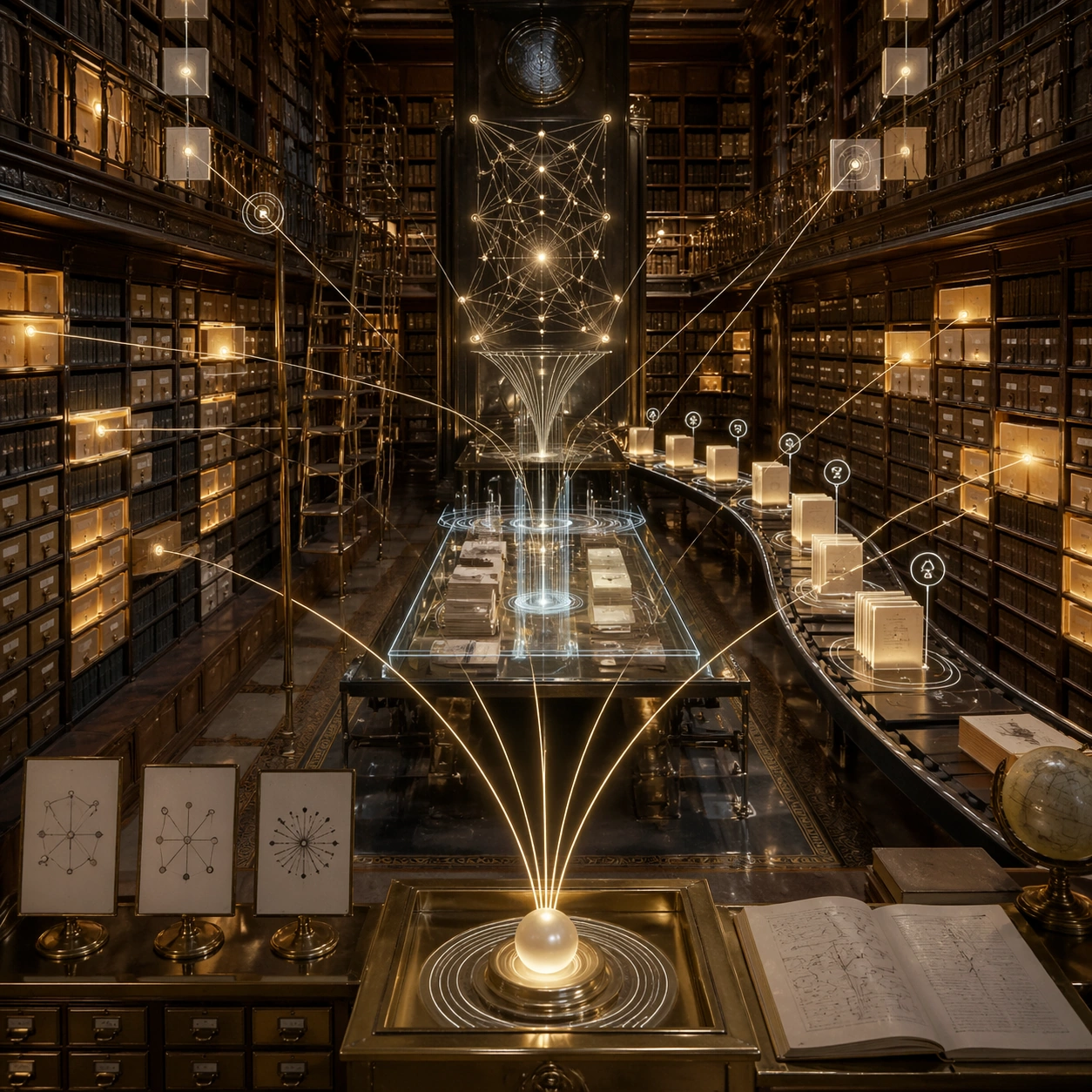
A square photoreal image of an impossible library where a neural network explains retrieval-augmented memory. Use warm archival lighting, tall shelves, translucent catalog drawers, fiber-optic index lines, and a central glass reading table. The space should feel like a real library merged with a precise technical diagram.

Subject:
A query sphere enters the scene at the front edge, splits into several search rays, and activates relevant memory shelves as glowing document blocks. A ranking conveyor brings a small set of retrieved blocks to the center table, where they are compressed into context ribbons feeding a neural response lattice at the back. Non-retrieved shelves remain dim. Use abstract citation markers, similarity rings, and symbolic annotation cards without readable text.

Important details:
The process must distinguish storage, search, retrieval, ranking, context assembly, and answer generation. Do not show every shelf glowing. The retrieved blocks should be visibly selected from a larger archive and then assembled into a compact context bundle. Keep library materials tactile: wood, paper, brass, glass, dust, and warm light. The data-flow overlays should be clean, sparse, and anchored to objects, not floating randomly.

Use case:
Neural Network Self-Explanation single study 8/8, testing retrieval-augmented generation as a photoreal library with query, search, ranking, and context assembly flows.

Constraints:
No readable text, no watermark, no logos, preserve exact 1:1 aspect ratio, no real book titles, no citations, no code, no private chain-of-thought, no all-shelves-glowing pattern, no magical fantasy library, no random paper storms, no disconnected response lattice.
Come usare
- Copia tutto il prompt originale, inclusi i parametri.
- Adatta soggetto, testo e composizione alle tue esigenze.
- Usa uno strumento esterno compatibile; verifica accesso e risultato.
Prima di iniziare
- Controlla se serve un’immagine di riferimento. La compatibilità non prova il modello usato per l’esempio.
- Verifica nomi, numeri e testi; i risultati cambiano con le versioni del modello.