原始文档
GPT Image 2 · en
Scene:
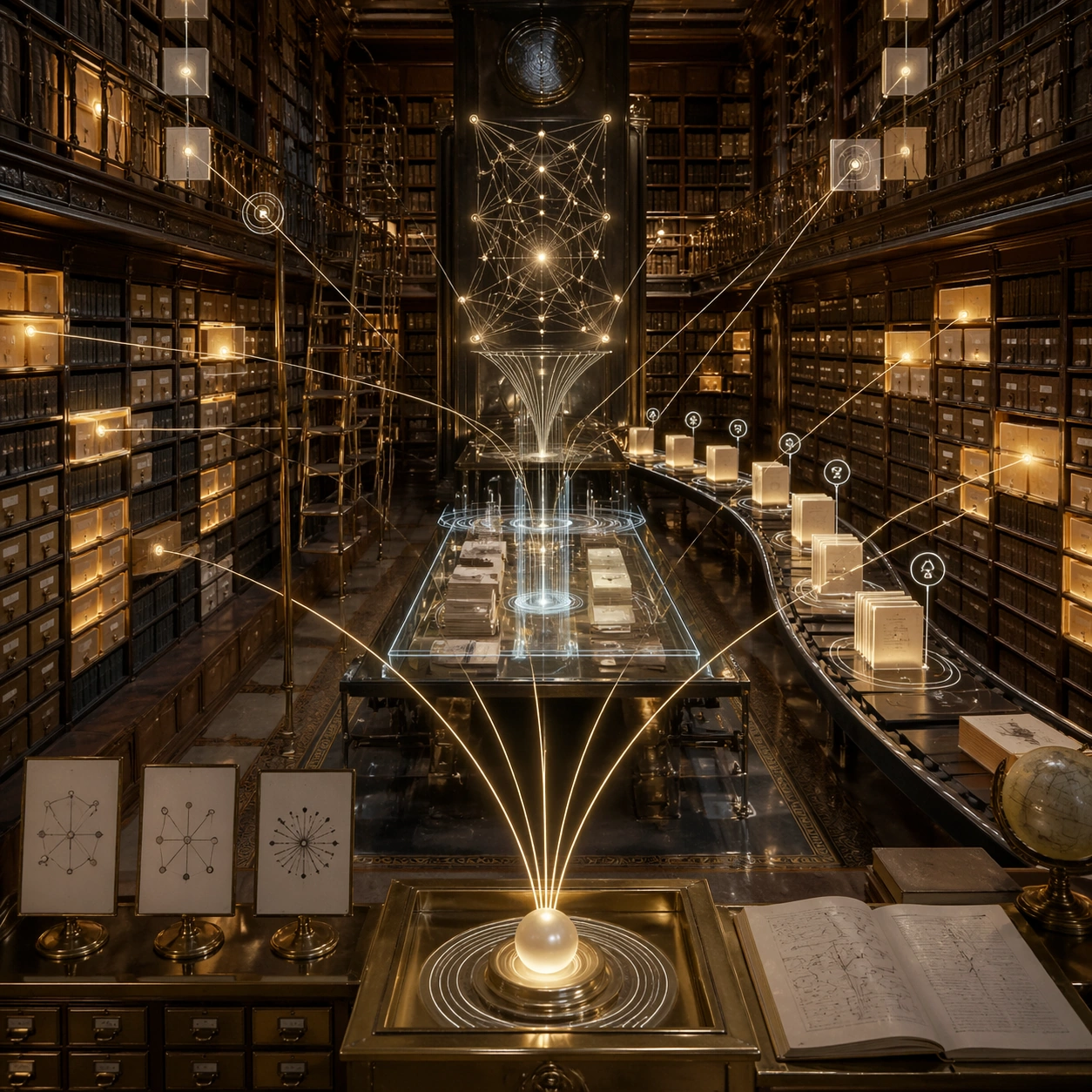
A square photoreal image of an impossible library where a neural network explains retrieval-augmented memory. Use warm archival lighting, tall shelves, translucent catalog drawers, fiber-optic index lines, and a central glass reading table. The space should feel like a real library merged with a precise technical diagram.

Subject:
A query sphere enters the scene at the front edge, splits into several search rays, and activates relevant memory shelves as glowing document blocks. A ranking conveyor brings a small set of retrieved blocks to the center table, where they are compressed into context ribbons feeding a neural response lattice at the back. Non-retrieved shelves remain dim. Use abstract citation markers, similarity rings, and symbolic annotation cards without readable text.

Important details:
The process must distinguish storage, search, retrieval, ranking, context assembly, and answer generation. Do not show every shelf glowing. The retrieved blocks should be visibly selected from a larger archive and then assembled into a compact context bundle. Keep library materials tactile: wood, paper, brass, glass, dust, and warm light. The data-flow overlays should be clean, sparse, and anchored to objects, not floating randomly.

Use case:
Neural Network Self-Explanation single study 8/8, testing retrieval-augmented generation as a photoreal library with query, search, ranking, and context assembly flows.

Constraints:
No readable text, no watermark, no logos, preserve exact 1:1 aspect ratio, no real book titles, no citations, no code, no private chain-of-thought, no all-shelves-glowing pattern, no magical fantasy library, no random paper storms, no disconnected response lattice.
使用方法
- 复制完整原始提示词,并保留其中的参数。
- 按需求替换主体、文字和构图要求。
- 在兼容的外部工具中使用,核对当前使用条件并检查结果。
开始前需了解
- 先确认是否需要参考图。标注兼容模型,不代表该示例由这个模型生成。
- 核对名称、数字与画面文字;不同模型版本的结果可能不同。