Oryginalny dokument
GPT Image 2 · en
{
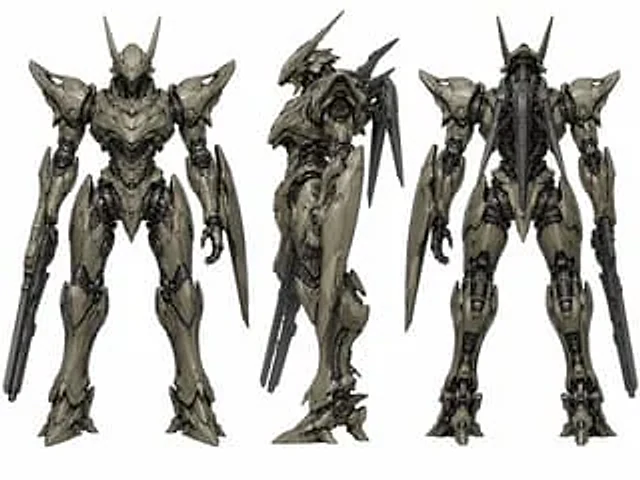
  "type": "Mech character three-view drawing",
  "subject": {
    "category": "Humanoid combat robot",
    "design": "A streamlined biomechanical sci-fi exoskeleton, equipped with sharp, angular armor plates and exposed mechanical joints.",
    "primary color": "{argument name=\"armor color\" default=\"Light olive gray\"}",
    "secondary color": "Dark graphite metallic color",
    "accent color": "Tiny red sensor light",
    "head": {
      "shape": "A narrow armored helmet with a pointed visor and two upward-extending, horn-shaped antennas.",
      "eyes": "Small luminous red goggle-style sensor"
    },
    "torso": {
      "build": "A broad, armored chest with layered armor plates and a narrow waist.",
      "details": "Dense pistons, cables, ventilation openings, and internal mechanical structures are visible through the gaps in the armor."
    },
    "arms": {
      "right arm": "Long rifle-style weapon integrated on the forearm",
      "left arm": "Large, elongated shield blade mounted on the hand and forearm"
    },
    "legs": {
      "style": "Toe-mounted mechanical legs, featuring heavy leg armor, exposed knee mechanisms, and pointed armored feet."
    },
    "back": {
      "attachments": "Two rear-mounted long blades or fin-like appendages, and a central spine-like backpack assembly."
    }
  },
  "layout": {
    "background": "Pure light gray studio background",
    "presentation": "Simple concept art",
    "views": [
      {
        "position": "left",
        "view": "Front view",
        "count": 1
      },
      {
        "position": "middle",
        "view": "Left side view",
        "count": 1
      },
      {
        "position": "right",
        "view": "Rear view",
        "count": 1
      }
    ],
    "total_views": 3
  },
  "style": {
    "rendering": "High-Detail Industrial Concept Art",
    "linework": "Precise hard-surface mechanical drawings with clear and sharp lines.",
    "surface": "Wear-resistant matte armor with minor scratches and panel seams.",
    "lighting": "Soft, neutral, and uniform lighting",
    "composition": "Full-body images are arranged vertically in the center, with ample space between views."
  }
}
Jak używać
- Skopiuj cały oryginalny prompt wraz z parametrami.
- Dostosuj temat, tekst i kompozycję do swoich potrzeb.
- Użyj zgodnego narzędzia zewnętrznego; sprawdź warunki dostępu i wynik.
Przed rozpoczęciem
- Sprawdź, czy potrzebny jest obraz referencyjny. Zgodność nie potwierdza modelu użytego do przykładu.
- Sprawdź nazwy, liczby i napisy; wyniki zależą od wersji modelu.