原始文档
GPT Image 2 · en
{
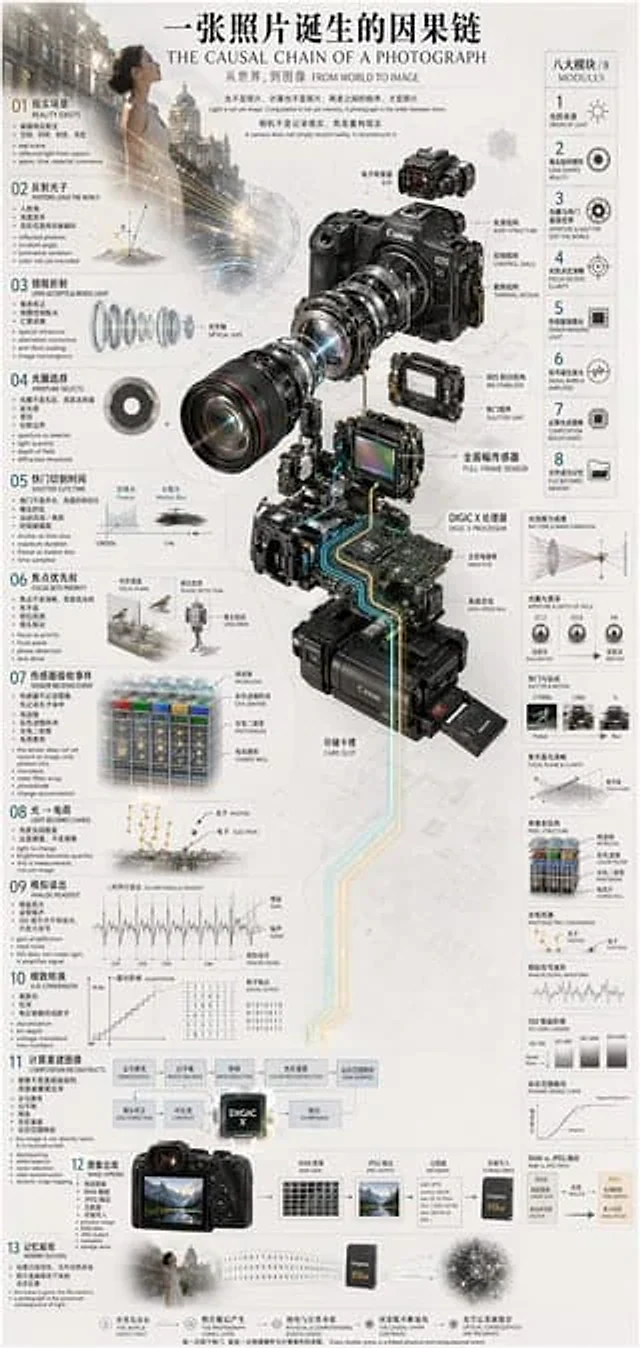
  "type": "Technical Infographic",
  "subject": "{argument name=\"subject matter\" default=\"Digital photography process\"}",
  "header": {
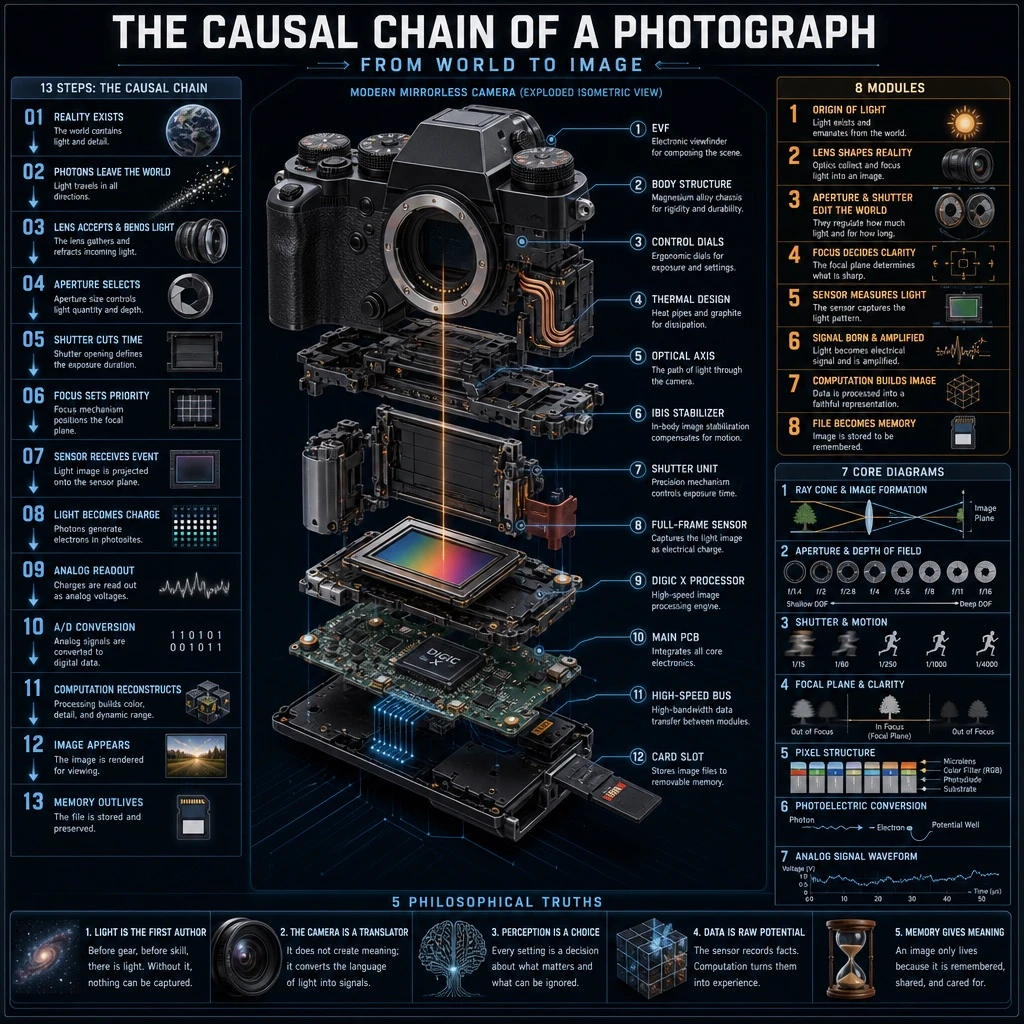
    "title": "{argument name=\"main title\" default=\"The Causal Chain of a Photograph\"}",
    "subtitle": "From World to Image"
  },
  "centerpiece": {
    "description": "Isometric exploded view of a modern mirrorless camera",
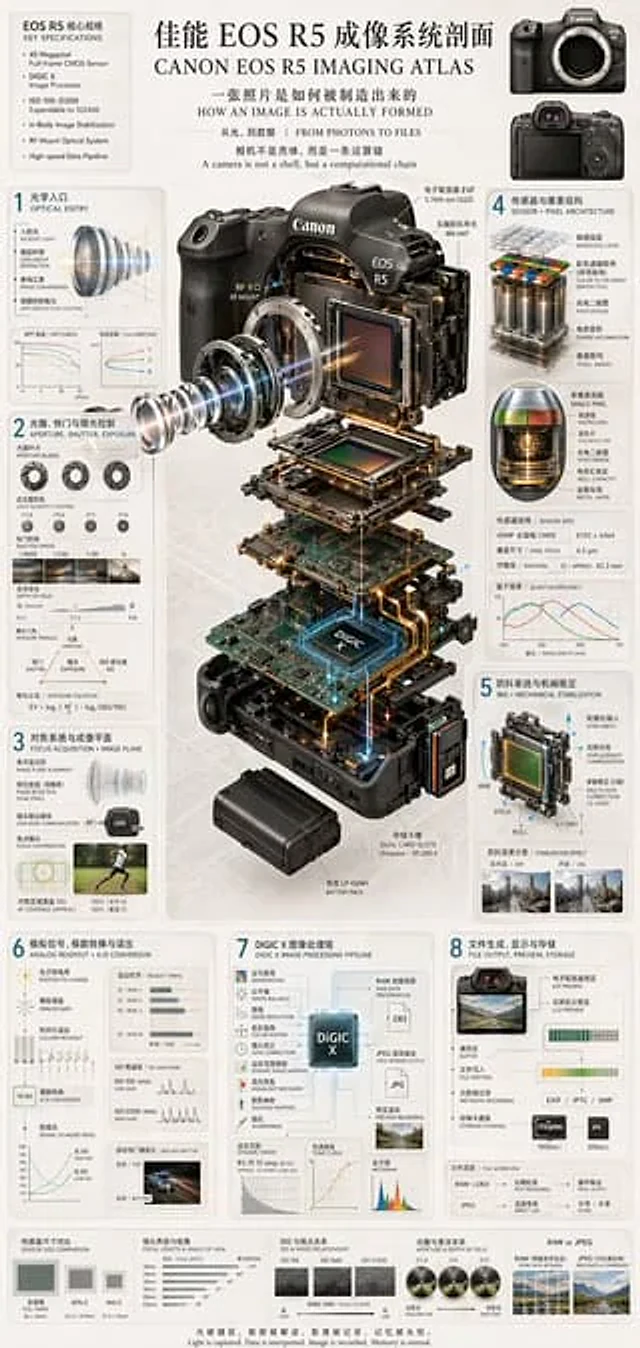
    "model": "{argument name=\"camera model\" default=\"Canon EOS R5\"}",
    "labeled_parts_count": 12,
    "labeled_parts": [
      "EVF (Electronic Viewfinder)",
      "fuselage structure",
      "Control dial",
      "Heat dissipation design",
      "Optical axis",
      "IBIS In-Body Image Stabilization",
      "shutter assembly",
      "Full-frame sensor",
      "{argument name=\"processor name\" default=\"DIGIC X processor\"}",
      "Main PCB circuit board",
      "High-speed bus",
      "Memory card slot"
    ]
  },
  "layout": {
    "left_column": {
      "description": "Time causality chain",
      "count": 13,
      "steps": [
        "01 Existence in reality",
        "02 Photons Leave the World",
        "03 The lens receives and refracts light.",
        "04. Select the aperture.",
        "05 Shutter Cut-off Time",
        "06 Focus setting priority",
        "07 Sensor Receive Event",
        "08 Light is converted into electric charge",
        "09 Analog Signal Reading",
        "10 A/D Analog-to-Digital Conversion",
        "11 Computational Reconfiguration",
        "12 Image Presentation",
        "13. Memory Retention"
      ]
    },
    "right_column": {
      "title": "Eight modules",
      "count": 8,
      "modules": [
        "1. The Origin of Light",
        "2. The camera shapes reality.",
        "3. Aperture and Shutter Editing World",
        "4. Focus determines sharpness",
        "5. Sensors measure light.",
        "6. Signal Generation and Amplification",
        "7. Calculate and construct the image",
        "8. Documents become memories"
      ]
    },
    "side_diagrams": {
      "count": 7,
      "descriptions": [
        "Light Cone and Imaging",
        "Aperture and Depth of Field",
        "Shutter and motion",
        "Focal plane and sharpness",
        "Pixel structure",
        "Photoelectric conversion",
        "Analog signal waveform"
      ]
    },
    "footer": {
      "count": 5,
      "description": "Key points of philosophical summary"
    }
  },
  "style": "Technical, precise, wireframe elements, luminous data cable, photorealistic camera components, clean layout, bilingual."
}
使用方法
- 复制完整原始提示词,并保留其中的参数。
- 按需求替换主体、文字和构图要求。
- 在兼容的外部工具中使用,核对当前使用条件并检查结果。
开始前需了解
- 先确认是否需要参考图。标注兼容模型,不代表该示例由这个模型生成。
- 核对名称、数字与画面文字;不同模型版本的结果可能不同。