原始文档
GPT Image 2 · en
{
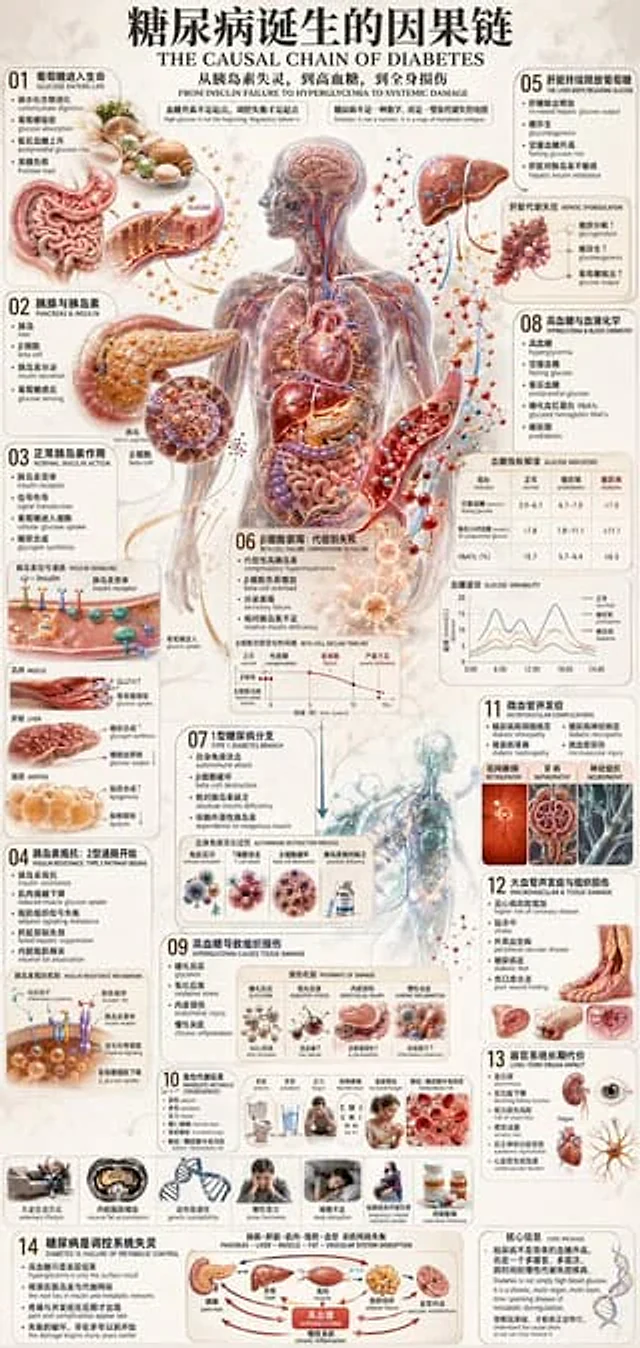
  "type": "Medical Infographic Poster",
  "topic": "Cause and effect chain of diabetes",
  "language": "Chinese with English subtitle",
  "style": "High-detail biomedical illustrations, editorial infographics, warm beige parchment background, realistic anatomical structures combined with 3D cross-sectional organ and molecular diagrams.",
  "format": "Vertical poster",
  "title": {
    "main": "The causal chain of diabetes",
    "subtitle": "THE CAUSAL CHAIN OF DIABETES",
    "tagline": "From insulin failure to hyperglycemia to systemic damage"
  },
  "central_visual": {
    "description": "A large, semi-transparent full-body anatomical diagram is displayed in the center, showing the brain, blood vessels, lungs, heart, liver, pancreas, stomach, intestines, kidneys, and surrounding glucose and insulin signal transduction patterns.",
    "emphasis": "The metabolic pathway originates in the pancreas and liver, and spreads to multiple organs via the bloodstream."
  },
  "layout": {
    "sections": [
      {
        "title": "01 Glucose enters life",
        "position": "top-left",
        "count": 1,
        "labels": [
          "GLUCOSE ENTERS LIFE"
        ]
      },
      {
        "title": "02 Pancreas and Insulin",
        "position": "upper-left",
        "count": 1,
        "labels": [
          "PANCREAS & INSULIN"
        ]
      },
      {
        "title": "03 Normal Insulin Function",
        "position": "left-mid",
        "count": 1,
        "labels": [
          "NORMAL INSULIN ACTION"
        ]
      },
      {
        "title": "04 Insulin Resistance: Type 2 Pathway Initiation",
        "position": "lower-left",
        "count": 1,
        "labels": [
          "TYPE 2 PATHWAY BEGINS"
        ]
      },
      {
        "title": "05 The liver continuously releases glucose",
        "position": "top-right",
        "count": 1,
        "labels": [
          "LIVER KEEPS RELEASING GLUCOSE"
        ]
      },
      {
        "title": "06 β-cell exhaustion: from compensation to runaway",
        "position": "center-lower",
        "count": 1,
        "labels": [
          "BETA CELL FAILURE: COMPENSATION TO FAILURE"
        ]
      },
      {
        "title": "07 Type 1 Diabetes Branch",
        "position": "lower-left-center",
        "count": 1,
        "labels": [
          "TYPE 1 DIABETES BRANCH"
        ]
      },
      {
        "title": "08 High blood sugar and blood chemistry",
        "position": "upper-right-mid",
        "count": 1,
        "labels": [
          "HYPERGLYCEMIA & BLOOD CHEMISTRY"
        ]
      },
      {
        "title": "09 High blood sugar causes tissue damage",
        "position": "lower-mid-left",
        "count": 1,
        "labels": [
          "HYPERGLYCEMIA CAUSES TISSUE DAMAGE"
        ]
      },
      {
        "title": "10 Acute metabolic consequences",
        "position": "bottom-mid-left",
        "count": 1,
        "labels": [
          "IMMEDIATE METABOLIC CONSEQUENCES"
        ]
      },
      {
        "title": "11 Microvascular complications",
        "position": "mid-right-lower",
        "count": 1,
        "labels": [
          "MICROVASCULAR COMPLICATIONS"
        ]
      },
      {
        "title": "12 Major Vascular Complications and Tissue Damage",
        "position": "lower-right",
        "count": 1,
        "labels": [
          "MACROVASCULAR & TISSUE DAMAGE"
        ]
      },
      {
        "title": "13. Long-term costs to organ systems",
        "position": "bottom-right",
        "count": 1,
        "labels": [
          "LONG-TERM ORGAN IMPACT"
        ]
      },
      {
        "title": "14. Diabetes is a result of a malfunctioning regulatory system.",
        "position": "bottom-left-wide",
        "count": 1,
        "labels": [
          "DIABETES IS FAILURE OF METABOLIC REGULATION"
        ]
      }
    ],
    "connectors": "All sections are connected by arrows, branching flowcharts, circular labels, and cause-and-effect diagrams, extending downwards and horizontally across the page."
  },
  "illustrations": {
    "organs_count": 12,
    "organs": [
      "Cross-section of the digestive tract (including the stomach and intestines)",
      "Pancreas close-up",
      "Microscopic illustration of pancreatic islets",
      "Muscle tissue illustration",
      "Liver close-up",
      "Human central brain",
      "Chest cavity and heart",
      "Abdominal intestines",
      "Retinal/fundus images",
      "kidney images",
      "Images of nerves/neuropathy",
      "Damage to blood vessels in the foot and lower leg"
    ]
  },
  "small_panels": {
    "count": 6,
    "items": [
      "Glucose and fructose intake scenarios (including fruits and sweets)",
      "Insulin receptor signal transduction map (including GLUT4 transport)",
      "Diagram of insulin resistance membrane structure",
      "β-cell decay timeline chart",
      "24-hour glucose fluctuation line graph",
      "AGEs/Oxidative Stress/Inflammatory Tissue Damage Sequence"
    ]
  },
  "photo_style_insets": {
    "count": 8,
    "items": [
      "sedentary lifestyle scenarios",
      "Abdominal scan images of visceral fat",
      "Blood glucose test strips or blood glucose measuring tools",
      "Obese/Back Fat Human Photos",
      "Sleep disorders and fatigue",
      "Medicine vials or insulin vials",
      "Photographs of eyes with retinal disease",
      "Photo of diabetic foot ulcer"
    ]
  },
  "color_palette": {
    "background": "old paper, beige",
    "primary": "Dark brown typography",
    "accent": "Red blood vessels and glucose granules",
    "secondary": "Orange pancreas and liver hue",
    "tertiary": "Blue signal molecules and cool-toned anatomical highlights"
  },
  "typography": {
    "headline": "Large, bold, serif-style Chinese title with a centered English subtitle below.",
    "section_numbers": "Large double-digit dark blocks from 01 to 14",
    "body_text": "Compactly arranged bilingual explanatory text, with bullet points and microlabels."
  },
  "composition": "This science poster boasts extremely high information density, with balanced left and right sidebars, a centrally located human figure, multiple magnifying organ cross-sections, and floating molecular chains around it—an educational design with magazine-quality features.",
  "rendering": "Ultra-detailed, clear, print-quality posters; realistic anatomy; elegant infographic spacing; delicate parchment texture; soft vignetting; high resolution."
}
使用方法
- 复制完整原始提示词,并保留其中的参数。
- 按需求替换主体、文字和构图要求。
- 在兼容的外部工具中使用,核对当前使用条件并检查结果。
开始前需了解
- 先确认是否需要参考图。标注兼容模型,不代表该示例由这个模型生成。
- 核对名称、数字与画面文字;不同模型版本的结果可能不同。