
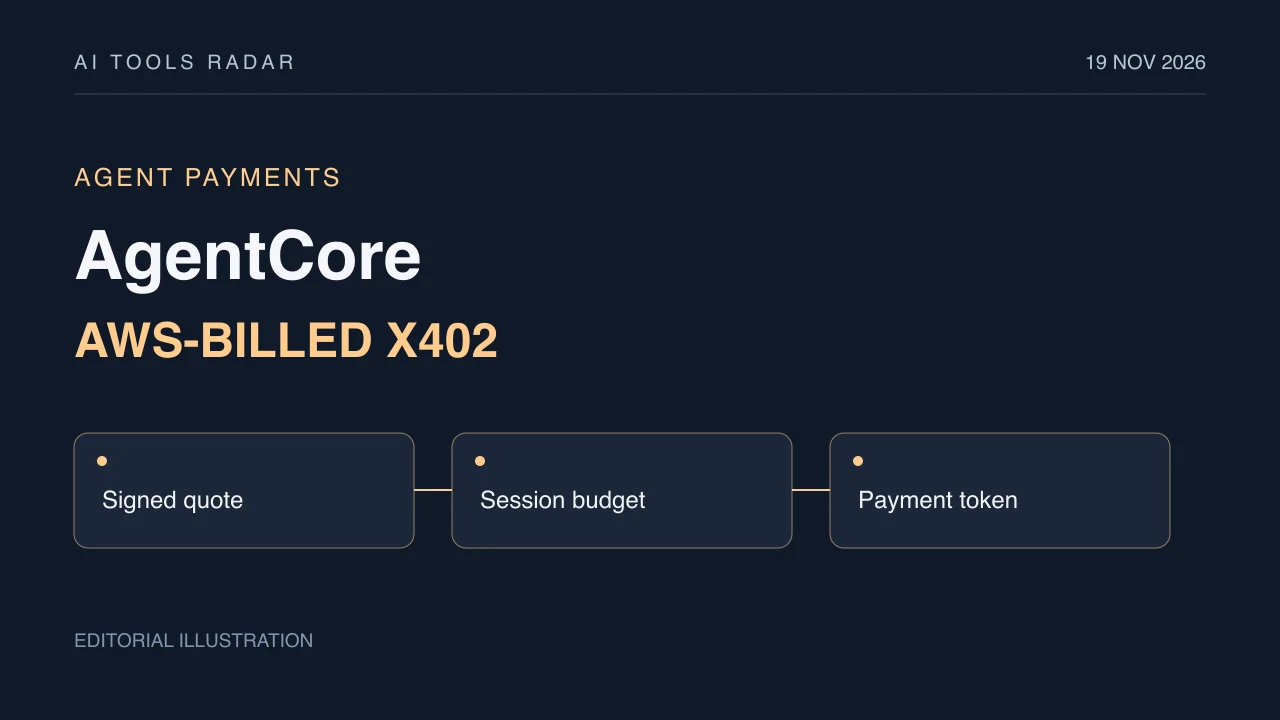
AWS expanded AgentCore payments on November 19 so agents can buy eligible x402-enabled Marketplace products and settle charges in USD on their developer's AWS bill. The integration removes the need for a stablecoin wallet or a seller API key for this purchase path.
The AWS announcement builds on payments' August 2026 general availability. The new element is AWS Billing for Marketplace purchases, alongside an optional Gateway connector for product discovery.
For teams considering autonomous purchasing, the meaningful details are who can set a budget, how a quote is checked and which account receives the charge.
A signed quote connects the request to a budget
The seller first responds with HTTP 402 Payment Required. A signed quote appears in PAYMENT-REQUIRED; Marketplace checks that signature against the seller's registered key, rejecting an altered price.
The agent forwards the quote to ProcessPayment with payment type AWS_BILLING_X402. AgentCore checks the remaining session budget before returning a payment token. If the budget is insufficient, the call fails and the developer is not charged for that purchase.
The agent retries the seller request with the token in PAYMENT-SIGNATURE and receives the content. Tokens last about five minutes, so quotation, payment and redemption are intended to happen in one pass.
At launch, the AWS Billing integration supports x402's exact scheme: a fixed price quoted for each request. This is not unrestricted purchasing from every website or a claim that every payment protocol uses this billing path.
The AWS account owns the agreement and the bill
Developers create a Payment Manager with an AWS Billing connector. The account needs the service-linked role AWSServiceRoleForMarketplaceAgenticCommerce; each task can then receive a payment session with a spending limit and session ID.
The first purchase from a seller creates an agreement between that seller and the AWS account. Later purchases are tracked against it, with each product appearing as a Marketplace line item. Metering is asynchronous and settlement reaches the monthly AWS bill.
AgentCore policy can restrict approved sellers. An organization using Private Marketplace limits agents to the products it permits. CloudTrail and Cost Explorer provide transaction visibility; these controls should be evaluated alongside the organization's existing purchasing rules.
The session cap bounds purchases within that session. It should not be interpreted as a cap on every infrastructure charge incurred while running an agent or its supporting resources.
Discovery is optional and read-only
The new Marketplace connector in AgentCore Gateway lets an agent search listings, inspect a listing and obtain fulfillment options. Those three discovery tools are read-only, and search returns endpoints accepting x402.
AWS illustrates a financial analyst asking about the week's agentic-payment announcements. The agent discovers Tavily search, obtains its endpoint and quote, pays for a request, then produces an answer with sources and the purchase cost.
That is the vendor's sample workflow. It demonstrates the intended sequence, rather than an independent Radar test or a guarantee that the model always chooses the best product.
Teams can skip Gateway discovery and set SELLER_URL to a specific endpoint. That narrows the example to paying the configured seller instead of searching for one.
Separate roles prevent the agent from raising its own allowance
The linked sample's setup_aws_billing.py --region us-east-1 configures the Payment Manager, connector, service-linked role and three IAM roles. The session role can set budgets but cannot pay. The agent role can pay but cannot create sessions, keeping budget-setting authority outside the paying agent.
setup_gateway.py --region us-east-1 adds the optional discovery connector and permissions. Its Gateway role is restricted to the three read-only Marketplace actions.
The sample runs with strands_marketplace_agent.py. Its defaults are a $0.05 session budget and a $0.02 per-request cap. In AWS's illustrated run, the agent compared two listings and bought one $0.01 request. These are sample settings and observations, not universal service pricing or a promise that a whole research task costs one cent.
Transaction inspection and cleanup remain part of the workflow
The sample prints the amount, Marketplace product ID and processPaymentId. AWS notes that the billing line item takes time to appear, so the absence of an immediate line item is not evidence that nothing was purchased.
After evaluation, the source instructs developers to run cleanup.py and verify resource deletion to avoid continuing resource charges. Audit records and bill inspection serve a different purpose from cleanup.
The integration gives eligible agent purchases a familiar billing destination and an explicit budget boundary. Its usefulness depends on suitable Marketplace sellers, appropriate permissions and developers checking the complete cost and audit trail, not merely whether a payment token was issued.