
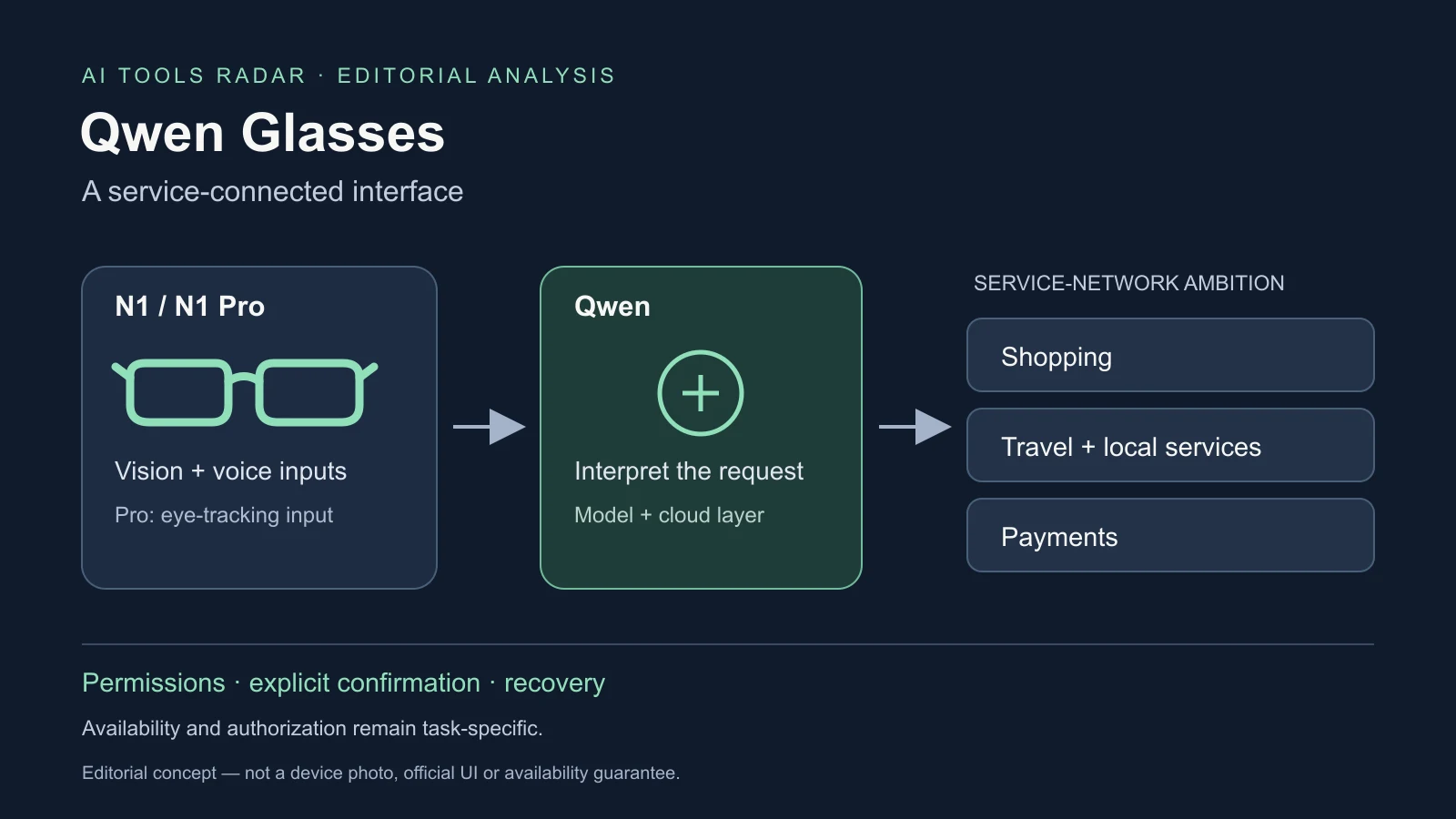
Alibaba began official Chinese sales of its Qwen Glasses N1 and N1 Pro on October 13, following September’s Apsara preview and a September 22 preorder opening. The important change is not merely a better camera. Alibaba is putting an assistant near the wearer’s eyes and connecting it to shopping, payments and everyday services that the company already operates.
That makes the launch a different challenge to Meta from a conventional specifications contest. Meta’s eyewear partnerships help make AI glasses acceptable things to wear. Alibaba wants its integrated services to make them useful things to keep wearing. Neither a launch demonstration nor a long feature list establishes that the strategy works reliably in daily life.
What the N1 launch actually adds
The standard N1 has a 50-megapixel sensor for first-person capture. N1 Pro adds eye tracking, which Alibaba positions as an input for object recognition and payments. Shopping, health tracking, translation, music and Qwen interactions form the wider feature package. The source describes bone-conduction audio interaction; it does not provide enough technical detail to independently establish the microphone arrangement.
Alibaba claims up to 25 hours of standby or nine hours of music playback per charge. Those are two distinct manufacturer measurements, not nine hours of continuous AI assistance or 25 hours of camera use. Mixed recording, connectivity, navigation and model requests can change power consumption and heat substantially. Independent mixed-use testing remains necessary.
The range follows Quark-branded glasses introduced in 2025 and the subsequent move to Qwen branding. At Mobile World Congress in March 2026, Alibaba presented S1 and G1 lines offering translation, meeting transcription, visual recognition and high-definition capture. It also announced phased Qwen-app integration for voice-driven food orders, hotel bookings and ride requests. Those earlier plans are context for N1, not evidence that every promised service is already available on every device.
Bloomberg’s launch reporting also describes Qwen Clip open-ear earbuds developed with Bose. They are a separate product, not an N1 component or proof that Bose supplies the glasses. Together with a Qwen-powered computer and updated note-taking device shown at Apsara, they demonstrate Alibaba’s effort to spread its assistant across multiple physical interfaces.
From identifying an object to completing an action
A conventional chatbot receives what a user types, uploads or shares. A permitted wearable can add speech, visible objects, time, location, movement and gaze. The higher-resolution camera supplies detail; eye tracking can help identify which object the wearer means. Those inputs can reduce the need to explain a scene in a text prompt.
Alibaba described a proactive version of this approach in May: combining preferences with live signals to check weather before a commute, suggest an umbrella, monitor posture, plan routes or show personalized news. Its announcement also outlined access to ride-hailing, delivery, travel planning, reviews and movie tickets. These are company-described capabilities and plans, not independent task-completion results.
The distinction between recognition and action matters. Identifying a restaurant supplies information. Retrieving reviews, booking a table, navigating there and settling the bill constitutes a connected workflow. Similarly, looking at a product could initiate identification, comparison and purchase, while translation could avoid repeatedly retrieving a phone. These illustrate the intended experience; dim light, an obstructed view, ambient noise or a misunderstood command can still interrupt it.
Alibaba controls several layers needed to attempt that workflow: Qwen models, cloud infrastructure, consumer platforms and the hardware that receives requests. The cloud processes model requests, Qwen interprets intent and authorized services supply actions. Its Chinese commerce, maps, workplace communication, entertainment, delivery, travel and payments networks are therefore as consequential as the camera.
For work, capturing a meeting or observation is only the beginning. Recordings, notes and images must remain retrievable, connected to relevant context and convertible into tasks. Otherwise more sensors simply produce a larger archive. Earbuds suit discreet voice interaction, a note-taking device suits long meetings, a computer manages documents and software, and glasses supply visual context. Those different roles explain the broader hardware portfolio without establishing automatic interoperability between every product.
Meta’s advantage is a different part of the system
Meta’s EssilorLuxottica partnership supplies recognizable frames, lens options, fitting knowledge and retail distribution. Comfort, prescription support, durability, repairs and appearance are not secondary to AI: an uncomfortable device cannot provide all-day assistance if its owner stops wearing it.
The source’s account of third-generation Ray-Ban Meta glasses emphasizes additional styles, more microphones and longer claimed battery life. Those incremental changes address wearability rather than proving inferior ambition. Meta is also strengthening its assistant and experimenting with displays, while Alibaba invests in cameras, audio and frames. The strategies overlap even though their starting advantages differ.
Alibaba does not need to outperform Meta worldwide to establish a meaningful Chinese competitor. A service-rich regional platform can be useful where its connected tools already reach customers. Rokid and Xiaomi face related pressure: specialized manufacturers can compete on optics, weight, displays and design, but a large platform business can support hardware development through a broader AI operation.
Integration also creates switching costs. Users gain the most when they already use the platform’s services. Developers receive ready-made commercial tools but must consider who controls customer access, payments and data. Outside providers may hesitate to integrate deeply if the platform becomes a competing gatekeeper.
Gaze and payments make trust a product requirement
Combining scene capture, attention tracking, identity and financial authorization creates a more sensitive device than an ordinary camera. Gaze can improve object selection while also revealing interests, reactions and decision patterns. The source’s description of iris-based payment raises separate questions about biometric storage, protection and separation from behavioral data.
That does not establish how N1 implements every payment safeguard. Clear confirmation before a purchase, intelligible permissions, encryption, account protection and recovery after an incorrect action remain requirements to evaluate. A health-related suggestion is not verified medical guidance; a mistranslation, mistaken purchase and misleading health prompt have different consequences.
Proactive reminders can become intrusive if every glance or location triggers a suggestion. Users need controls for personalization, retention, account history, connected services and deletion, including information about copies stored elsewhere. Bystanders have fewer choices and may not know whether glasses are recording or recognizing a scene. Visible capture indicators must remain recognizable under different lighting conditions.
Alibaba previously described encrypted audio transmission and deletion after transcription for QwenNote A2. That is not an N1 privacy policy. Camera footage, voice, gaze and biometric authentication require product-specific documentation rather than protections inferred from another device.
The evidence that would distinguish a platform from a launch
Alibaba said earlier in 2026 that an international Qwen Glasses version was planned within the year. N1’s launch is China-centered. Exporting frames does not export a domestic services network: overseas availability needs supported languages, regional data handling, prescription options, repairs and local payment, travel, delivery and mapping partners.
Adoption claims need similar care. In May, Alibaba cited external research claiming 53% of cumulative online smart-glasses sales in China since launch. The figure appeared in its own announcement without an independently explained category definition. It is not a measure of active users, retention, returns or satisfaction, and it does not establish N1’s market share.
More useful evidence would show repeat use, successful translations and navigation, completed authorized purchases, error rates and activity months after purchase. Independent app data and retailer returns could complement company figures. Reviews should revisit software updates and separate camera quality from agent reliability: attractive footage can coexist with failed services, just as good answers can coexist with uncomfortable frames or unreliable connectivity.
Partner participation and competitors’ responses will also matter. More Qwen-compatible tools would extend utility without Alibaba building everything itself; Meta could expand transactional actions through its partners, while Chinese rivals could offer lighter designs or multiple assistants. The decisive result is whether useful, trustworthy actions remove enough phone interactions to justify wearing and charging the glasses after the novelty fades.