
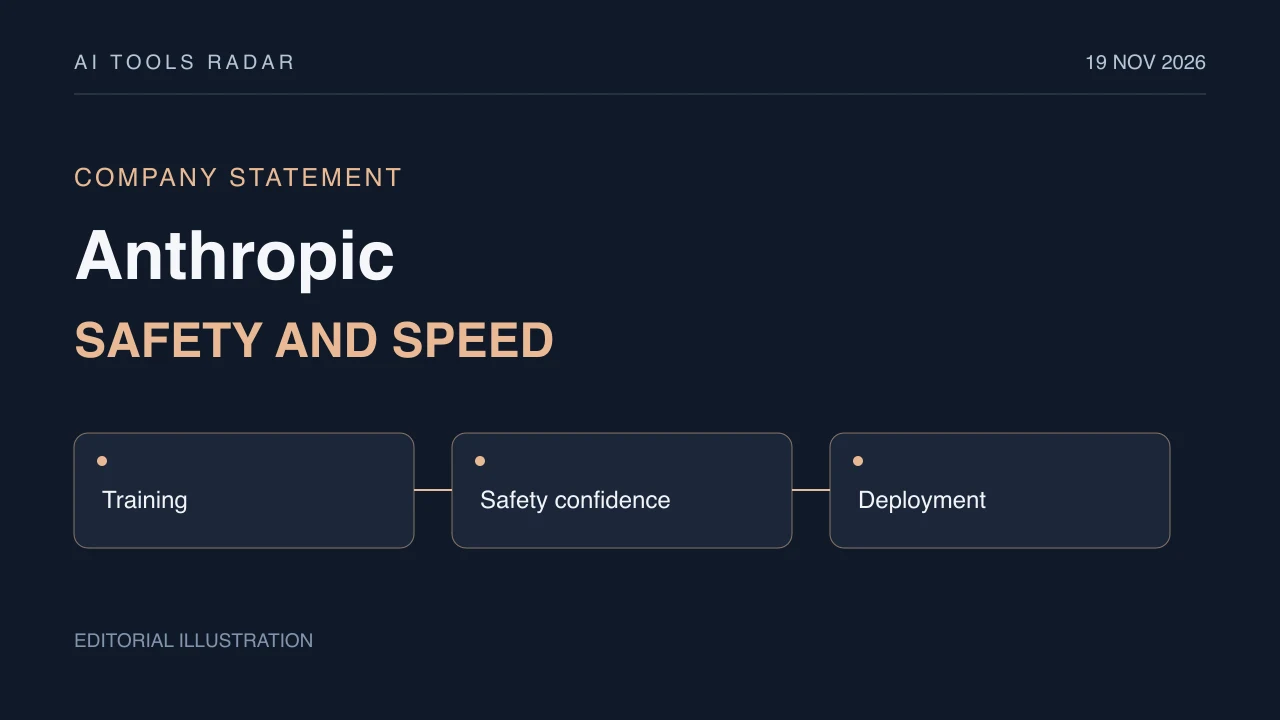
Anthropic used its November 19 Nasdaq debut to make a commitment about development speed. CEO Dario Amodei said the company would pace both AI training and deployment until it had confidence in safety and continued human control.
In the statement posted by Anthropic, Amodei said business and political pressure would not override that commitment. He presented the company's stronger financial position as support for the mission, rather than a reason to relax its safety work.
The statement matters because a public-market milestone creates expectations about growth. It does not itself demonstrate that future systems are safe, or specify a numerical threshold that will stop a release.
Medical progress supplies the ambition and the qualification
Amodei grounded the speech in a personal account: he and his sister Daniela lost their father to a disease that became curable a few years later. He described entering biology in the hope that future cures could arrive sooner.
His argument connects scientific progress to the ability to understand complex patterns. Gene editing, gene synthesis and methods for controlling brain cells with light started as ideas. Turning discoveries into treatments, however, can take many years, as the path from repeating DNA patterns to CRISPR-based treatment illustrates.
He named protein folding, drug design, cancer genetics and clinical-trial administration as areas where scientists are using Claude. His claim that AI working with people could compress a century of progress into a decade is a belief about potential, not an observed medical outcome.
Amodei explicitly qualified that ambition: the results are early, and experiments and clinical trials still require time. Those caveats prevent a prediction about research acceleration from becoming a claim that AI has already delivered equivalent clinical progress.
The pledge covers training as well as releases
The risks identified in the speech span misuse by individuals or nation-states, economic disruption and the possibility of losing control of AI systems. Amodei portrayed those outcomes as avoidable through the choices developers make, rather than inevitable consequences.
He pointed to safeguards against biological and cyber misuse, alignment training, testing and interpretability work intended to reveal model behavior. These are Anthropic's descriptions of its work. The speech supplies no new independent evaluation establishing their effectiveness.
The operationally significant promise covers both training and deployment. Amodei said the company would take the time necessary to gain confidence that systems remain safe and under human control, even when commercial or political incentives push differently.
That remains a commitment requiring future evidence. The statement does not publish release-blocking metrics, audit findings or an enforcement mechanism. Readers should distinguish the scope of the promise from proof of its delivery.
A stronger balance sheet is presented as room to maintain standards
Amodei argued that financial strength could reinforce responsible choices. He also described customers applying AI to business growth, poverty reduction, democratic institutions and everyday public services. Those are broad company-attributed claims, without quantified outcomes in this statement.
His proposed industry effect is a race toward better safety: a successful company that maintains standards could encourage others to do the same. He framed the goal as safer behavior across the industry, whether Anthropic leads model rankings or loses that position.
The practical question after the debut is therefore how that stance shapes actual decisions when safety and speed conflict. The speech leaves substantial work ahead and offers no timetable guaranteeing medical benefits or the elimination of AI risk.