
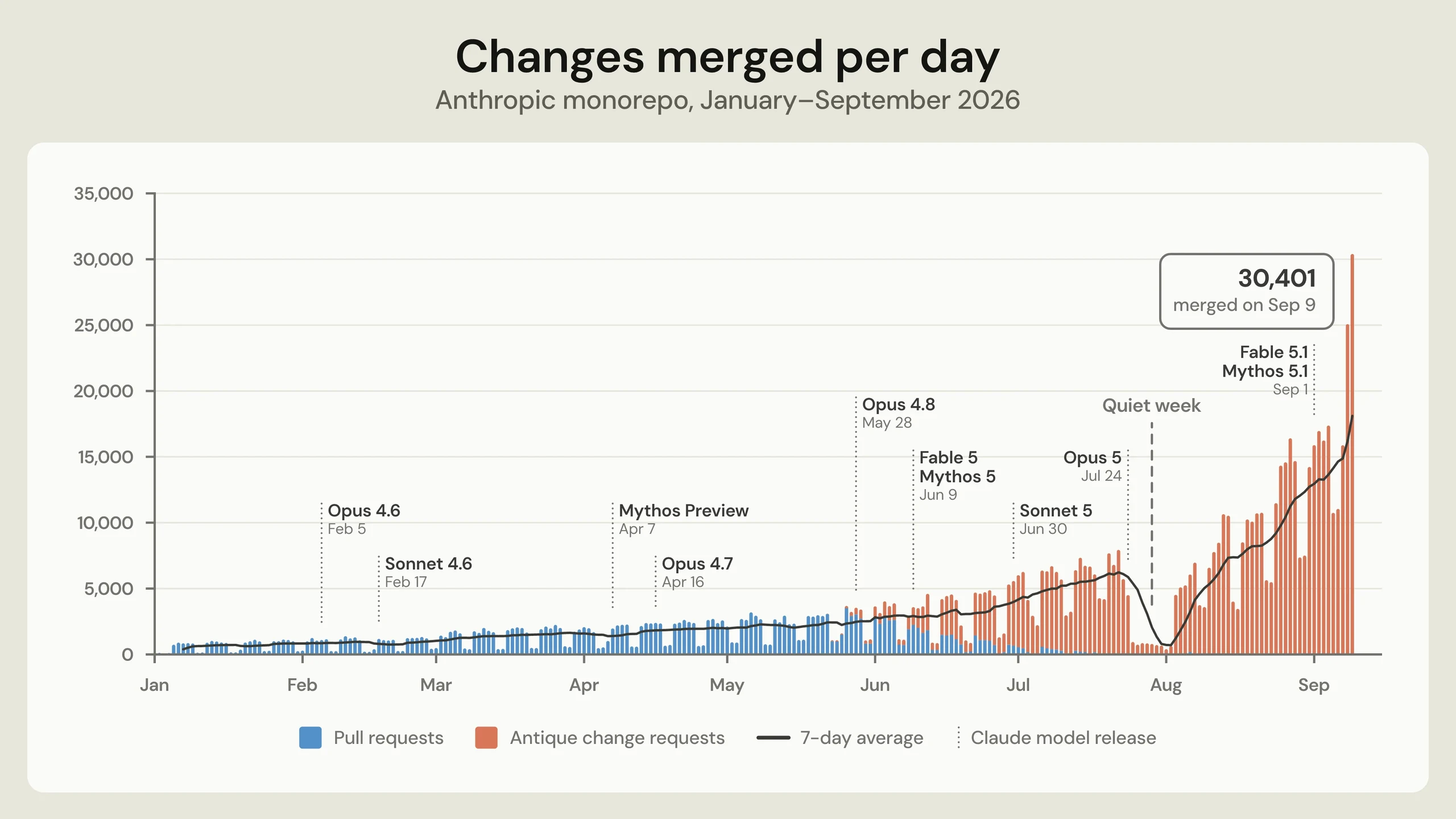
Anthropic's source-control migration begins with a dramatic change in demand: roughly 2,500 daily merges in May 2026 became more than 30,000 by September. The company says Claude-driven engineering and research made its existing Git infrastructure increasingly expensive to feed. Its response was Scion, an internal service built for online agents rather than self-contained local repositories.
Seven engineers also built the Antique review system and supporting services, completing the migration in five months, according to the company. The account explains a real architectural problem, not a general verdict against Git. It also exposes the next constraint: once accepting and distributing code becomes cheap, testing combined behavior and assigning responsibility still take work.
The workload was checkouts as much as commits
The monorepo's main history approached 100 GB and a compressed working copy exceeded 25 GB. Before developer environments, sandboxes and research jobs were included, CI performed about 25 million checkouts each day. Anthropic calculated that naive retrieval would create more than 600 petabytes of daily Git traffic.
The company had already used shallow clones, sparse checkouts, snapshots and several hundred internal mirrors. Those measures reduced traffic but became awkward as code advanced. Snapshots aged between refreshes, while partial history complicated operations such as diff, history search and blame. Another cache was not necessarily a solution to the underlying request pattern.
Git's distributed design gives clones enough data and functionality to work independently and offline. Anthropic's dominant clients were online automated jobs, often needing one directory, a diff or a merge base rather than a complete repository. Repeatedly giving those clients laptop-like independence imposed costs for a capability they rarely used.
Scion turns the server into the source-control computer
Scion moves history queries, commit creation, diffs, merges and rebases to the server. A lightweight client keeps a bounded cache and materializes only needed files. Some jobs can query the API without creating a filesystem checkout at all, shifting source control from synchronization between full peers toward a shared computation service.
Its basic record is a changeset in a write-ahead log, describing changed files relative to a parent. Compressed, content-addressed file objects live separately. Unlike mutable content, these immutable objects can be reused safely through caches. Clients do not need to create and exchange large Git packfiles for every new change.
References such as branches and tags remain, but Anthropic discourages most beyond the main line and release branches because global coordination becomes costly at high commit rates. History indexes for blame, copies and graph relationships are derived separately and can be created immediately or on demand. Changing an index therefore need not change the repository's fundamental records or every client.
Compute-node daemons share cached objects locally, with regional caches between them and authoritative servers. The hierarchy is enforced so a regional failure does not send every job directly to the center. Sparse and virtualized checkouts limit materialized files; API-only operations avoid them. This architecture deliberately depends on network and central-service availability more than an autonomous Git clone does.
Reported gains explain the migration, not every team's next step
Anthropic reports cache hit rates above 99 percent at each tier, 200 times less CPU and memory than its old mirror fleet, and CI/research checkouts dropping from minutes to seconds. It says the change returned 25 percent of CI CPU capacity to the broader fleet. Those are internal workload measurements, not independently reproducible comparisons available to outside teams.
Claude also helped build the replacement. An early internal model reportedly rewrote a hand-built ingestion prototype using 20 times less memory and running four times faster while retaining implicit ordering and data-structure requirements. That is a specific company-reported optimization, not proof that every agent rewrite improves performance or preserves hidden requirements.
Large centralized repositories already have precedents. Google's Piper and Meta's Sapling respond to related scale pressures through different designs; Sapling also supports familiar Git workflows. Scion's distinctive assumption is the always-online automated client. Adopting it would mean replacing review, search, identity, permissions and CI integration—not installing a faster command-line utility.
Human review now emphasizes intent, while interactions remain difficult
Anthropic says every change still receives human review, but reviewers concentrate on intent rather than reading every line. That shifts more trust to tests, agent explanations and automated analysis. A change can fit the requested goal while implementing it incorrectly or violating an invariant the prompt never made explicit.
The company describes engineers repeatedly telling Claude no. Some generated components tried to scan a commit log linearly instead of querying Antique for an authoritative merge time. Adversarial feedback could also prompt excessive defensive checks and unnecessary complexity. The same models that found useful optimizations sometimes needed humans to reject plausible local solutions.
Scion blocks textual conflicts, not semantic ones. Two edits can merge cleanly while breaking behavior together: one updates a function and existing callers, while another adds a caller built around the old assumption. A conventional merge queue tries to test a combined state before accepting the next batch. At Anthropic's rate, hundreds or thousands of changes can arrive during a test run, making a global lock impractical.
Anthropic has therefore invested in post-merge, pre-deployment testing rather than insisting that all interactions be settled before code enters the repository. Fuzzing, isolated simulations, rate limits, directory permissions and risk-sensitive approval contribute to that boundary. They do not make semantic risk vanish; they move detection and repair closer to release, where deployment controls must still prevent a bad combination from reaching users.
The missing comparison is software quality over time
Persistent Claude monitors, called superfans, watch component telemetry and logs through dedicated Slack channels alongside traditional alerts. They may identify patterns outside fixed thresholds, but more monitoring is not itself an outcome measure. Repair speed matters only alongside how quickly a problem is detected and whether its effects can be isolated or reversed.
Merge count measures activity, including small, experimental or reverted changes. Anthropic has not published independent defect rates, rollback frequency, incident trends or the share written and reviewed by agents. Without those denominators, outsiders cannot tell whether throughput gains also improved downstream reliability or simply increased the amount governance must absorb.
The transferable lesson is narrower than replacing Git. Server-side metadata, shared caches, virtualized workspaces and risk-aware review can address particular bottlenecks without abandoning portable history and offline resilience. Most teams have not demonstrated Anthropic's unusual workload or its tightly integrated control of models and infrastructure.
Scion shows how code generation can force a development platform to change. The stronger proof of success would connect those infrastructure savings to stable or improving releases, clear ownership and fewer escaped failures. Until that evidence appears, its impressive throughput should be read as an engineering result with an explicit verification tradeoff, not a universal model for safe software production.
Related reading on preserving working context: technical-document knowledge bases ; AI-native second brains.