
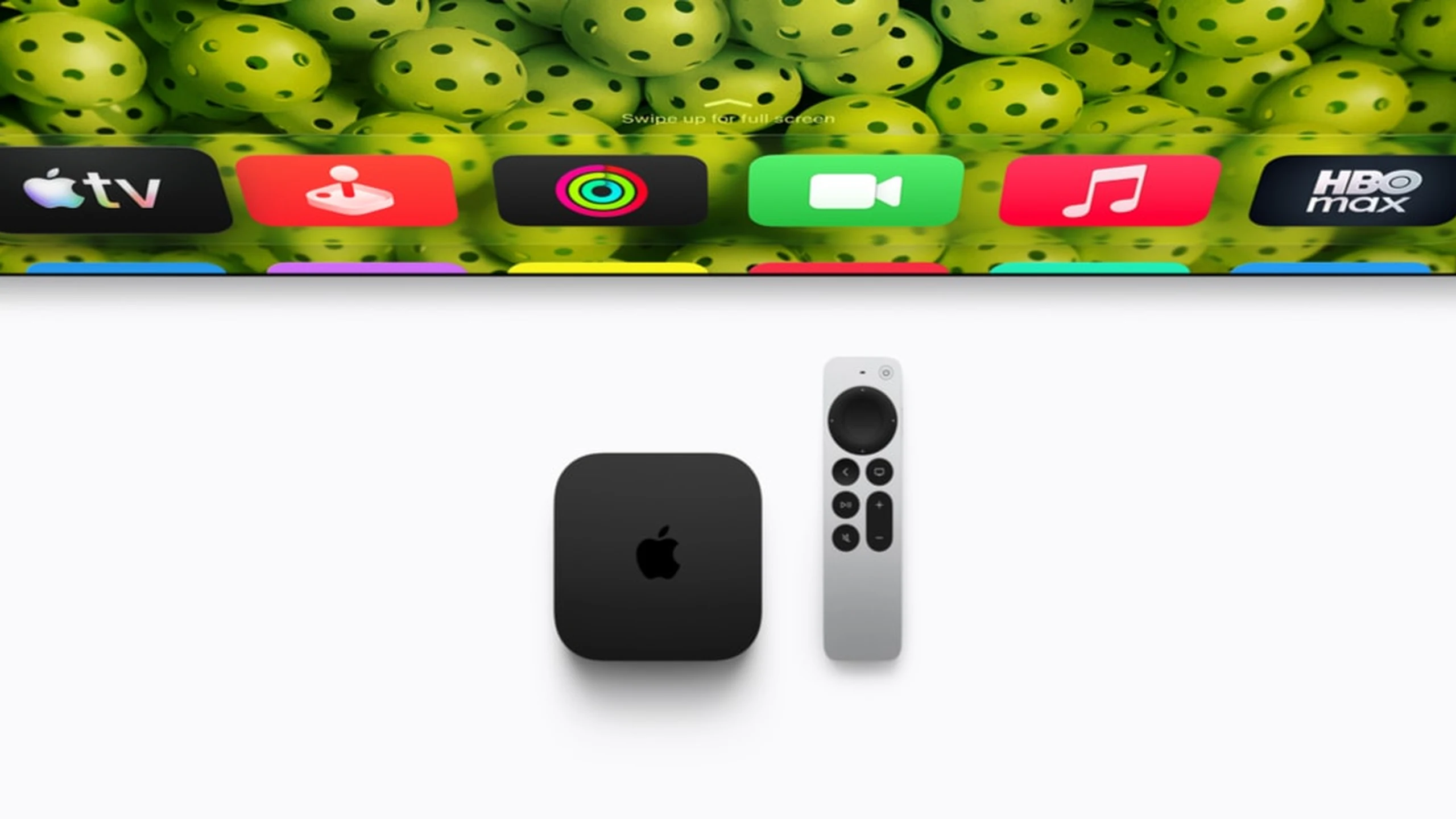
Apple announced the fourth-generation Apple TV 4K on October 13, with availability scheduled for November 13. Its most consequential change is not simply a faster processor: three built-in microphones let the television receive Siri requests from across the room, while conversational search and camera summaries expand its role as a shared home interface.
But the software and hardware stories diverge. Siri AI arrives in beta on second-generation Apple TV 4K and later, so existing owners need not replace a working box to access Siri AI itself. The product announcement describes a broader platform; the purchase decision depends on which parts require the new hardware, other Apple devices or compatible accessories.
What the new hardware actually adds
Apple says the A19 delivers up to 50% faster CPU performance and twice the GPU performance of the previous generation. These are company comparisons, not independent benchmarks or a promise that ordinary streaming becomes 50% faster. Games, demanding applications and interface responsiveness may expose differences that video playback does not.
A dedicated AV1 decoder reduces processing work for compatible video, while the codec can deliver high-quality streams with less bandwidth. That benefit depends on services providing compatible content. Wi-Fi 7 and Bluetooth 6 also join the hardware specification, but none of these additions establishes the quality of Siri's answers.
The three far-field microphones are a clearer interaction change. Apple says echo cancellation separates commands from television audio, removing the need to find a remote, hold a button or have a nearby HomePod. Reporting on the microphones explains the hands-free approach, but recognition across distances, accents, room layouts and loud soundtracks still requires independent testing.
The fourth generation can also coordinate four compatible HomePods, arranged as matching front and rear pairs. Apple says position detection calibrates timing and volume for the room; older boxes remain limited to two HomePods in this configuration. The revised Siri Remote keeps its familiar design and adds Find My, compatible-iPhone Precision Finding and an audible locating alert. It also works with earlier Apple TVs, so finding a misplaced remote is not, by itself, a reason to replace the box. The hardware feature comparison helps separate those boundaries.
Conversational discovery depends on more than the television
Apple's Siri AI demonstrations move beyond searches that require a title, actor or service. A request for award-winning comedies can produce full-screen posters and related categories. During playback, questions about a filming location or suitability for a teenager use a smaller overlay rather than replacing the programme. Follow-up questions are intended to preserve conversational context.
A more personal example—finding the programme a friend recommended when its title has been forgotten—requires an iPhone with Apple Intelligence enabled. The phone supplies the private context; the television displays the result. This is not an Apple TV independently reading every household member's messages, nor a capability available without the supporting device.
The approach extends the cross-device architecture introduced in Apple's June WWDC preview, spanning iPhone, iPad, Mac, Apple Watch, Apple TV and Vision Pro. On a television, visual results let several viewers consider recommendations together. Existing services including Apple TV, Fitness+, Arcade, FaceTime, Photos, live sport and third-party apps provide the surrounding platform, not evidence that every app already supports every conversational action.
App Intents participation will matter to how far system actions extend beyond Apple's own services. Broader developer adoption is something to watch, not a guarantee of a general-purpose household agent at launch.
Home control makes accuracy a different kind of problem
Apple TV has served as a home hub for years, coordinating compatible accessories, automations, remote access and low-power Thread devices. The new microphones make those controls easier to reach. Siri can operate accessories and scenes; a compatible doorbell can show a television notification, let viewers see and speak to a visitor, and leave the programme available.
HomeKit Secure Video adds AI activity descriptions and summarized notifications. Apple says its video remains end-to-end encrypted and inaccessible to Apple. That is a processing and access claim, not a measurement of whether a generated description correctly identifies an event.
A mistaken film suggestion is inconvenient; an omitted visitor or misdescribed camera event can change a family's understanding of what happened. Summaries should help locate relevant footage rather than replace the underlying security record. The announcement does not establish independent accuracy for camera descriptions, age-suitability answers or filming facts.
Nor should accessory control be treated as one uniform permission. Playing music and opening a lock carry different consequences. Clear identity, appropriate confirmation and inspectable automation conditions become more important as conversational access reaches household actions.
The earlier home preview is context, not another confirmed product list
The day before the announcement, Bloomberg's October 12 preview discussed a reported J490 home hub, a HomePod mini refresh and Apple's wider home ambitions, including reported collaboration with LG. Those were preview reports. They are not specifications for this Apple TV, and the television announcement alone does not confirm every anticipated hub or partner product.
The competitive argument is concrete even without those predictions. Google's Gemini home examples cover device control, schedules and household requests. Amazon's Echo interface guidance describes a display that adapts to viewing distance. Existing speakers, accessories, accounts, subscriptions and routines give incumbents a switching-cost advantage that a new assistant cannot erase with a demonstration.
Apple's Matter developer guidance offers a route for compatible cross-platform accessories, but shared standards do not promise equal features in every vendor's app. The Matter 1.5 announcement covers cameras, closures, energy management and larger data transfers, including camera privacy and storage options. That describes the standard's scope—not proof that Apple TV implements every capability or that every existing accessory gains it.
A household mixing Android phones, non-HomeKit cameras and other speaker ecosystems may therefore obtain fewer coordination benefits than an all-Apple home. “Mixed” here concerns platforms and brands, not merely different device generations.
Private processing does not settle shared-screen privacy
Apple says Secure Exclaves isolate microphone processing and restrict access by tvOS, applications, users and Apple itself. Some work takes place locally; more demanding eligible requests can use Private Cloud Compute, which Apple says neither stores requests nor makes them accessible to the company. Those protections require independent scrutiny of activation, diagnostics, updates and failure behaviour after release.
There is also a social problem that encryption alone cannot solve. The television is shared, while personal context belongs to individuals. Similar voices, children, guests and background speech complicate determining whose information should be used. Even a technically protected request can reveal private information to another person watching the screen.
Visible listening indicators, understandable microphone controls and a way to disable listening without losing unrelated television functions are consequently important. Hospitality, meeting rooms or managed residences may eventually find uses, but they would need stronger identity and retention controls; the consumer announcement is not evidence of a ready enterprise deployment.
Availability limits the upgrade case
At launch, Siri AI on Apple TV supports English in eight markets: the United States, Australia, Canada, India, New Zealand, Singapore, South Africa and the United Kingdom. Far-field Siri has a different set of language and configuration support. Those two lists must not be collapsed into a claim that every voice control, or every localized article's language, supports the full AI beta.
The launch coverage emphasizes remote-free commands, A19 and four-speaker audio; AP's broader Siri reporting places them within Apple's generative-AI effort. Neither establishes post-release reliability. Siri AI's second-generation-and-later support creates a useful comparison: if older boxes answer similarly, the fourth generation's main distinction is ambient microphones and expanded home-theatre coordination.
After November 13, the decisive evidence will be tests against the Siri Remote and HomePod, across noise and distance, plus comparisons of response speed, context handling and search quality on older hardware. The new box has a defined hardware proposition. Whether it becomes a dependable household assistant remains a beta question, not a conclusion supplied by the announcement.