
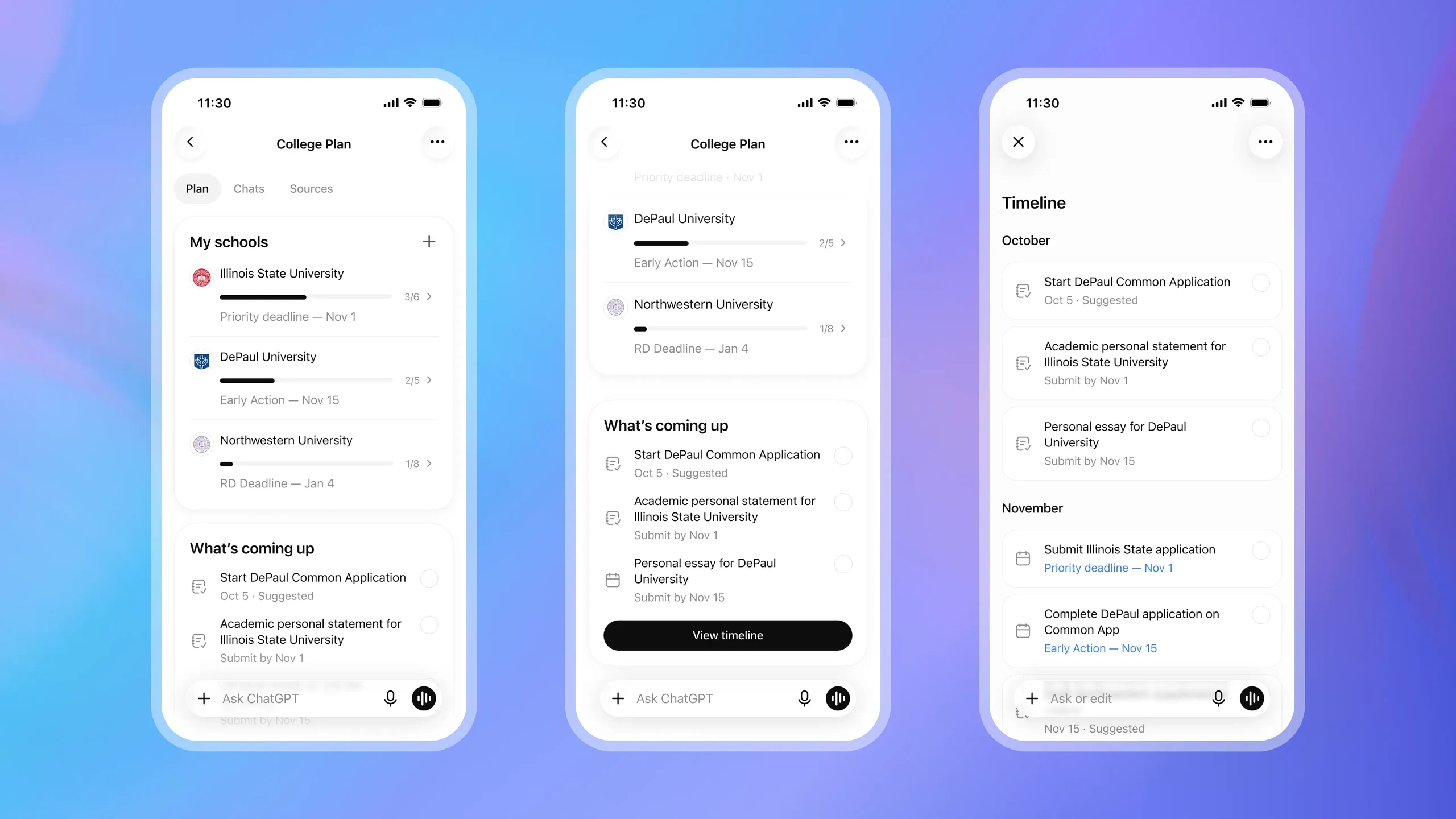
OpenAI's planned College Planner would give US high-school students a persistent place inside ChatGPT to organize applications, deadlines and financial-aid tasks. Announced on October 7, 2026, it moves the chatbot toward managing a process that lasts months. The key question is not whether an organized timeline is convenient, but whether it keeps authoritative sources and human judgment visible when a wrong date or requirement could close off an opportunity.
The initial scope is grades 10 through 12 in the United States considering four-year colleges. Other countries, two-year colleges, technical colleges and trade schools are planned later, not established coverage. OpenAI says hundreds of thousands of US teens already ask ChatGPT college-planning questions each week. That describes existing conversation use, not confirmed users of the coming College Planner or proof that it has already reached everyone eligible.
From a school list to a returning workspace
Students would start with a list of institutions. The planner would combine each school's requirements, application deadlines, aid steps and related tasks into one plan, showing progress, a timeline and unfinished work on return. A conversational layer could explain an unfamiliar requirement or help a student begin, across instructions otherwise scattered among portals, college websites, aid pages, emails and counselor documents.
Its stated role is administrative support, not choosing a school, estimating admission chances or replacing a counselor. Those boundaries matter because conversation can blur organization into advice. A student adding six colleges might discover one institution's separate aid form, another's scholarship deadline and a third's portfolio requirement in a combined timeline. The same confident interface could also make an outdated answer look definitive.
The announcement did not explain every sourcing mechanism: whether each deadline links to an official page, how changes are detected or how conflicting information is resolved. Missing public detail is not proof of unreliability, but it leaves important quality controls untested. A persistent plan can preserve useful context across sessions; it can also preserve a mistaken requirement until someone corrects it.
College Planner accompanies other educational additions for teen accounts, including flashcards, improved quizzes and continuous multi-photo capture on iOS. The capture feature combines photographs of several pages into a PDF for upload as study material. Together they point toward a continuing workspace for study, review and planning, with a larger role in the documents students upload and the information they act on.
Existing teen use explains the expansion, not its success
OpenAI introduced ChatGPT for Teens in August 2026. It automatically applies to accounts identified as under 18 and includes age-adjusted behavior, onboarding, break reminders, parental controls and restrictions on sensitive interactions. That identification condition matters: the description is not a guarantee that every minor is correctly recognized.
The company reported approximately 2.7 million additional learning-related messages in its comparison with comparable users without access, described in terms of an average. The reporting does not support interpreting that as 2.7 million messages per individual teen. OpenAI also said nearly 1.2 million teens used Learning Visualizations in one week and more than 180,000 used Study Mode. These are company figures, not independently audited learning outcomes.
Frequently selected conversation starters concerned developing ideas, reviewing drafts and checking evidence. OpenAI presents the teen experience as active learning that keeps students questioning information and connected to teachers and other people. A months-long application process offers repeated small questions and a reason to return, but usage and saved context alone cannot demonstrate accurate guidance.
Official requirements must remain distinguishable from generated advice
BigFuture from College Board, school counseling systems, admissions websites and Common Application already organize parts of the process. BigFuture provides grade-based checklists, college search, scholarship discovery and deadline tracking. ChatGPT's potential advantage is synthesis and follow-up questions connected to a school list, task status, uploaded notes and earlier conversations; traditional resources often make official forms, definitions and institution-specific origins easier to inspect.
A conversational summary can conceal whether a statement comes from a college page, a general pattern or a model inference. Admission, housing, scholarships, portfolios and aid can have different deadlines. The applicable date can vary with program, residency or decision plan, and a once-correct answer can become stale when a school changes its schedule.
College Board advises using college websites for accurate deadlines. Material tasks should make the institution, form, applicant category, official source and last-checked date clear, with warnings when sources conflict. Those are safeguards the product should demonstrate, not features the announcement conclusively established. A footer disclaimer cannot do the work of verification inside the workflow.
Aid requires similar care. Students may need the Free Application for Federal Student Aid, CSS Profile, institution-specific documents or verification materials, and some aid deadlines precede admission dates. Explaining a term is different from being the final authority on eligibility, filing status or required documents. Government systems, aid offices and official instructions remain authoritative.
Counselors can recognize misunderstood requirements, unrealistic school combinations and missed local opportunities. They know course availability, transcript processing, recommendation-request timing and community scholarships that may not fit a database field. Personal notes and research can be organized in a student knowledge hub, but must not be confused with official instructions.
The human partnership can save work—or move correction downstream
OpenAI is supporting College Advising Corps, which places recent graduates as advisers in under-resourced high schools. The contribution is intended to help the nonprofit enter new states and establish an AI fellowship for participating advisers. CEO Ekaterina Struett framed the planner as preparation for adviser conversations, noting how an unanswered deadline, fee or form question can feel like a closed door.
After-hours questions, repetition without embarrassment and simpler explanations could help students with limited counseling time. Reliable first-pass handling of terminology, documents, fee waivers and deadlines could free advisers for affordability, educational fit and family circumstances. A model can summarize factors; it does not share responsibility for the decision's consequences.
The opposite outcome is possible too. Incorrect, overconfident or stale AI guidance can create new correction work. Visible sources let professionals review a plan efficiently; without them, counselors must reconstruct its basis. The fellowship can help test whether repetitive work actually falls or verification is merely pushed downstream.
Schools may welcome a supplemental planner or restrict ChatGPT for privacy, academic-integrity or safety reasons. A consumer product cannot assume school endorsement or require counselors to use the same platform to remain useful. Access also does not ensure equity: students with experienced adults have someone to catch mistakes, while unsupported students may trust the chatbot more precisely because no checker is available.
Personalization exposes more than deadlines
Students may discuss grades, family finances, citizenship, disabilities, preferences or rejection fears, and upload identifying documents. OpenAI has not said the planner requires all those details. Conversation can nevertheless invite voluntary disclosure that a student mistakes for an official form requirement. Collection should be minimized and the need for requested information explained.
For linked parent accounts, the teen experience offers selected settings, Quiet Hours and limited high-risk notifications, alongside break reminders. OpenAI says teen use averages under 15 minutes daily and fewer than 2% spend more than three consecutive hours. These company engagement numbers do not establish safety.
On October 7, Common Sense Media published a critical assessment of ChatGPT for Teens, raising failures in crisis support, parent alerts and friend-like responses when teens treated the system as a person. OpenAI disputed the methodology, telling the Associated Press that much testing might have preceded full activation of parental controls and calling the findings inaccurate. The dispute concerns broader teen interactions, not a direct College Planner test or evidence of missed application deadlines.
Admissions planning is not usually a crisis scenario, but anxiety, money pressures, family conflict and fears about the future can arise from a deadline conversation. A planner needs boundaries around task-focused help, offline support and imitation of emotional authority. Product-specific source links, update times, conflict warnings and a distinction between confirmed requirements and generated suggestions address a different but equally concrete accuracy risk.
Essay boundaries are separate again. Scheduling drafts or interpreting a prompt is not authoring a personal statement. Colleges do not share one generative-AI policy; permission to use an organizer does not make all AI assistance on submissions acceptable. Institution-specific rules still need checking.
Student Defense warns about bias, incorrect information, privacy and unequal outcomes in admissions, aid and counseling. Its analysis mainly concerns institutional systems, not a test of this planner. Its principles of data minimization and human accountability are nonetheless relevant when AI is placed on the applicant's side.
OpenAI is also supporting Boston Children's Hospital's Digital Wellness Lab and an independent Student Advisory Council for three years. About 22 students are expected to participate in digital-wellness and AI tracks during the 2026–2027 school year. Teen input may reveal interface problems adults miss, but consultation is not a substitute for independent accuracy tests, transparent incident reporting or measurable safeguards.
What would demonstrate that the planner helps
Three kinds of evidence matter: visible authoritative sourcing with change handling; independent tests of realistic applicant scenarios; and sustained effects on students and counselors. Evaluations should cover changing deadlines, ambiguous requirements, aid questions, privacy controls and inappropriate essay requests, with errors reported by task. A harmless explanatory mistake and a missed filing date should not disappear into one aggregate score.
Advisers should see fewer repeated questions without more correction work, while students complete correct tasks, verify official sources and understand limits. Credible error response requires quick corrections, visible history and institution-specific reporting. Feedback from the fellowship and student council can contribute, but broader outcomes—not conversation volume—must establish value.
The expansion roadmap is another access test. Community colleges, certificates, technical and trade routes have different schedules, funding, licensing and local partnerships; supporting them requires more than extending a school database. A four-year degree should not quietly become the default definition of success. Later coverage remains a plan whose timing and depth have to be demonstrated.
The useful division of labor is an organizer and starting point alongside trusted people and official systems. Important dates belong back on college websites, aid instructions with official offices, and consequential choices in conversations with advisers and families. If verification is built into the product rather than left to student caution, the planner could reduce a genuine burden. If fluency becomes unquestioned authority, convenience would displace the safeguards applicants most need.
Sources and related reading
OpenAI learning and College Planner announcement · ChatGPT for Teens · College Board checklists · Related reading: student research hub · AP report on disputed teen-safety assessment · Student Defense higher-education analysis · Original discovery report