
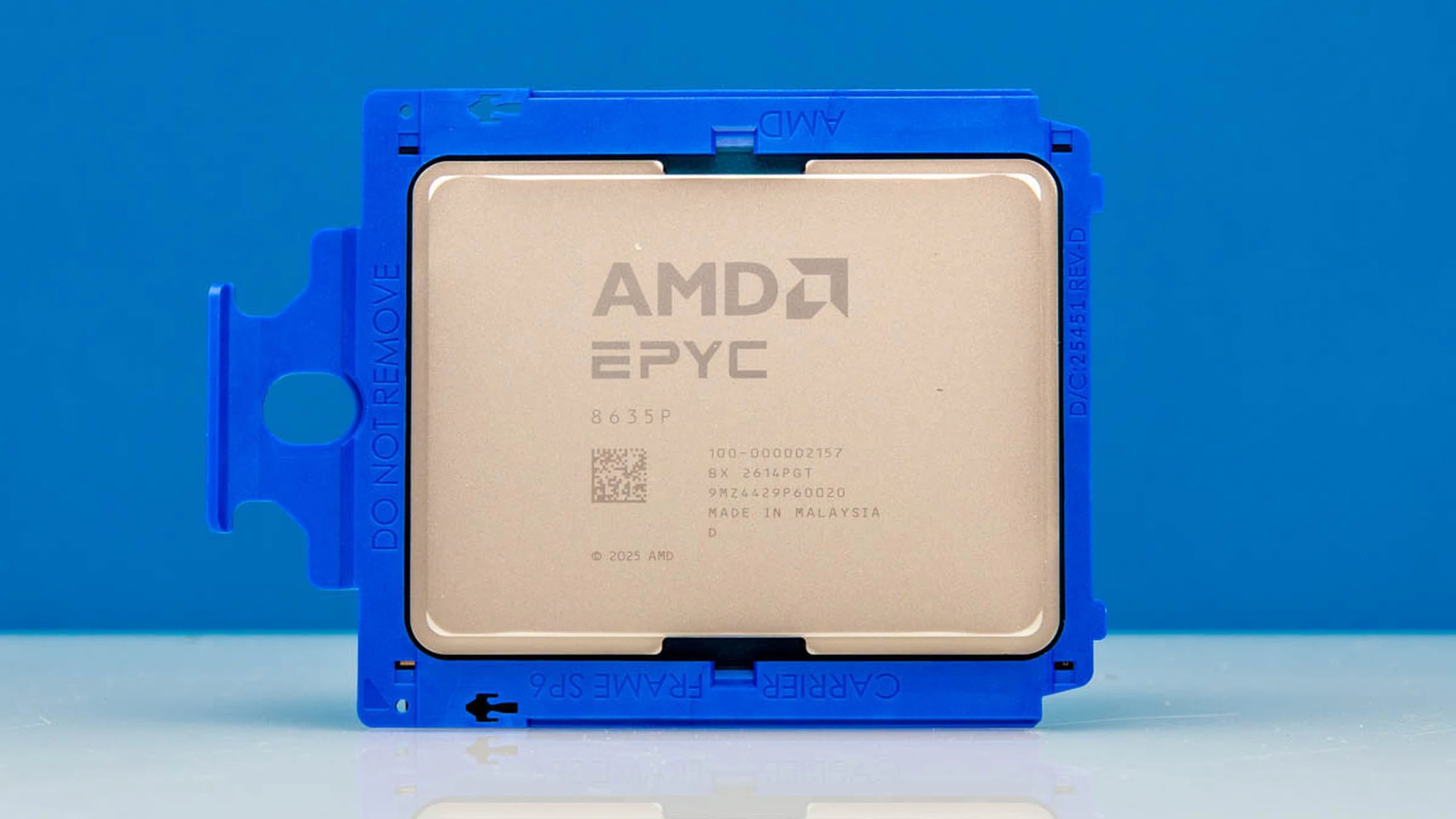
AMD’s EPYC 8005 “Sorano” family expands its compact single-socket server offering from eight to 84 full Zen 5 cores while keeping the same memory channels and PCIe connectivity across seven processors. That consistency removes some artificial feature segmentation. It does not make the largest model the best value for every workload: shared bandwidth, cache, software licensing and sustained clocks change the economics substantially.
The ServeTheHome SKU analysis positions Sorano as a broader mainstream option than its predecessor, not merely an edge refresh. It challenges Intel Xeon 6 and overlaps more of AMD’s larger EPYC 9005 market. The important choice is which resource a complete server needs, rather than the biggest core count available in SP6.
Seven processors, one shared platform
The lineup maps core count to model as follows: EPYC 8025P has eight cores, 8125P has 16, 8225P has 24, 8325P has 32, 8435P has 48, 8535P has 64 and 8635P has 84. All use full Zen 5 cores, unlike the compact Zen 4c cores in EPYC 8004 Siena.
Every model supports six DDR5-6400 memory channels and 96 PCIe Gen 5 lanes for storage, networking and accelerators. All have a maximum boost of 4.5 GHz, but that is not a promise for all active cores. The configurable thermal-design-power envelope spans 70–225 watts across the family. Workload, cooling, firmware and power configuration determine sustained behavior.
An eight-core 8025P therefore retains unusually substantial memory and I/O for storage or network appliances that do not need dozens of compute cores. The 16-core 8125P adds headroom but has a lower all-core frequency than the 24-core part. The 8225P’s reported 4.1 GHz all-core boost makes it relevant to serial stages and per-core-sensitive applications.
The 8325P offers 32 cores and a balanced general-purpose profile. The 48-core 8435P moves toward virtualization and parallel services without the top models’ degree of resource sharing. The 64-core 8535P is less obvious value than its position suggests: the 84-core 8635P adds 20 cores for just 15 more watts at default TDP, 225 watts versus 210.
The flagship is the throughput candidate, not a universal speed winner. Its reported all-core boost is 3.45 GHz, below the 8225P’s 4.1 GHz. Applications unable to use many threads can favor fewer, faster cores, while lightly threaded boosts remain subject to operating conditions.
A larger generational change than the socket suggests
AMD’s platform information contrasts Sorano with Siena: up to 84 full Zen 5 cores rather than 64 Zen 4c cores, maximum boost rising from 3.15 to 4.5 GHz, memory support from DDR5-4800 to DDR5-6400, and maximum configurable power from 200 to 225 watts. SP6 remains a compact single-socket platform, but its workload range broadens.
Capacity disclosures need careful reading. AMD’s product page lists up to 3 TB per socket for 8005 versus 1.5 TB for 8004. Architecture documentation describes support up to 6 TB under broader platform conditions. These are not grounds to assume every orderable server supports 6 TB: buyers need the manufacturer’s validated memory configurations.
Keeping SP6 also does not guarantee a drop-in upgrade. AMD requires manufacturer enablement and a BIOS update for boards designed for 8004, and some vendors offer new Sorano boards. Physical fit alone cannot establish firmware, power delivery, cooling or memory support, particularly at remote edge sites where maintenance is costly.
A fixed I/O die manages memory and external connections even on low-core models. ServeTheHome calculates nearly 12 watts of default TDP per core for the eight-core part versus about 2.7 watts for the flagship. Those are TDP ratios, not measured wall-power efficiency. Fewer cores retain the same supporting circuitry while receiving more shared resources per core.
Cache and bandwidth change the value calculation
The eight-, 16- and 32-core models provide 8 MB of L3 cache per core. The 24- and 48-core parts provide about 5.3 MB, the 64-core part 4 MB, and the 84-core part less than 4.6 MB. L3 reduces slower trips to system memory, so cache-sensitive applications may not scale in proportion to cores.
Across six DDR5-6400 channels the platform offers approximately 307 GB/s. An even division is about 38 GB/s per core at eight cores but only 3.7 GB/s at 84. Real software does not divide bandwidth uniformly, yet the contrast explains why memory-bound analytics, scientific work, packet processing or software-defined storage can stop gaining from extra cores.
Per-core software licenses can reverse the hardware advantage. More enabled or assigned cores can increase database or enterprise software charges without improving useful throughput. Virtualization also needs peak and tail-latency analysis: several guests can contend for cache, memory or storage even when average CPU use looks modest.
The 32-core 8325P is therefore ServeTheHome’s broad general-purpose candidate. The 24-core 8225P suits frequency-sensitive or limited-scaling workloads. Small models deserve attention when drives and network ports, not computation, dominate. These are workload hypotheses, not independent measurements proving one SKU best everywhere.
Vendor comparisons have a defined scope
AMD reports a SPECrate2017 integer score of 667 for an EPYC 8635P reference system at 225-watt TDP, against 634 for a 72-core Intel Xeon 6776P-B system at 325 watts. AMD also claims higher performance per watt, a small per-core advantage and roughly 48% better value in a comparison combining processor power and processor acquisition cost.
The benchmark disclosures matter: these are selected vendor comparisons across systems with different memory configurations and firmware, not a universal application advantage. TDP is not whole-server energy consumption. Acquisition cost and power combined in AMD’s metric are not a substitute for a full licensed-system cost model.
Intel can still differentiate through workload accelerators, software certification, procurement relationships and fleet-management consistency. Migration testing, spare inventory and staff experience count. Within AMD’s lineup, EPYC 9005 provides more memory channels, PCIe lanes, cores, power headroom and dual-socket support. Sorano reduces platform overhead but cannot reproduce those ceilings.
Single-socket operation avoids cross-socket NUMA traffic and simplifies placement, not all locality effects: chiplets still matter. The architecture overview describes 48 CXL 2.0 lanes for coherent memory and accelerator expansion. Deployable CXL still depends on the board, firmware, operating system, devices and validated design.
The 84-core model uses seven active cores in each eight-core complex across 12 compute dies. Schedulers generally handle the topology, but latency-sensitive work should validate placement and locality. A supported processor feature alone is not proof that every server exposes it usefully.
Local inference and adoption remain conditional
AMD reports 26.9% higher throughput for an 8635P system than an EPYC 8534P system in one Qwen3-8B OpenVINO test, with improved time to first token. That supports investigating smaller CPU-based inference, not replacing GPUs for large models or demanding latency targets. Software, compiler settings and exact server configuration can alter outcomes.
The named server ecosystem includes HPE, Supermicro, ASUS, ASRock Rack, Gigabyte and Tyan. Orderable configurations, validated memory, cooling, storage layouts, certifications and management features will determine how broad the platform becomes. A partner list is not equivalent to identical availability or validation from each vendor.
AMD targets vRAN, industrial edge, cloud storage, analytics and local AI. Virtualized radio access networks run radio-processing software on general-purpose servers and require predictable latency within power limits. Samsung describes work with AMD on AI-ready software-driven networks; Wobot AI describes local edge workloads with less cloud or GPU dependence. These are partner intentions, not independent production-adoption data.
The strongest next evidence would be shipping systems and independent results across the whole range, especially the 24-, 32- and 64-core models rather than only the flagship. Sustained clocks, wall power, memory scaling, storage throughput and tail latency should be distinguished from tuned or default settings.
Sorano’s significance is a consistent server platform serving seven different compute levels. Its value comes from matching those levels to licensing, I/O, bandwidth, cache and deployment constraints. Higher density is compelling when applications scale; it is not a remedy for a bottleneck elsewhere in the system.