
Microsoft’s October 7, 2026 Windows and Surface event connected two previously separate assistant jobs: finding information and acting on the computer that stores it. Its expanded Copilot plan includes local file context, document organization, diagnostics, troubleshooting, coding and multi-step workflows on supported Copilot+ PCs. The important shift is authority over the environment, not just a faster answer.
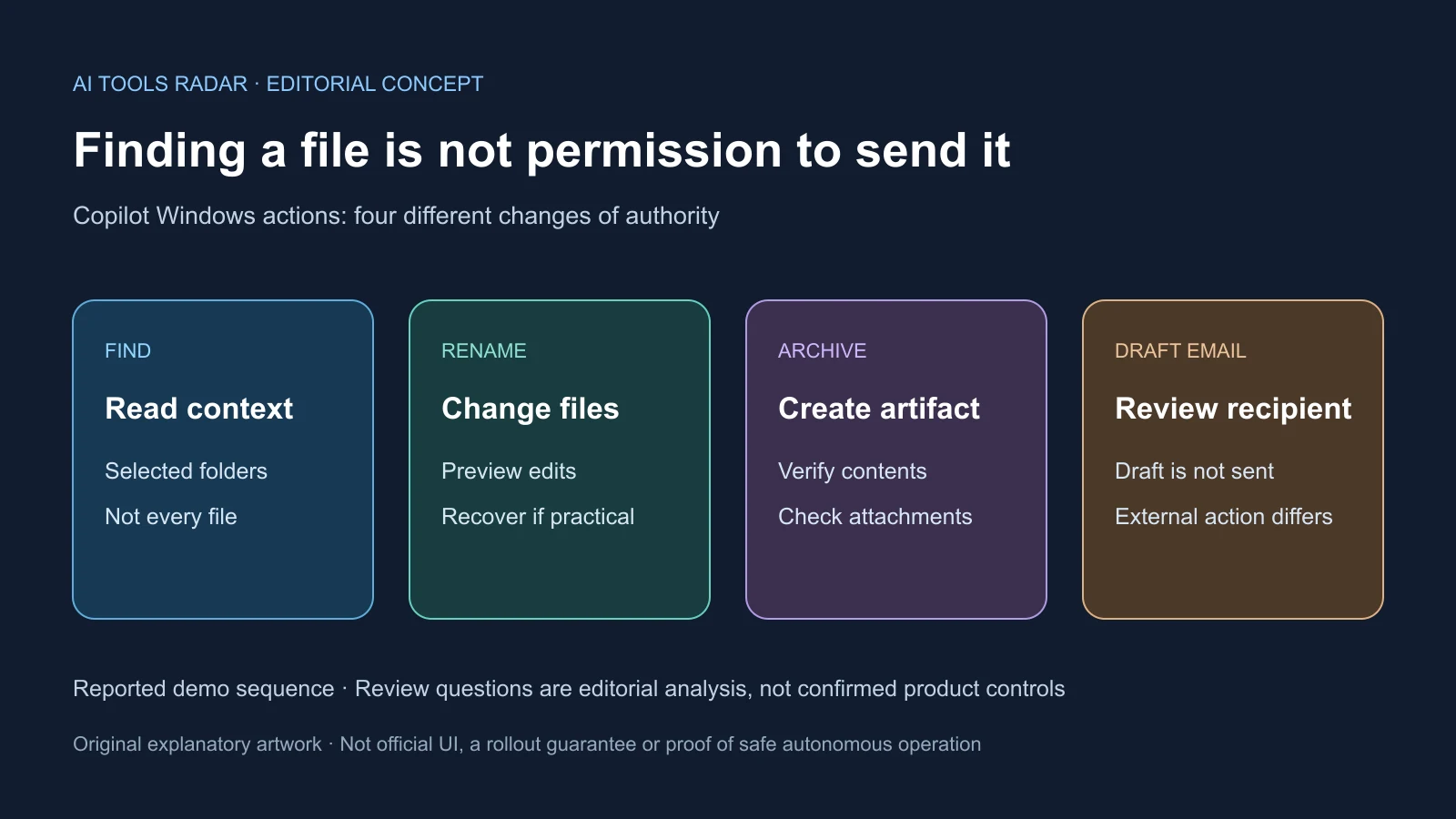
A demonstration reported by The Verge made that shift tangible. An Autopilot agent searched several folders for tax documents, renamed them, created a compressed archive and drafted an email to an accountant with the archive attached. Drafting is not sending. Each transition changes either file state, creates a new artifact or prepares information for an external recipient, even though the user gave one natural-language goal.
The rollout has several different clocks
Earlier Copilot semantic search interpreted meaning rather than requiring exact filenames. An August 2025 Insider preview could find a résumé or photograph; users then selected a file to send explicitly into a conversation. Retrieval did not by itself authorize an application-spanning sequence.
The new hybrid-intelligence plan extends from retrieval to execution with permission. Separate Windows Search actions can change dark mode, mute sound, arrange windows or handle a short message from the taskbar. Microsoft describes thousands of possible actions, but these are distinct from the larger agent workflow demonstrated with the tax records.
Search actions began entering the experimental Windows Insider channel on October 7. Hybrid Copilot capabilities were to start rolling out on Copilot+ devices over coming months, varying by machine, market and silicon. A demonstration and an announced rollout do not establish that most users already have the full experience.
Microsoft also announced general availability of Microsoft Execution Containers, MXC. That is a containment component’s status, not a statement that every consumer Copilot workflow already uses every security layer. Treating the experimental interface, future rollout and available execution infrastructure as one released product would erase the very questions customers need answered.
Windows can expose actions without imitating the mouse
A third-party computer-use agent may depend on APIs, accessibility, browser automation or screenshots. Windows can instead expose structured files, settings, application actions, identities and hardware under a common permission model. A defined system action can be less fragile than a moved button or redesigned dialog, although OS integration does not guarantee the agent chooses correctly.
Microsoft calls the placement architecture hybrid intelligence. Local models can reduce latency, keep selected context on-device and limit repeated cloud inference. Larger cloud models supply capability when the local option is insufficient. A long workflow may alternate between them while maintaining context.
Microsoft says Copilot+ PCs perform more than two trillion local inferences monthly and represent over 40% of laptops being built for business. These are company figures, not independently audited utilization or safety measurements. They explain the distribution pitch rather than establish reliability.
The platform spans NPU-based everyday PCs and higher-end builder hardware. Microsoft cites Surface Laptop Ultra with up to 128GB unified memory and models exceeding 120 billion parameters, not a typical office laptop specification. The hardware launch is separate from this software question: which task can an authorized model actually perform?
GitHub’s forthcoming local-model system illustrates the routing approach. Microsoft says it can choose local or cloud-scale inference, with developers also able to select local explicitly. Its own guidance warns that local inference does not make the session offline: model execution, tools, network access and file authority have separate boundaries.
File discovery is not a blanket grant
The unit of trust is the whole workflow: model, supplied files, callable tools, reachable destinations and actions allowed without renewed confirmation. A request to organize a project may need several folders, but does not inherently authorize uploading, deleting originals or contacting outsiders.
Agent Workspace is Microsoft’s contained Windows environment with a separate agent identity and limited approved resources. Users can grant particular files or folders, with renewed approval when the task reaches beyond them. Policies and activity records are intended to constrain and reveal behavior rather than give the agent the human’s entire desktop session.
MXC translates policy into controls over files, networks, processes, credentials and system capabilities. Agent 365 adds enterprise discovery and management. The latest announcement points toward these complementary layers but does not publicly explain every consumer workflow’s implementation.
Even consistent enforcement cannot resolve all meaning. A policy can allow editing a document without knowing whether the inferred edit matches the owner’s intention. Finding a tax file, renaming it, packaging it and attaching it are different operations. A useful interface needs to show selected files, proposed names, archive contents, recipient and whether the message remains a draft.
A personal knowledge base can organize approved context and preserve sources. An OS agent adds the power to change that source environment, requiring a higher authorization standard. Enterprise classifications, retention rules, identity boundaries, external communication and audit requirements may differ sharply between family photographs and regulated customer or legal records.
A legitimate task can still encounter hostile content
Microsoft’s security guidance identifies cross-prompt injection: instructions hidden in a document, page, message or interface can be mistaken for authority. Reference material telling an agent to ignore the user must remain untrusted, even when the file itself is relevant to the task.
For example, a downloaded invoice could contain concealed instructions to add an unrelated credential file to the final archive. The user’s goal is legitimate; intermediate content is poisoned. Action-taking raises the consequence from a bad summary to file changes, commands or transmission.
An independent file boundary can block the unrelated credential. Network rules can stop an unknown destination, while an attachment preview can reveal unexpected material. These defenses do not depend on perfect recognition of malicious text. A model filter alone is probabilistic and may behave differently after an update, longer conversation or routing change.
Routing makes consistent enforcement especially important. Models can differ in capability and resistance to manipulation. File and network policies should remain in force whichever model handles a step. Consequential-action logs should identify the model, tool, agent identity and policy without requiring users to decode an internal reasoning trace.
An outcome-oriented desktop must still expose its state
Copilot’s proposition is to turn applications into steps toward a user’s goal. Email still handles the message, an archive tool packages documents and Windows controls storage; the agent coordinates them. Finding and standardizing twelve related documents can justify that coordination more clearly than renaming one file.
Troubleshooting could connect diagnostics, recent activity, an approved setting change and a check that the problem disappeared. A developer could combine private code, local inference, sandboxed tools and stronger cloud reasoning. These are promising workflows, not evidence that daily completion rates already match staged examples.
Natural language reduces navigation through settings and menus, but can hide alternatives and system state that conventional interfaces display. Users need previews, understandable activity history and practical recovery. File changes should be reversible where possible; a draft should remain a draft until unmistakably approved for external action.
Permission design can fail in either direction. Constant interruptions encourage automatic approval or abandonment; broad persistent grants can outlive the task. The useful approval names the operation, exact resources, external destination and reversible or irreversible effect, rather than merely saying Copilot wants access.
Ordinary error matters as much as attack. Similar client names, multiple contract versions or a misclassified personal document can lead to the wrong file without malicious instructions. Narrow scope and previews limit harm even when the model seems confident.
Recall’s lesson is relevant without making it the same product
Recall sought retrieval through locally captured activity snapshots and was delayed and redesigned after security objections. Copilot actions are different: intentional requests and permissioned operations rather than continuous visual capture. The comparison is not proof that their mechanisms are identical.
The shared lesson is that “stored locally” does not settle access, consent, retention or attack surface. Likewise, a local model can invoke online tools, while a cloud model can receive narrowly selected context. A request may move from local discovery to cloud reasoning and return for file changes; significant transitions need to remain understandable.
Microsoft’s OS distribution offers an advantage over standalone assistants and applications deciding whether to expose actions or build agents. Apple and Google can deepen their own OS integrations, while OpenAI and Anthropic develop computer-use tools and partnerships. Windows’ reach also amplifies mistakes: file changes and external transfers cost more than an optional chatbot’s unhelpful answer.
The useful test comes after the demonstration
Three kinds of evidence matter. First, the Copilot+ rollout should expose specific, temporary and revocable permissions with clear previews for external effects, not approval fatigue or hidden broad access.
Second, varied repeated work needs completion rates, time saved after review, incorrect-file frequency and the number of interventions. Local and cloud choices should be compared for capability and data handling. Automation fails its purpose if verification creates more work than doing the task manually.
Third, governance around November’s Ignite and subsequent releases should show agent discovery, restricted tools, incident investigation and existing identity policies working consistently across experiences. Logs must remain useful without becoming another uncontrolled copy of private information.
The substantial question is not whether an agent can finish the tax-document demo once. It is whether people can see what it will do, authorize the right scope, review the result and undo or stop a messy workflow. Microsoft’s deeper access becomes an advantage only if that authority remains intelligible to the person who granted it.
Sources
Earlier semantic-search preview · Windows hybrid-intelligence plan · Reported Copilot demonstration · GitHub local models and sandboxed tools · Personal and team knowledge-base reference · Windows agent security guidance