
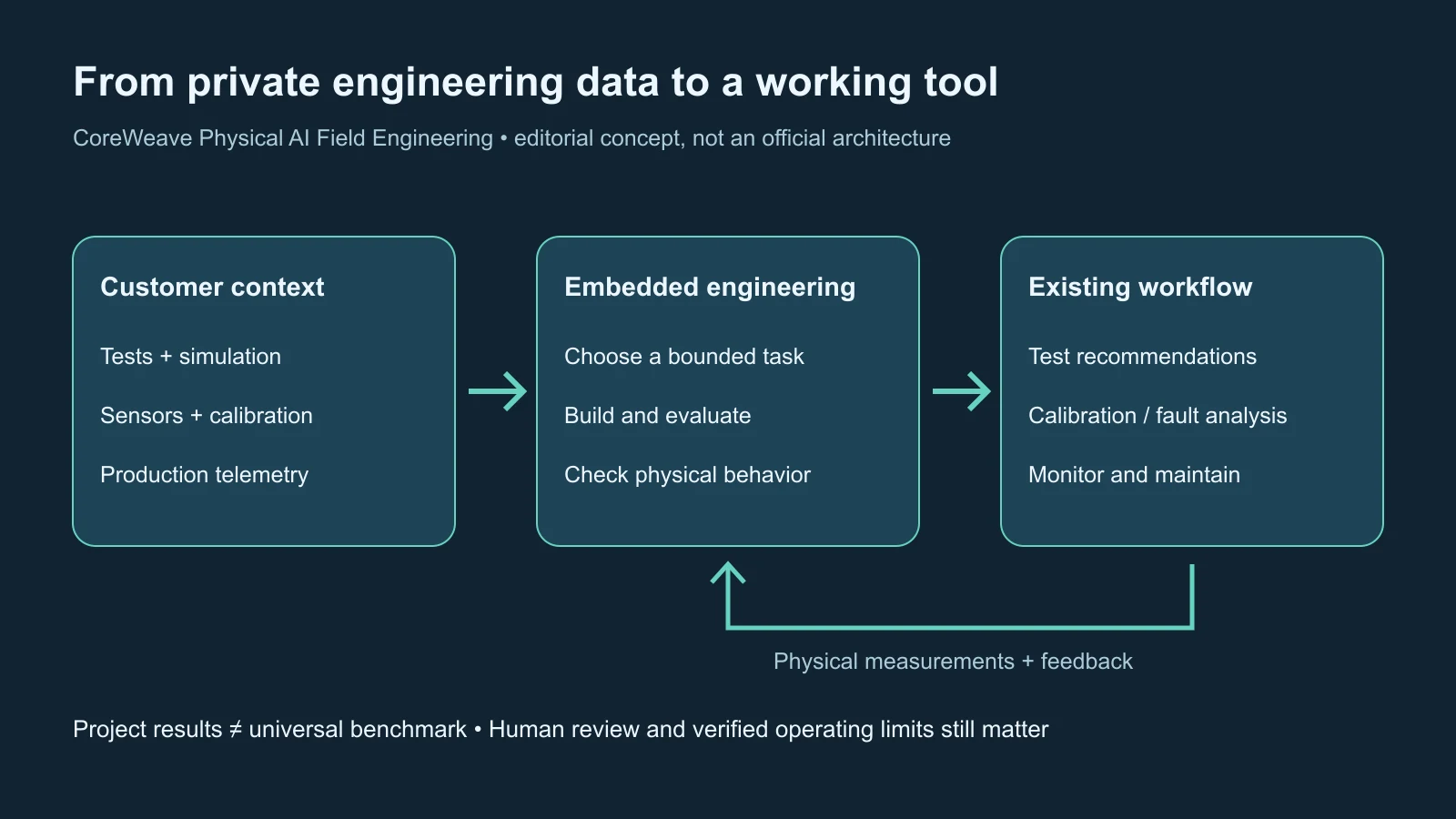
CoreWeave's Physical AI Field Engineering service moves the company into work that rented GPUs alone cannot perform: deciding how a manufacturer's private records can improve a specific engineering decision. Announced on September 10, 2026, it embeds specialists alongside customer teams to build, validate and integrate applications for physical systems. That includes testing and calibration, not only robots.
The launch combines methods from Monolith AI with CoreWeave infrastructure and acquired development tools. Nissan and motorsport examples give the proposition concrete substance. They do not yet establish repeatable results across industries, sustained performance after production changes, or that customers can maintain applications after the embedded team leaves.
Start with a decision, then assemble the system
CoreWeave says engagements begin with an on-site workshop to map workflows, inspect available data and select a practical use case. Engineers then co-build and validate models before integrating an application into an existing process. This reverses the conventional sequence of buying a general platform, training staff and only then finding a useful problem.
Inputs can include simulation outputs, test-bench results, production signals, calibration records and live telemetry. Physical AI here predicts, evaluates or influences outcomes governed by real physics: test selection, anomaly detection, fault analysis and optimization all qualify. A suspension measurement, aerospace component test and factory sensor history are not interchangeable. A generic model cannot recover missing local context simply from data volume.
The offering has four areas: strategy selects the problem and data; simulation infrastructure provides compute and storage; real-world data supports predictions and fault analysis; agentic learning connects outputs to engineering actions. W&B Models supplies experiment tracking and marimo data exploration, both from earlier acquisitions. Field engineers must bridge domain specialists, data scientists, software and infrastructure rather than merely assemble products.
CoreWeave says its specialists have completed more than 100 automotive, aerospace and industrial projects. That is a supplier-reported experience base, not proof that every engagement shares the same economics or outcome. Turning the accumulated expertise into a repeatable production service is the commercial test.
Monolith provides methods and a route into longer cloud relationships
CoreWeave acquired Monolith AI in late 2025. A company filing says the transaction included $185 million in convertible notes issued to certain former Monolith shareholders; that figure describes the notes, not a newly announced service revenue number. Monolith specialized in predictions from limited, expensive physical-test data, which CoreWeave can now connect to its cloud.
The strategy extends infrastructure differentiation beyond chip availability. Industrial work brings simulation, training, storage and deployment; shaping its workflow can influence where future workloads run. Customers comparing rented GPU capacity can weigh availability, performance and contract terms. Moving an application co-developed with embedded engineers is more complicated.
That does not make integration inherently restrictive. Expertise can create real value, especially as enterprises seek measurable operational results rather than broad experiments. But legal ownership of data and resulting models—the control CoreWeave promises—is not automatically practical portability. Experiment histories, pipelines, custom algorithms and deployed applications also need a workable route between environments.
The reported results describe different tasks
Nissan began working with Monolith before the acquisition, applying machine learning to vehicle testing, including chassis bolt-joint behavior. Historical records helped predict outcomes and identify informative experiments. Nissan reported 17% fewer physical tests than its previous process while preserving validation standards. The companies later extended the relationship for three years, intending to expand European vehicle-development work.
That example starts with decades of Nissan simulations, test results and engineering knowledge. Younger manufacturers may have fragmented records, inconsistent sensors and few rare-failure examples; established firms can also struggle to combine differently collected data. Reliable labels, traceable conditions and operating-range coverage matter more than raw volume. Routine training data may be least useful precisely where a rare condition is safety-critical.
CoreWeave's technical brief separately describes a calibration cycle cut from three months to 24 hours, characterization work with up to 35% fewer tests, and another example using one-twentieth as much captured data while maintaining target accuracy. These are distinct reported project results, not a standardized independent benchmark or a combined guarantee. Data quality, test design, model selection and the acceptable-accuracy definition shape each comparison.
For Aston Martin's Formula One team, CoreWeave says its tool transcribes and categorizes 40 competitor-radio channels within five seconds during a race. For Cadillac Hertz Team JOTA, a recommendation application reads a seven-post suspension-test rig and suggests the next setup to evaluate. These examples narrow a decision space that people cannot exhaust in the available time; they do not show autonomous control of all vehicle systems.
Test rankings can be checked against subsequent experiments, calibration against measurements, and fault correlations against known incidents. Direct equipment control carries a higher burden: verified operating constraints, tighter safety controls, monitoring and fallback behavior. “Agentic learning” means software selects or executes actions toward a goal; the label does not remove the need for human review when mistakes have serious consequences.
The incumbent competitor is the engineering workflow
CoreWeave enters organizations already using computer-aided engineering, digital twins, test management, statistical analysis and procedures shaped by past failures, regulation and safety obligations. Its focused entry point may let one use case proceed without redesigning the entire software architecture. A useful demonstration, however, must enter the approved workflow to produce durable value.
Nvidia's industrial network includes Cadence, Dassault Systèmes, PTC, Siemens and Synopsys in accelerated simulation and digital twins. Siemens and Nvidia describe an Industrial AI Operating System linking design, engineering, manufacturing, operations and supply-chain data. Existing vendors can own the interface, engineering data model and long-term customer relationship. They are potential integration partners and constraints on CoreWeave's workflow ambitions.
Any production application must connect with identity, data governance, monitoring and established engineering software. Responsibility for maintenance, retraining and response to changed conditions cannot be inferred from prediction accuracy. Partnerships could simplify deployment while limiting CoreWeave's share of the relationship; a more closed environment could capture more value while heightening portability concerns. Comparable incumbent services would force differentiation through delivery speed, domain knowledge or infrastructure performance.
A physically plausible model is more than an accurate average
CoreWeave says engineers validate against physical behavior, not only held-out data. Historical correlations can originate in an instrument, procedure or environment rather than the underlying system. A model with good average performance can fail near a safety limit. Plausibility may require conservation laws, known material limits, simulation comparisons, expert review or controlled hardware tests; the implementation varies by customer.
Validation must also state where a model should abstain rather than confidently extrapolate outside its training range. Components, suppliers, firmware, tolerances and environments change. Monitoring by relevant operating segment, not just one aggregate score, is necessary after process updates. Explicit limits need corresponding acceptance criteria, contractual deliverables and maintenance ownership.
Fewer tests or faster calibration are meaningful only while minimum quality, safety and confidence remain intact. False-alarm reduction and improved fault detection likewise need defined outcome measures before development starts. Launch materials did not publicly explain engagement scope, embedded-team duration or how service commitments change after deployment, leaving these commercial and operational responsibilities unresolved.
Customer independence is part of the production test
Practical control includes training records, feature definitions, model versions, evaluations and deployment documentation, plus internal knowledge sufficient to inspect or replace the application. Concentrated external expertise can accelerate delivery but becomes a dependency if the customer cannot operate independently afterward. Replacing knowledge held by a few employees with an opaque outside workflow would reproduce the problem.
Searchable records of assumptions, test evidence, model changes and approvals support knowledge transfer, provided sensitive material is governed appropriately. Proprietary test and telemetry data can expose product behavior, manufacturing methods and unreleased designs. Data location, access, retention, isolation and incident response therefore remain concrete questions despite the promise of customer control.
Scaling also creates a tension between reusable components and local validation. Automotive calibration expertise does not automatically transfer to aerospace materials or industrial robotics. Excessive standardization can ignore physics; insufficient reuse leaves labor-intensive consulting with uneven margins. More than 100 projects supply experience, not a settled answer to that tradeoff.
The strongest next evidence would span aerospace, robotics, energy and manufacturing with measurable results and documented validation. Longer production periods, retraining frequency, operator adoption and performance after workflow changes matter alongside deployment counts. Expansion from one customer problem to several would test whether models, pipelines and trusted methods are genuinely reusable rather than rebuilt each time.
Nissan's extension supports local value, while the broader claim remains open. The important distinction is between persuasive pilots and maintained production applications that preserve safety, portability and customer expertise. CoreWeave is selling the integration between private context, physical constraints and daily decisions; lasting expansion beyond GPU infrastructure depends on repeatedly making that integration work.
Sources
Service announcement · Technical brief · Nvidia industrial software partnerships · Nissan project · Related reading: engineering knowledge base · Original discovery entry (Google News aggregation)