
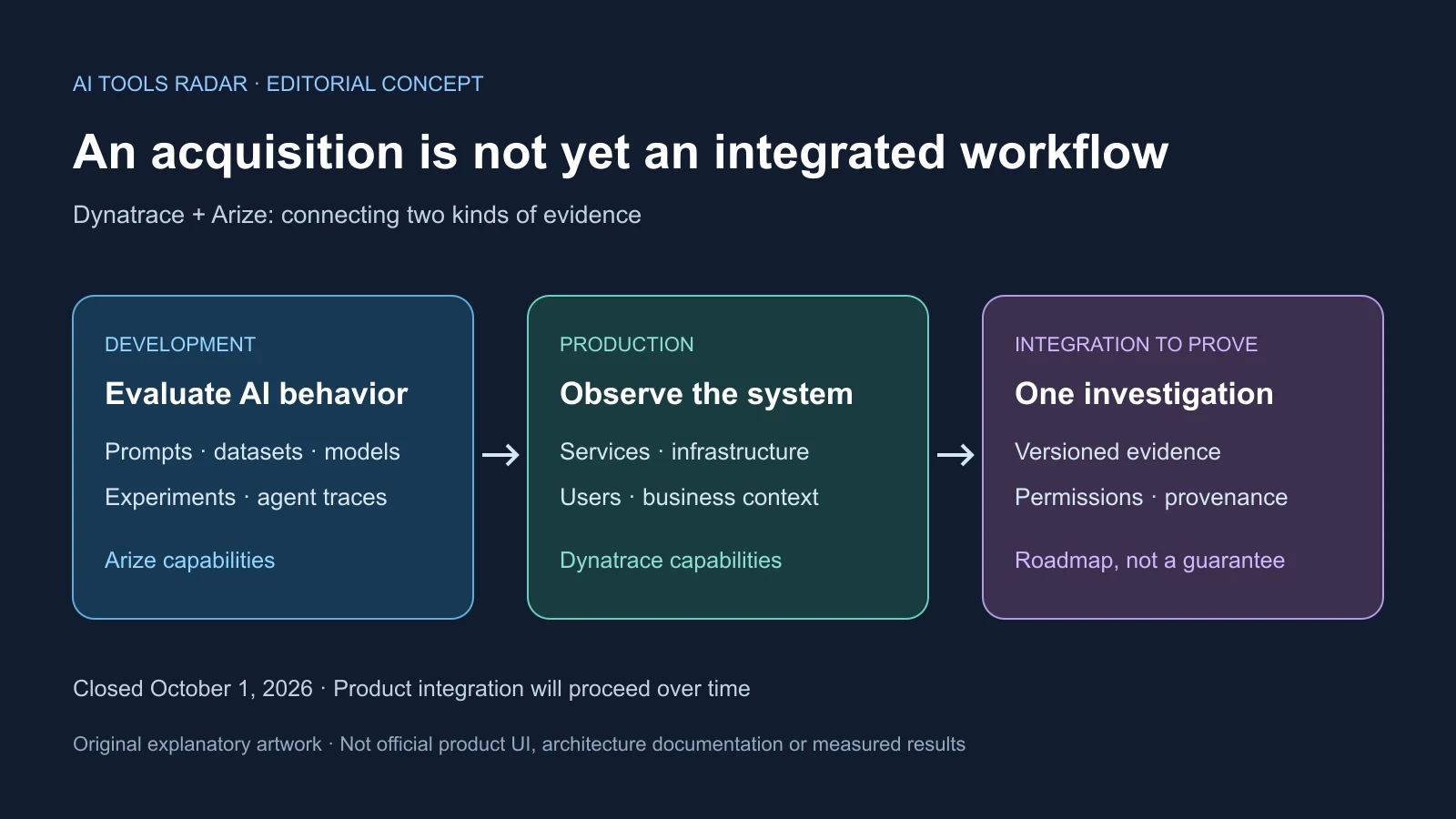
Dynatrace completed its acquisition of Arize on October 1, 2026, bringing AI tracing, evaluation and experimentation under the same ownership as a broad production-observability platform. The immediate result is a closed transaction and aligned products, not proof that every development and operations workflow already runs as one system.
The strategic question is concrete. When an agent produces an irrelevant answer, calls the wrong tool or loops expensively while every service returns a normal status code, which team can reconstruct the failure? Arize contributes evidence about AI behavior; Dynatrace contributes infrastructure, applications, user experience and business-process context. Combining them is plausible. Preserving their meaning across the handoff is the work still ahead.
What changed at closing
The agreement was announced on August 13 with a stated value of $915 million, including approximately $815 million in cash and replacement equity awards for Arize employees joining Dynatrace. Dynatrace said it planned to finance it with cash on hand, its existing credit facility or both. The cash component should not be confused with the total transaction value.
At signing, Dynatrace projected roughly 200 basis points of additional annual recurring revenue growth in fiscal 2027 and a 175-basis-point reduction in non-GAAP operating margin that year. One hundred basis points equal one percentage point: these were company expectations, not independently established results after integration.
Co-founders Jason Lopatecki and Aparna Dhinakaran joined Dynatrace. Lopatecki continues leading Arize and reports to chief executive Rick McConnell. Dynatrace says it will keep supporting Phoenix, Arize’s open-source observability and evaluation project, and AX, the enterprise platform for traces, experiments, datasets and evaluations.
Arize capabilities are to enter the wider Dynatrace platform over time through a shared roadmap. Customers have a direction, not a complete integration timetable. Continuity of the team and products matters because Arize’s value includes developer trust and specialized investigative workflows, not just dashboard features that can be relabeled.
Why a healthy service can still have an unhealthy agent
A conventional monitor can show whether a request finished, how long it took and which dependency failed. An AI evaluation asks whether the response was relevant, supported, safe and useful, or whether the chosen tool and action sequence made sense. Availability and behavioral acceptability are different questions.
Generative applications change with prompts, retrieved documents, model versions, tool results and conversation history. Agents may plan, revise and delegate. A successful HTTP response can conceal unsupported advice, sensitive-data exposure, wasted actions or an incorrect business outcome.
A trace records the request’s steps; an evaluation checks behavior against specified criteria. Before release, teams use representative datasets and experiments. In production, they may evaluate samples, feedback or known failures. Connecting these records to services, hosts, databases and customer interactions gives AI engineers, SREs, security and business owners a shared incident account.
Dynatrace’s vendor-sponsored survey of 919 senior leaders responsible for agent implementation illustrates the demand, with appropriate limits. Fifty-two percent cited security, privacy or compliance as a leading production barrier, 51% cited managing and monitoring agents at scale, and 44% cited skills or training shortages. These are respondents’ concerns, not measured incident rates or proof of the acquisition’s effectiveness.
The purchasing shift follows the operational one. A developer can adopt an experimental tool quickly; a customer-facing deployment draws platform, procurement, security and compliance teams seeking consistent access and retention. Dynatrace gains a route into development, while Arize gains distribution among complex production estates. Neither advantage automatically resolves ownership disputes or defines acceptable behavior.
Two similar symptoms, two different responsible systems
Consider a support agent that retrieves policy documents and can issue account credits. Before launch, developers compare prompts, models and datasets for relevance, policy compliance, tool choice and task completion. After launch, live language and data interact with permissions, missing documents and infrastructure changes.
If answers become incomplete, an evaluation may detect declining relevance even though the model is unchanged. Production telemetry could reveal a retrieval slowdown after an infrastructure update, causing a timeout before the useful document arrives. Another similar incident could have healthy retrieval but a revised prompt that selects the wrong tool. The first involves operations; the second points more directly toward AI development.
Cost likewise needs both views. More spending may reflect higher traffic, longer prompts, repeated tool calls or ineffective loops. Infrastructure data identifies usage changes; agent trajectories explain decisions. Security investigators need the prompt, retrieved context or intermediate choice behind a service call and permission failure, not only a count of requests.
A useful combined record must preserve versions of prompts, datasets, models, tools and evaluators. A changing score may reflect a new test dataset or evaluator rather than a better model. Experimental traces must remain distinguishable from customer-facing traces, with identities, environments, roles and access policies aligned rather than silently merged.
More evidence also means more sensitive data. Prompts and responses can contain personal information, confidential documents or accidentally supplied credentials. Redaction, regional storage, access logging, deletion and retention must work across inherited and integrated products. Customers also need contractual clarity about training use and whether evaluation data leaves their controlled environment.
Detailed trajectories add storage and processing cost. Sampling and filtering must not erase rare security failures merely because common latency events are easier to summarize. Shared evidence is helpful only when it remains diagnostically useful, appropriately restricted and affordable to retain.
Open instrumentation leaves room for mixed toolchains
Datadog already combines agent tracing, evaluations, experiments and production monitoring, including visibility into external agents and permissions. New Relic treats agents and tools as observable entities and documents frameworks including LangGraph, Strands and AutoGen. LangSmith, Langfuse, Phoenix and other specialists compete through focused prompt, dataset and evaluation workflows.
The choice is therefore not simply one vendor against another. An integrated platform offers common identity, telemetry and incident context; a specialist can offer faster framework coverage and deeper experimentation. A team may use open-source evaluation while exporting traces to an enterprise platform.
OpenInference instruments model calls, agent actions and retrieval steps. In 2026, Arize proposed donating selected instrumentation libraries to OpenTelemetry; the accepted grant covered code for several languages and AI frameworks. It did not transfer the whole project, its specification or semantic-convention packages.
OpenTelemetry’s vendor-neutral traces, metrics and logs can reduce dependence on proprietary collection. Open instrumentation does not replace evaluation datasets, experiments, annotations or investigation workflows, and exporting traces does not guarantee these other assets are equally portable.
Dynatrace says it will preserve Phoenix, OpenInference and their builder communities. There is no announced plan to restrict them. The issue is future incentives: a platform owner may favor commercial integrations, while developers need neutral backends, credible governance and timely maintenance. Repository releases, outside contributions, issue handling and compatibility will test the commitment.
Evidence of integration must follow the acquisition
Combining data models, permissions, interfaces, support and billing can leave two branded products side by side or standardize away the flexibility AI engineers need. Neither a shared login nor an embedded dashboard establishes a connected investigation. Operations teams’ alerts and service objectives should coexist with developers’ detailed traces and rapid experiments.
Dynatrace’s Davis AI and causal-analysis capabilities offer a potential route from agent decisions to technical and business effects. That remains a product direction, not a completed outcome proven by the deal. Demonstrations should reproduce a customer’s actual failure across models, frameworks, clouds and backends without requiring wholesale migration.
The financial projections create pressure for cross-selling and efficiencies, but do not reveal whether growth will come from new customers, contract expansion or retained Arize usage. Recurring revenue, margins, customer retention and detailed integration commentary will provide stronger evidence than logos or the announcement alone.
Three signals matter next: released workflows preserving development-to-production provenance; healthy, neutral Phoenix and OpenInference maintenance; and financial and customer evidence that the combination reduces investigation friction. Teams can map where experiments, evaluations, traces and incident knowledge currently live, including the relationships retained in a searchable engineering knowledge base. The gaps, rather than a feature count, determine whether consolidation is useful.
Dynatrace has acquired credible technology, experienced founders and a developer community. The case for full-lifecycle AI observability will be established by what teams can diagnose after closing—not by treating the closing itself as completed integration.
Sources
Completed acquisition announcement · Original transaction terms · Dynatrace agentic-AI survey · Datadog agent monitoring · New Relic agent documentation · OpenTelemetry instrumentation grant · Engineering knowledge-base reference · Original news record