
A humanoid robot can make a compelling demonstration because it can reach the doors, controls, tools and stairs that people already use. That compatibility is real. It is not proof that the machine is dependable in a hazardous setting, and it certainly is not proof that an armed system should make its own decisions.
Recent reporting on Foundation's Phantom MK-1 and related military research is best read as an early evaluation signal. Public accounts describe field testing and ambitious plans, but they also describe short endurance, limited payload, environmental sensitivity and extensive supervision. The useful question for an operator is narrower: which dangerous support task can this machine complete more safely and reliably than a simpler alternative?

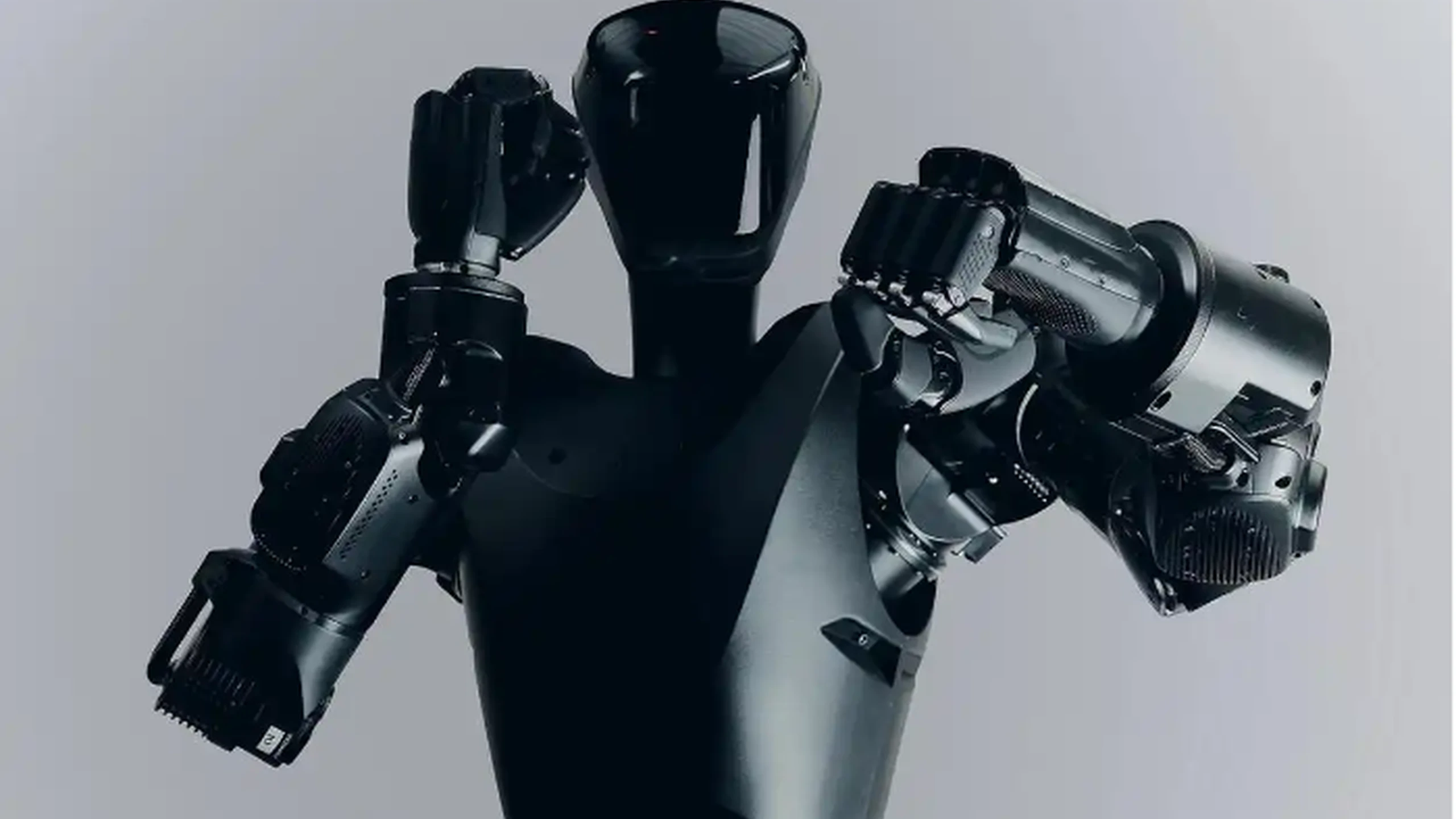
Source-attributed image shown by The Paper in its reporting on Foundation's humanoid robot. It identifies the reporting context; it is not evidence of a field result, autonomy level, or safe use of force.
Begin with the task, not the silhouette
A robot's human shape matters most where a site was designed for human reach and manipulation. Opening a standard door, moving an object between shelves, operating a control panel or inspecting a confined industrial area may justify hands and two-legged access. Carrying a load along a known route, however, may be better served by wheels, tracks or a four-legged platform.
Write the task in observable terms before comparing products. Name the payload, route, weather, communications conditions, operator role, prohibited actions and evidence that counts as completion. A video of a robot standing, walking or holding an object does not answer those questions. A useful trial records repeatable task completion, operator interventions, falls, recharge time, repair work and safe stops.
This avoids a common procurement error: comparing a complex humanoid to an imaginary baseline. Compare it with the simplest machine that can safely do the same job. If a wheeled carrier completes the route with more payload, longer endurance and less recovery work, human-like hands are not a benefit for that mission.
Treat field exposure as a test, not a verdict
A deployment near a hazardous area can reveal far more than a controlled demonstration. It can also reveal why a prototype is not ready. The public reporting around Phantom MK-1 should therefore be described as field evaluation unless independent data establishes mission rates, conditions, failures and maintenance needs.
Ask what evidence is available beyond selected footage. Does the record show the operating hours, weather, terrain, payload, link interruptions, successful recoveries and failures? Does it separate a remotely directed movement from a behavior the machine selected itself? Are there results from repeated tasks, not a single favorable run?
The answer may remain incomplete in public. That is not a reason to fill gaps with a cinematic narrative. It is a reason to limit claims and keep the next test small. An early trial may still be useful if it identifies the exact conditions under which the robot loses balance, exhausts its battery or needs human repair.
Make human judgment a system requirement
In hazardous support, autonomy is not a single on-or-off feature. A system can navigate a mapped corridor, maintain balance, identify a tool, request help and still require an operator to approve consequential actions. Those boundaries need to be explicit before a pilot begins.
Use a control plan that states what the robot may do without a new instruction, what requires a supervisor, what must stop immediately and how the operator verifies the final state. Test degraded communications as carefully as normal operation. A useful machine should fail visibly and move to a safe state when sensors disagree, a link is lost or the task falls outside its approved scope.
This is especially important where a robot might encounter people. A perception error, damaged sensor or ambiguous signal can turn an otherwise routine action into harm. Human judgment over the use of force is a governance boundary, not a performance feature to optimize away. The appropriate near-term applications are support, inspection, logistics, emergency response and other tasks whose success can be checked without delegating irreversible decisions.
Measure resilience as a whole system
Humanoid mobility consumes energy continuously: balance, joints, perception, computing and communications all draw from the same operating budget. Adding a payload, climbing an obstacle, working in heat or recovering from a fall changes that budget. Published maximum runtime figures are therefore only a starting point.
Test the complete configuration at the expected duty cycle. Record time on task, energy remaining, thermal behavior, communications quality, operator attention, sensor faults, falls and time to recover. Include the equipment that makes the machine useful, not just the base robot. A configuration that performs well in a clean indoor video may not survive rain, dust, vibration or an interrupted network.
Service matters as much as hardware. Teams need spare parts, trained maintainers, secure software updates, clear diagnostic logs and a way to recover a disabled machine. A robot that protects a person on one task but creates a long, exposed recovery operation on the next has not yet delivered a safety gain.
Decide with a bounded comparison
The sensible next step is a supervised pilot around one permitted mission. Use a measurable success condition and a comparison platform. Keep the initial scope reversible: a known environment, limited hours, an operator who can stop the system, and an agreed recovery plan.
Review more than the headline result. Compare completed missions, human exposure avoided, intervention rate, energy use, repair time, operator workload and failure modes. Document what the machine could not do as carefully as what it could.
Humanoid robots may become valuable where existing spaces and tools reward human-like manipulation. That possibility deserves disciplined testing. It does not remove the need for simpler machines, rigorous operational evidence or meaningful human accountability. The strongest claim an early prototype can earn is not that it replaces a person; it is that it completed one bounded, supervised task safely enough to justify the next test.