
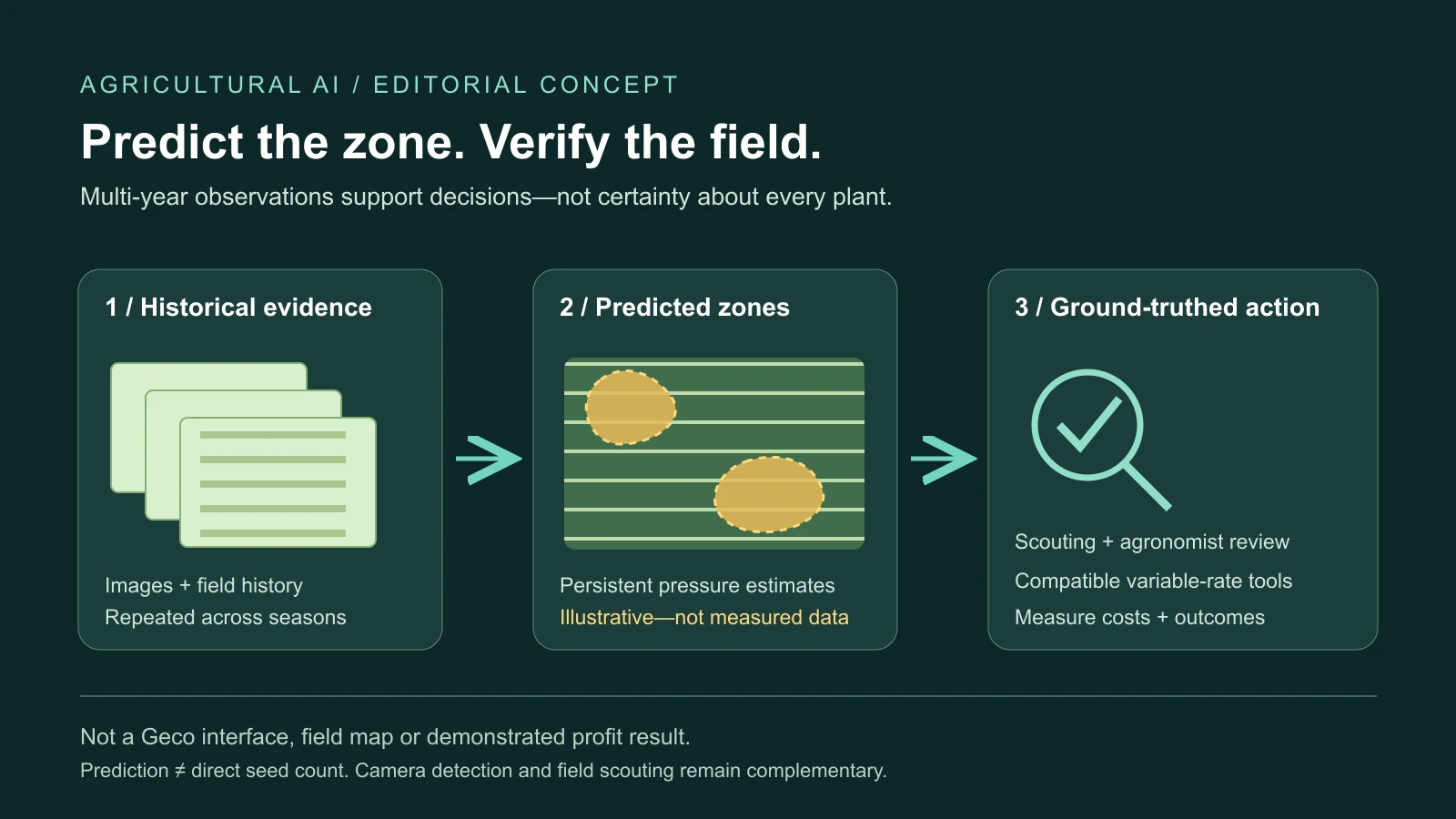
Geco Strategic Weed Management is expanding a different form of agricultural AI from the camera that spots a weed just before a sprayer passes. Its software uses several years of imagery and field history to estimate persistent weed zones before the next intervention. EMILI reported commercial availability in North America and use on more than 160 farms in seven countries by January 2026, up from three Western Canadian trial farms in 2023. That is evidence of reach, not yet evidence of repeatable farm profit.
The economic distinction matters. More seed or stronger herbicide can improve a crop while also increasing costs. Geco’s proposition is that historical evidence can identify where the extra expense is justified. Current trials with Manitoba-based EMILI and the national AIVA Network are meant to connect predicted zones to measured weeds, harvest outcomes and machinery operations—not merely produce convincing colored maps.
A seed-bank strategy is not a photograph of underground seeds
A weed seed bank is a reserve of viable seeds in or near the soil. Some germinate this season; others remain dormant and create future pressure. A field can look clean after successful herbicide treatment while retaining that reserve. Geco founder Greg Stewart’s account in the Country Guide report shifts attention from today’s visible plants to recurring populations and sustained attempts to reduce their worst concentrations.
The company says it generally analyzes five years of field history and more than 100 satellite images, combining AI with agronomic models. Drone imagery or optical-sprayer data can supplement the record. This is an inference from repeated observations, not a direct satellite count of seeds underground. Its usefulness depends on distinguishing recurring weed signals from crop stress, volunteer plants, residue, bare soil, disease and ordinary field variation.
The output divides a field into management zones. Denser crop seeding can increase competition for light, water and nutrients; residual herbicides remain active in soil for a period and target germinating weeds. Tillage and harvest weed-seed control are other possible responses. Crop rotation, resistance, soils, equipment and the existing weed program still determine which intervention is appropriate. The map does not replace an agronomist or prescribe one treatment for every farm.
Prescription files turn those zones into variable-rate instructions for compatible seeders, sprayers, tillage tools or autonomous machines. Geco says it works with existing equipment brands rather than demanding a dedicated platform. That reduces one adoption barrier, not the need for accurate records, file preparation and actual compatibility. A forecast only becomes operationally valuable when equipment can use it during a suitable field-work window.
Growth inside a market with limited AI deployment
EMILI—the Enterprise Machine Intelligence and Learning Initiative—began working with Geco in 2023. Its report of more than 160 farms does not disclose enrolled acreage, prescription use frequency, renewal or multi-year retention. These measures would tell more about engagement than the farm count alone. Nor does one startup’s expansion establish widespread AI use across Canadian agriculture.
Farm Credit Canada and Deloitte’s adoption analysis reported AI use by just 1.8% of Canadian agricultural businesses in the second quarter of 2025, compared with 12.2% in other industries. Rural connectivity, capital constraints, talent shortages, fragmented infrastructure and uncertain governance were barriers. Geco therefore grows in a difficult, uneven deployment environment rather than a universally automated sector.
EMILI supplies Manitoba land, historical records, drone observations and ground scouting. AIVA extends validation through partners in Alberta, Ontario and Saskatchewan. The program covers wheat, soybeans, potatoes, corn, rye, barley, canola and faba beans; separate robotic-route trials involve pumpkins and onions. Different canopies, growth stages, soils, weather and weed species make transfer from one wheat field to another region’s potatoes a question to test, not an assumption.
Early validation involved herbicide-resistant kochia and wild oat, major Prairie problems for programs relying on limited herbicide classes. Agriculture and Agri-Food Canada’s kochia research notes that one plant can produce 30,000 seeds and describes expanding resistance. That makes persistent hotspots a consequential target: concentrating expensive measures could be useful, but biological importance alone does not prove that the recommended action earns a return.
Three experiments connect prediction to field work
EMILI’s initial field validation compared satellite models with drone imagery and physical scouting and found reliable identification of larger patches in the tested fields. That supported using widely available satellite data for prescriptions. It did not establish equivalent performance for every species, crop, field or growth stage.
The current AIVA experiments first compare satellite zones with observed species and density through four scouting visits during the season. This makes verification part of the process. Repeated images can reduce dependence on an unusual season, but do not eliminate ambiguity from weather, application timing, access or changing crops.
A second experiment combines baseline and elevated seeding with baseline and elevated residual herbicide rates. Increased seeding is approximately 25–50% in selected zones. Researchers will measure weed pressure, yield and protein content. Those outcomes connect a detection map to agronomy and income; the elevated rate itself is not a universal recommendation for every crop.
A third experiment compares weed-oriented robotic-weeder routes with conventional straight routes in pumpkins and onions. Limited daily robot capacity makes prioritization potentially valuable. Human scouts can use the same logic. Camera sprayers ask what is growing here now; Geco asks where pressure recurs across seasons. Prediction, close-range detection and human verification can complement one another rather than compete as mutually exclusive technologies.
One promising seeding result is not a customer-wide return
In 2025, Geco and EMILI tested higher seeding in three strips, each 120 feet wide, on an Innovation Farms field. Selected weed zones received 25% more seed. EMILI reported a 7% yield increase and 29% weed reduction. Stewart described a sevenfold return on the additional seed’s cost. The attribution and denominator matter: this is a specific treatment in one season, not a sevenfold return on every expense of the software or across all customers.
The mechanism is established crop competition; Geco contributes the targeting layer. Adding seed everywhere could waste it in low-pressure zones, while a premium herbicide might only be worth using where persistent pressure justifies the expense. A 2026 wheat trial tests the four baseline/elevated seed-and-residual combinations, and Olds College runs a comparable replicated-block trial in Alberta. Weed pressure and harvest yield will precede agronomic and economic comparisons.
A full return calculation must include software, agronomic time, extra seed or chemical, machine passes, prescription preparation, scouting and operational complexity. It must separate the effect of targeting from the effect of simply applying more treatment. One favorable rainfall year or field variation can exaggerate a gain; preventing future seed return may create value that the current harvest misses. Multi-year assessment is necessary because the strategy itself is multi-season.
Replication across crops is equally important: competitive wheat canopy is not widely spaced vegetables, and canola economics differ from soybeans. EMILI collects observations independently of Geco’s model and AIVA can test transfer beyond Manitoba, improving credibility without settling the outcome. Public evidence still lacks customer-level profit distributions, failure rates, enrolled acreage and multi-year retention. That gap defines the remaining proof, rather than invalidating the early result.
Image resolution sets limits that algorithms cannot wish away
Satellites offer broad coverage and historical archives, including fields never surveyed by drone. They may identify large recurring patches while missing small plants or mixing several features in one pixel. Clouds interrupt collection; residue, soil color, shadows, canopy closure and growth stage complicate classification. More repeated observations or supplemental imagery help, but the signal still needs ground verification.
A peer-reviewed 2026 UAV study compared three drone approaches with ground-camera reference data in summer fallow. All undercounted weeds: omission rates were 41–65% for RGB, 48–73.5% for near-infrared and 78–85% for a YOLO model. Crucially, this was not an evaluation of Geco or its multi-year satellite method. It illustrates why algorithmic complexity alone cannot compensate for insufficient image detail; those percentages must not be assigned to Geco.
Persistent zones are a broader target than counting every small weed on spraying day and may suit satellite data better. Nevertheless, false positives waste inputs and false negatives can leave resistant populations to produce more seed. Their costs are asymmetric and depend on species, resistance, crop value, treatment cost and expected seed production. A generic accuracy score cannot substitute for measuring the consequences of acting on an erroneous zone.
The remaining decisions belong to farms and validators
Data governance also matters: crop history, imagery and prescription maps can reveal sensitive farm performance. Ownership, storage, reuse and portability terms need clarity, as does transfer between agronomic software and machines without repeated manual work. Preparing files before field operations can reduce connectivity demands, but poor rural broadband can still delay uploads, support and new imagery. Agronomists remain responsible for questioning unusual zones and fitting interventions to crop and resistance history.
The next evidence should combine replicated net returns from variable-rate trials, species-level false-positive and false-negative results across AIVA sites, and practical integration with working equipment. Results concentrated in certain crops would call for narrower use, not a universal precision claim. The robotic-route test is especially concrete because it asks where an actual machine should work first, rather than whether a dashboard looks plausible.
Geco’s substantial proposition is that several seasons of evidence can make costly weed control more selective. The unresolved question is where that selectivity reduces future pressure without creating greater present costs. Treated and untreated outcomes across seasons, compared with local weed history and full operating costs, will say more than commercial reach alone.
A Google News aggregation entry provides another route to the coverage; it is not an additional field study or official Geco statement.