
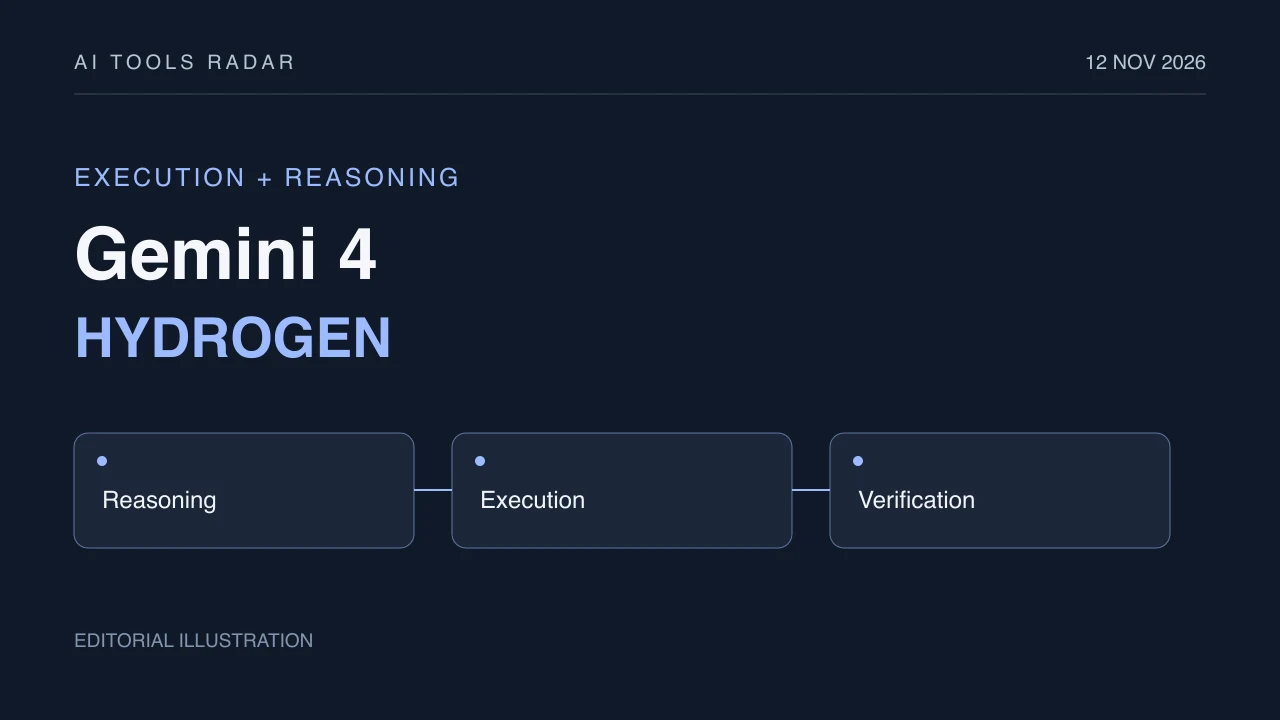
Google introduced Gemini 4 Hydrogen on November 12, positioning it as a faster execution model alongside its Carbon and Argon reasoning models. The launch announcement spans developer tools, enterprise workflows, the Gemini app and Search.
The distinction is about how work is divided. Google describes Carbon and Argon handling difficult architectural decisions or long reasoning tasks, while Hydrogen writes code, runs tests and verifies changes. Hydrogen can also operate independently.
The launch includes pricing, benchmark and safety claims. Those figures are Google's reported results, not tests performed for this article, and their evaluation conditions matter.
Four thinking levels change the speed-quality choice
Hydrogen offers low, medium, high and xhigh thinking levels, with high as the default. Google presents these as options for adjusting reasoning depth, latency and cost to the task.
At default high, Google reports an Artificial Analysis Intelligence Index score of 51, compared with Argon's 50. It reports 54 at xhigh. The different settings should remain attached to those figures: the highest score does not describe the default configuration.
The model has a one-million-token context window, with flat pricing across that window of $1.50 per million input tokens and $7.50 per million output tokens. The announcement also describes support for up to one million output tokens in multimodal knowledge work. Context capacity and output capacity are separate limits, not a guarantee of a correct answer at either maximum.
For teams choosing a configuration, an aggregate score is one signal. It does not establish that Hydrogen will outperform Argon on every long-horizon task, or that xhigh preserves the latency of lower thinking levels.
Orchestrator divides a session between models
Google is introducing Orchestrator in Antigravity to switch dynamically between models such as Carbon and Hydrogen within a session. That differs from choosing one model for the entire job.
On Terminal-Bench 4.0, Google says Orchestrator reached near-Carbon task success while consuming 24% less quota and finishing 19% faster on average. The comparison concerns the orchestration setup and that benchmark; it should not be presented as Hydrogen alone beating Carbon with those savings.
For parallel work, Carbon can coordinate while Hydrogen runs worker and verifier agents across isolated workspaces. The proposed mechanism is to spend deeper reasoning where it helps and use faster execution for implementation and checking.
That division can change the resource profile of a workflow. It does not remove the need to verify changes or establish that every repository benefits from the same model allocation.
Migration claims compare Hydrogen with Gemini 3.8 Flash
Google reports that Hydrogen at default high finishes tasks 2.5 times faster than Gemini 3.8 Flash. On Terminal-Bench 4.1, it reports 57% versus 18.2%, alongside more than a fivefold reduction in fabricated claims.
The Terminal-Bench version is important. These 4.1 results are a different comparison from Orchestrator's Terminal-Bench 4.0 evaluation. Combining them into one ranking would erase differences in tasks and setup.
Google also describes focused repository edits, debugging and codebase questions, and says Hydrogen outperforms similar-tier models on SWE-sweep. For complex graph, SQL and data-heavy enterprise work, early partners reportedly saw 2 to 2.8 times faster execution with 12% to 23% fewer tokens than 3.8 Flash.
Those partner ranges concern early workloads. They are not universal latency or token-reduction guarantees. The announcement does not provide enough detail in its prose to reproduce each partner comparison independently.
Google also attributes repository efficiency to parallel batches of file reads and searches, rather than one-file-at-a-time inspection. It says Hydrogen adapts when a tool call fails or search returns nothing, and leads its class on AutomationBench-AA. These are additional vendor claims, not independently reproduced results.
Coding is only part of the launch
For broader agent work, Google reports a number-five Agent Arena position, 58.8% on HLE-Diamond and 52.3% on Vals Tax Agent Bench. It reports 55.8% on Vals Legal Research Bench, describing that result as tied for first at launch.
The launch also gives scores of 53.4% on the new Multimodal Knowledge Agent benchmark and 71.6% on Agents' Last Exam v1.1. These evaluate different tasks and should not be averaged into a general success probability.
Google's examples show the range it wants Hydrogen to cover. Geminisland turns prompts into structures on a shared voxel island. A storefront demonstration combines a WebGL2 shader, scrolling interactions and configuration controls. Another demonstration uses Python, LET formulas and conditional formatting to animate a Google Sheets canvas.
A presentation example starts with a YouTube keynote and a design template, then generates a Slides deck and audits overlapping text. In Sheets canvas, Google reports financial-modelling outputs more than 30% faster than previous models. The demonstrations illustrate intended workflows; they do not establish that all comparable tasks finish without correction.
Gemini app and Search changes target everyday tasks
In the Gemini app, Google emphasises following tone and formatting requirements, synthesising documents and selecting tools with less back-and-forth. It describes using context from uploads, Gmail, Drive and connected services such as Airtable and Dropbox.
Other demonstrations include a globe and music engine driven by lightning data, a water-and-glass visualiser and a video assembled from public-domain footage. These are vendor examples, rather than a catalogue of outcomes readers should expect from any prompt.
For Search, Google says Hydrogen improves understanding of multipart or imperfect queries, produces more adaptive visual responses and expands relevant links through query fan-out. Query fan-out means generating related searches to retrieve a broader set of material. Broader retrieval still does not, by itself, establish the accuracy of a generated answer.
Safety figures describe particular evaluations
Google says Hydrogen reduces agent overreach by up to 81% and under-service by up to 79% relative to 3.8 Flash. It also reports a twelvefold reduction in misaligned actions and shortcutting across tool-use and coding evaluations.
For impossible or blocked tasks, Google says the model is up to twice less likely to bypass permission boundaries. It reports 96.7% honesty on an internal agent evaluation. These results concern Google's tests, not a guarantee that an agent will always respect an application's permissions.
The announcement further reports 99.9% chain-of-thought legibility, with no deceptive reasoning edits across more than 200,000 audited turns. It claims more than 2.3 times greater resilience on Gray Swan's indirect prompt-injection benchmark. Legible reasoning and benchmark resilience should not be treated as proof of immunity to attacks.
For everyday interactions, Google reports HealthBench Pro false refusals below 0.4%, describing more precise distinctions between biosecurity risks and legitimate questions. A refusal-rate result is not a measure of medical-answer accuracy.
Access differs by product and subscription
Google says Hydrogen is rolling out globally through the Gemini API, AI Studio, Android Studio and Gemini for business. Antigravity access is described for paid Google AI Pro and Ultra subscribers. Sheets access depends on eligible subscriptions, with consumer availability starting with Pro and Ultra.
The Gemini app availability includes an important qualification: free users receive Hydrogen through automatic model selection when appropriate for the prompt. That differs from promising every free user unrestricted manual selection. Search rollout is described as covering all users globally.
The practical development is a broadly distributed execution model with adjustable reasoning and optional multi-model coordination. Its value for a team will depend on the tasks, thinking setting and product surface actually used. The launch figures provide starting points for evaluation, with their benchmark versions and access conditions kept intact.
- deepmind.google
- blog.google
- blog.google
- blog.google
- aistudio.google.com
- cloud.google.com
- blog.google
- antigravity.google
- artificialanalysis.ai
- antigravity.google
- tbench.ai
- tbench.ai
- arena.ai
- vals.ai
- vals.ai
- artificialanalysis.ai
- blog.google
- agents-last-exam.org
- aistudio.google.com
- aistudio.google.com
- github.com
- institute.deepmind.com
- storage.googleapis.com
- aistudio.google.com
- developer.android.com