
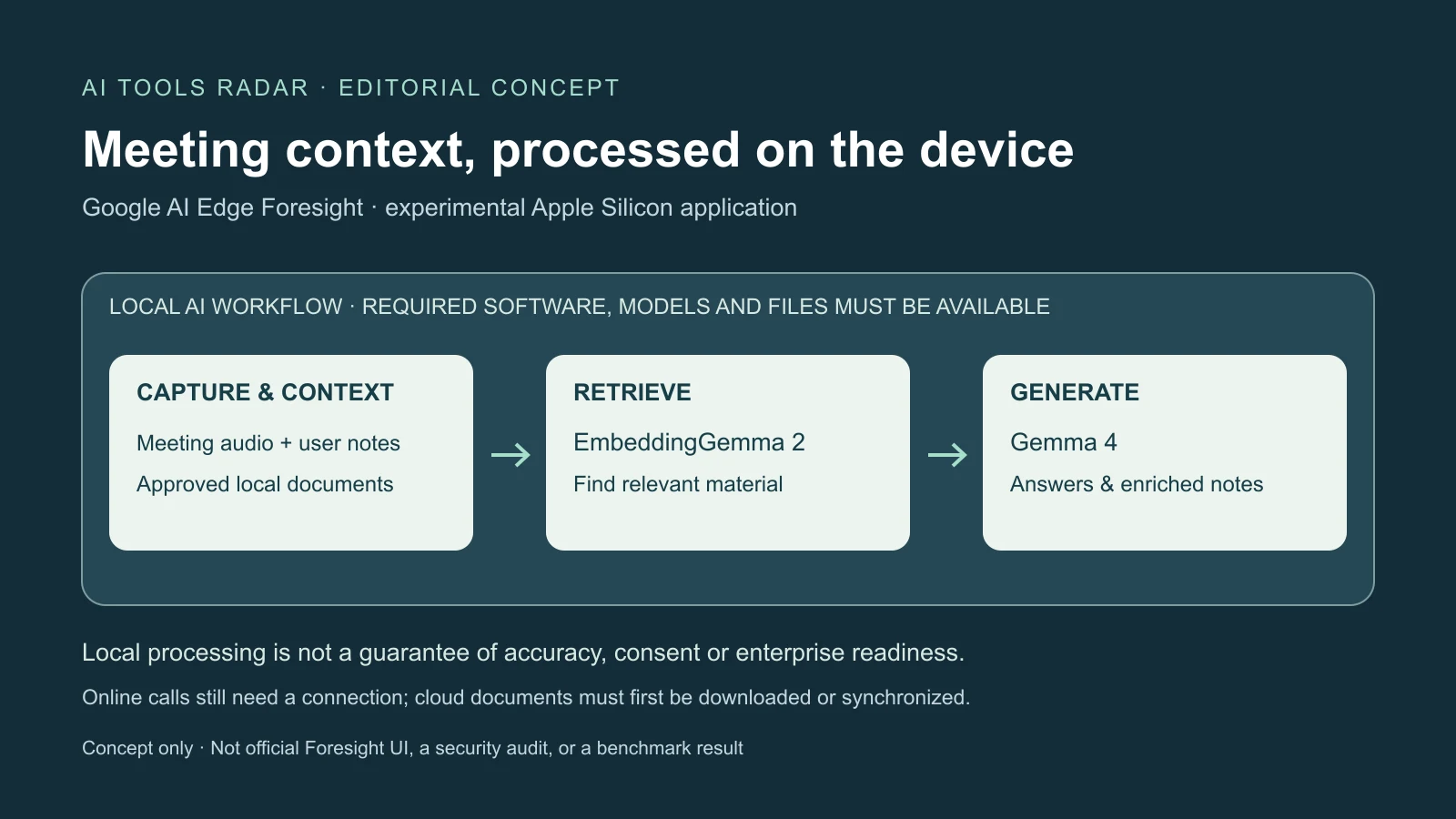
Google AI Edge Foresight puts a local-first proposition into a complete meeting workflow: capture a discussion, combine it with the user’s notes, search private files and answer contextual questions on a Mac. Google announced the experimental application on October 6, 2026, optimized for Apple Silicon rather than as a universal Google productivity service.
The challenge to Granola and other meeting assistants is not simply another summary. It is whether useful meeting intelligence requires sending the discussion and personal library to remote inference. Google says Foresight can do its AI work fully locally and offline; that architecture is a vendor claim to test, not an independent security audit or proof of accurate notes.
A human-guided record connects meetings with a private library
Foresight captures microphone and system audio, working beside meeting platforms rather than joining as a visible participant bot. A Mac microphone can also capture in-person discussions. In a split-screen interface, users write shorthand while the application follows the transcript, then enriches those notes with details. Human emphasis shapes the record instead of accepting an entirely automatic summary.
That resembles Granola’s original middle ground between manual notes and transcription. Foresight adds a local knowledge layer: PDFs, Google Docs, Microsoft Office files, plain text, Markdown and web bookmarks can contribute material for search during the discussion.
A roadmap meeting could retrieve an earlier requirement; an engineering discussion could surface an architectural decision from prior notes. This contextual assistance combines the live transcript and personal sources. It makes retrieval—not transcription alone—important to whether a conversation remains useful weeks later.
Bot-free capture is not the absence of recording. Participants can reasonably expect notice, and workplace or legal recording obligations still matter. Retention, deletion, access and acceptable-use policies remain necessary even when the vendor does not receive the audio. Local execution removes a transmission path, not every responsibility.
Two models divide retrieval from generation
EmbeddingGemma 2 converts content into vectors for semantic matching; Gemma 4 produces contextual answers and enriched notes. Searching relevant passages before generation avoids repeatedly putting the whole library into a massive prompt. This retrieval-augmented-generation division lets a smaller retrieval model index and search while the generator uses selected evidence.
Google describes EmbeddingGemma 2 as a 740-million-parameter model mapping text, images, audio and video into a common space. Its reported active-memory figures are about 191 MB for text-only operation and 567 MB for the full multimodal model on supported mobile hardware.
Those are model-test figures, not total Foresight memory. Transcription, generation, indexes, interface and the operating system add overhead. Nor does a shared multimodal model space prove that the application exposes every supported media workflow identically.
Google’s LiteRT inference runtime targets CPUs, GPUs and neural processing units. It reports ranked retrieval in milliseconds under specified tests, relevant when a late answer would miss the meeting’s turn. Foresight hides model files, vector databases and pipeline management behind notes, demonstrating an integrated local stack rather than asking workers to assemble one.
That stack also transfers costs to the device: model downloads, storage growth, thermal limits, battery, compatibility and multitasking. Cloud systems can route to larger models and update centrally; a local application must balance quality against available resources. Google’s control of models, runtime, retrieval and showcase can improve optimization, but does not remove the tradeoff.
Offline has precise boundaries
Once required software and models are available, Google says AI processing can work without a connection. An online call still needs its meeting platform’s network connection. Cloud documents must first be downloaded or synchronized to be locally available; offline does not mean remote files materialize without transfer.
Travel and weak connectivity make this useful. Sensitive legal reviews, product planning, hiring and unreleased financial discussions may also benefit from reducing cloud transmission. But device software, operating-system protections, permissions and actual data flows remain the local trust chain.
Organizations still need to inspect imported files, temporary audio, transcripts, indexes and generated notes: where they are stored, who can access them, what is retained and how deletion or backups behave. The product’s privacy proposition is strongest when those details are verified rather than inferred from “local.”
Hardware also narrows reach. This release is optimized for Apple Silicon; Windows, Linux and Intel Macs are not established targets of the current experiment. A controlled performance target can make a demonstration coherent without making it a broadly supported company platform.
Granola offers a different trust and collaboration model
Granola also captures computer audio without another bot in the call, combining transcripts and manual notes. Its security documentation describes external transcription and AI providers, encryption, access controls and US-hosted infrastructure for stored information. Cloud processing does not mean no security; it creates a chain of processors, storage, contracts and transfers to evaluate.
Granola has developed shared workspaces, folders, permissions, integrations and APIs that move meeting context into writing, development, design and automation workflows. A March 2026 report described personal and enterprise APIs alongside team Spaces. Accumulated meeting records become shared organizational knowledge, not only one person’s archive.
Foresight has not established equivalent enterprise administration or shared workspaces, nor has Google presented it as a managed replacement for every company-wide system. A solo consultant might prioritize offline control; a distributed sales team might prioritize customer-system integration, shared records and centralized retention. Sensitive researchers may want local processing while still needing controlled sharing.
The comparison is therefore architectural, not a simple privacy winner against a collaboration winner. Buyers need both. Granola must expand collaboration without weakening archive control; Google would need to add sharing without imposing cloud dependencies on users attracted by self-containment.
Google’s Workspace, Drive, Calendar, Meet, Android and Gemma provide possible distribution routes, not announced mandatory integrations. Foresight could remain a developer showcase, become maintained desktop software or contribute components elsewhere. Required accounts or synchronization, if later introduced, would change the original tradeoff rather than follow automatically from this release.
Local answers still need evidence and lifecycle commitments
The announcement supplies no independent comparison of transcription accuracy, note fidelity, answer faithfulness or long-session performance. Missing negation, a wrongly assigned action item or an omitted unresolved disagreement can alter the decision record. Attractive notes are not necessarily trustworthy evidence.
Retrieval may find an outdated or superseded passage; generation may stretch beyond it. Local inference protects a data route, not factual correctness. Early users should compare notes with transcripts and retain accountable human ownership of decisions instead of treating a summary as final.
Useful field tests include accents, overlapping speakers, noise, weak microphones, specialist terms, long meetings and multiple documents with similar content. Correction rates for names, owners, deadlines and evidence, as well as energy use and sustained use, are more revealing than downloads or a polished first demonstration.
The experimental label also affects durability. Reporting notes that the team’s earlier local dictation application did not achieve mainstream use. A reference app can still influence developers even if Google does not maintain it indefinitely, but buyers need confidence that private archives remain usable after support changes.
Export formats, migration, backups, model updates, compatibility and a public support roadmap therefore matter to security as well as convenience. Privacy without a durable way to retrieve or move a meeting archive is incomplete control. The launch demonstrates an integrated workflow, not yet a full enterprise service.
What would show the experiment is becoming a product
Regular releases, documented storage and exports, broader device support and enterprise policies would clarify Google’s commitment. Windows, Linux, Intel Mac or mobile expansion would be meaningful future evidence, not current availability. Shared libraries, administration, retention and deployment controls would indicate ambitions beyond a showcase for EmbeddingGemma 2, Gemma 4, LiteRT and MediaPipe.
Independent daily-use evidence is the second test: can the app preserve decisions, responsibility, deadlines, qualifications and disagreements with less review burden? Sustained retrieval of reliable context weeks later matters more than initial novelty.
The third is competitive response. Granola and others could add local transcription or indexes, user-controlled encryption, private deployment or clearer cloud-data choices without copying the whole architecture. They can also emphasize collaboration, mobile capture, integration, administration and support.
The category already includes Granola, Fathom, Fireflies and collaboration platforms; Wispr and Calendly have introduced notes, and Superhuman acquired Fathom in 2026. Talat’s separate local note-taker shows on-device processing is not uniquely Google’s. Its arrival validates the direction while pressuring smaller local-first developers.
Raw transcription is becoming a baseline; control, retrieval, collaboration and subsequent work carry more value. Foresight makes personal AI without continuous context uploading tangible. Whether Google keeps building after proving the mechanism—and whether accuracy and lifecycle evidence justify trust—remains the consequential question.
Sources and related reading
Google AI Edge announcement · Foresight product page · Related reading: personal and team knowledge · Granola security documentation · Granola enterprise expansion · EmbeddingGemma 2 overview · Talat local meeting notes · Foresight launch reporting