
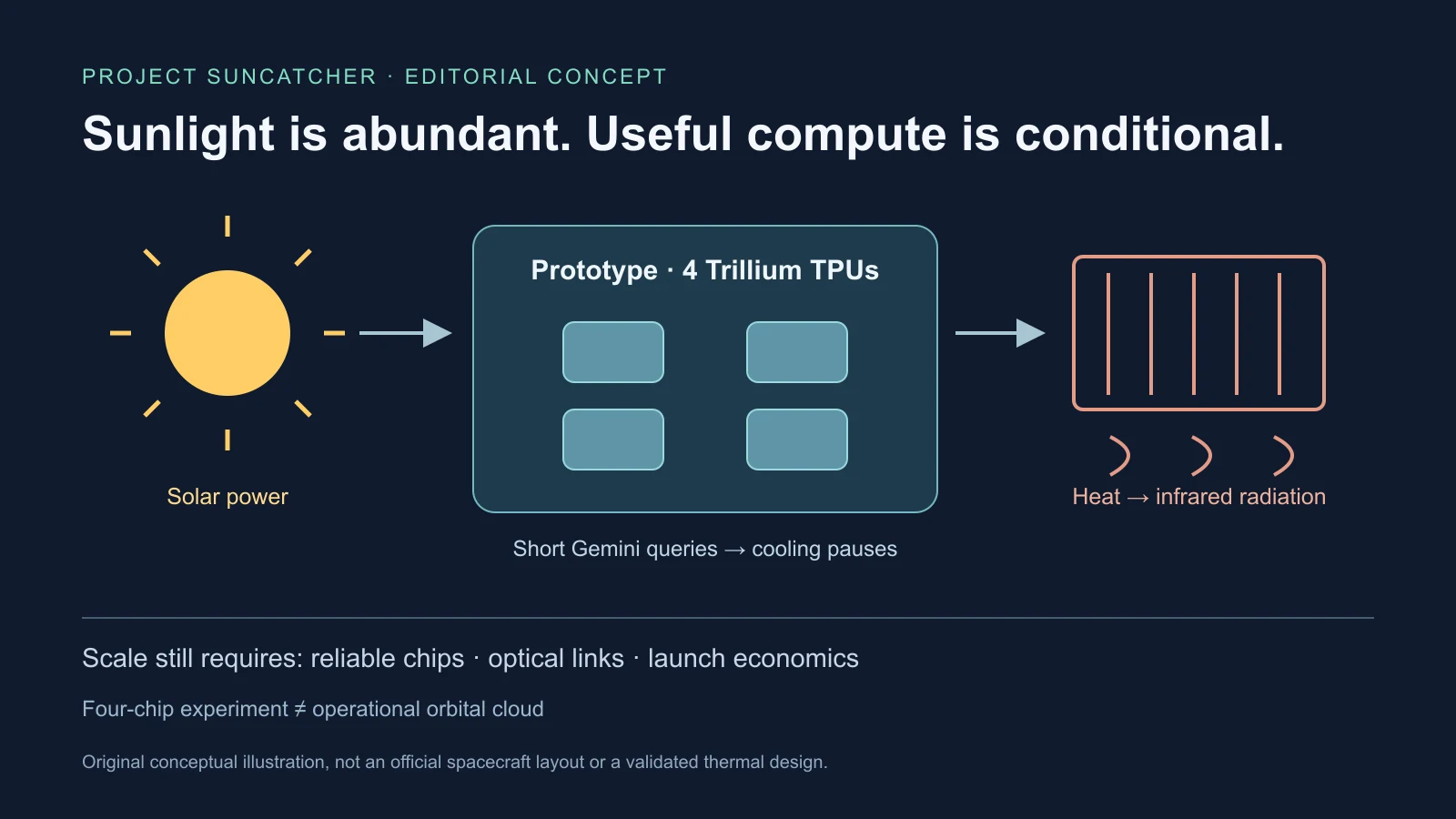
Google's Project Suncatcher has put four Trillium Tensor Processing Units into orbit, but the experiment is designed around short bursts of work followed by cooling pauses—not a continuously available orbital cloud. The October 1 launch makes commercial AI-chip behavior in space measurable. It does not establish that moving a data center off Earth is cheaper, cleaner or easier.
Google developed the solar-powered satellite with Earth-imaging company Planet. It flew on SpaceX's Transporter-18 rideshare, whose uncrewed Falcon 9 carried 130 payloads from California's Vandenberg Space Force Base into low Earth orbit. Google says contact has been established and operation is as expected. Those initial status reports are a starting point for reliability evidence, not a full-system verdict.
Four processors test survival, not the whole architecture
In its prototype update, Google describes collecting operating data over the following weeks. Engineers will examine vibration, radiation and thermal extremes. Unlike a terrestrial accelerator, the payload has no visiting technician, replacement parts or carefully controlled equipment room.
The planned short Gemini queries run in controlled periods, after which the chips stop to cool. A production service would need thousands of processors operating for long stretches, with memory, communications and fault tolerance adequate to distribute large jobs. The current mission does not demonstrate that duty cycle.
Google's larger research concept describes 81 solar-powered satellites flying within roughly a one-kilometer radius. Free-space optical links would exchange data by laser, while machine-learning systems coordinate formation and collision avoidance. Close formation matters because AI training repeatedly exchanges intermediate results; isolated chips do not automatically become a supercomputer.
The proposed network must sustain bandwidth and low latency while maintaining precise alignment between fast-moving spacecraft. Radio is adequate for this prototype, but exchanging large models and datasets with Earth would require much faster ground connections. The mission does not test an 81-satellite formation, large radiators, continuous service or high-volume optical ground links.
The electricity argument has conditions
On Earth, utility planning, transmission upgrades, permits and local negotiations can take years, with water and land use generating opposition. More compute supports training, experimentation, inference and customer growth, so delayed infrastructure can constrain products and revenue. The U.S. Government Accountability Office projection cited in the report puts data centers at up to 12% of American electricity demand by 2028, not a guaranteed share.
Suitable low Earth orbits can offer near-continuous sunlight without clouds or an ordinary night cycle. Google estimates up to eight times the annual solar energy of a panel at a mid-latitude terrestrial site. That is an exposure comparison, not free electricity. Arrays, power electronics, batteries and controls still add mass and must survive launch, radiation and repeated thermal stress.
Launch access changes the competitive structure. SpaceX operates rockets and Starlink and has proposed purpose-built orbital data-center satellites. Its filings contemplate as many as one million satellites; that is a proposed scale, not a deployed computing fleet. Elon Musk's forecast that space becomes AI's cheapest location within two or three years remains a corporate prediction, not demonstrated economics.
Google and Starcloud have both used SpaceX launches, creating dependence on a potential infrastructure competitor. A vertically integrated operator could optimize its own transport costs while setting commercial terms for others. Blue Origin's large-network and heavy-launch ambitions offer a possible counterweight, but its orbital-computing strategy is less mature.
Nvidia has introduced its Space-1 Vera Rubin Module for constrained orbital environments, claiming support for large language models, geospatial analysis and autonomous spacecraft. Availability and sustained in-orbit performance still need validation. Starcloud has flown an Nvidia H100 and wants larger training and inference clusters. These projects occupy different parts of the supply chain and are not equivalent demonstrations.
More sunlight does not remove waste heat
AI processors turn most electrical input into heat. Terrestrial facilities transfer it through air, water or specialized liquids and then fans, pumps, cooling towers or chillers. A vacuum offers neither atmospheric convection nor an external liquid sink. Spacecraft must move chip heat through an engineered path to radiators that emit infrared energy.
An IEEE thermal analysis estimates an 80-square-meter radiator for one 40-kilowatt rack—roughly a pickleball court—and at least 2,500 such radiators for a 100-megawatt installation. These are attributed engineering estimates, not hardware validated by Suncatcher. Each structure adds mass, drag, deployment mechanisms and failure points.
Ultraviolet light, atomic oxygen and radiation can degrade exposed radiator coatings. Extra initial capacity to compensate increases launch mass. Solar arrays also require surface area and suitable orientation; they and the radiators must avoid shading one another, destabilizing the spacecraft or creating excessive drag. Cold surroundings do not automatically cool a chip without the necessary heat-transfer pathway.
Google's research proposes heat pipes and radiators but acknowledges unfinished thermal management rather than a proven production-cluster design. Short workloads sidestep the full problem during the prototype. Commercial infrastructure would have to convert those cooling pauses into a predictable and economically useful availability level.
Radiation resilience trades hardening against quantity
Conventional spacecraft use radiation-hardened processors that generally trail leading AI accelerators. Commercial TPUs and GPUs offer modern density but are vulnerable to particle-induced memory-bit flips, corrupted calculations and electrical faults.
Google says ground tests exposed Trillium TPUs to radiation representing a five-year mission without permanent failure, although recoverable errors occurred. That supports orbital testing; a few surviving processors cannot establish reliability across a constellation containing many more memory modules, connections and power components.
Redundancy could let processors repeat calculations, compare answers and restart inconsistent nodes. It replaces some specialized hardening with additional ordinary hardware and acceptance of failures. The trade only helps if launching and replacing those extra units is cheap enough.
Earth-based technicians replace drives, cables, pumps and accelerators routinely. Robotic servicing in orbit remains limited, and bringing hardware home usually makes little economic sense. Retirement, deorbiting and replacement are therefore the likely maintenance path. Frequent replacement could introduce newer chips but also sustain an expensive launch cycle and greater traffic-management burden.
Cost per useful computation, not cost per kilogram alone
Google's economic model identifies roughly $200 per kilogram to low Earth orbit as an important launch threshold that might become possible in the mid-2030s. It assumes reusable heavy-lift rockets at high volumes and lower spacecraft mass without sacrificing power, cooling or durability. It is not today's demonstrated delivered-compute price.
The cited BCG cost model still finds a substantial orbital premium and strong sensitivity to satellite failure rates even in favorable scenarios. Cheap transport cannot rescue early processor failures, degraded radiators or a network that leaves expensive chips idle.
Useful compute over the working lifetime must account for cooling pauses, radiation errors, declining solar output, replacement launches, communication, disposal and unused capacity. Lost optical alignment or inadequate bandwidth can create idle time that additional satellites do not cure. Ground-station routing, added distance and weather interference with optical ground links also constrain interactive service latency.
Batch generation, scientific modeling, archive analysis and translation can tolerate more delay than real-time applications. Sensitive government tasks might value geographic separation and access to orbital sensors, but physical distance does not remove cybersecurity requirements: secure commands, authentication, updates and protection against compromised ground systems remain necessary.
Two markets, plus environmental obligations
Processing data already generated in space has a clearer near-term case than relocating ordinary chatbots. Earth-observation satellites collect more raw imagery than they can efficiently downlink. Onboard AI could flag fires, damaged infrastructure or unusual weather and send selected results, reducing transmission demand and response time without replacing an entire cloud region.
General-purpose orbital infrastructure faces a higher bar. It competes with the terrestrial facilities available when it scales, not those of today. Ground operators improve cooling and chips, contract new energy, locate near renewable or nuclear generation and favorable climates, and replace equipment without rockets.
The GAO assessment warns of astronomy interference, crewed-mission hazards and radio-frequency coordination demands from additional satellites. More objects mean conjunction warnings and avoidance maneuvers; collision fragments can remain hazardous and trigger further impacts. SpaceX cites Starlink's management record, but heavier computing platforms with larger external structures would pose a different scale of challenge.
End-of-life deorbiting matters even at low altitudes where reentry is possible. Frequent replacements increase launch and reentry traffic and emissions. An academic analysis cited in the account argues these could offset environmental gains, but that conclusion depends on rocket design, launch frequency, service life and which emissions are counted. Orbital compute is not automatically sustainable; it redistributes impacts across manufacturing, energy, launches, atmospheric chemistry and debris.
The next evidence should be sustained TPU error rates, temperatures, active time and performance; then multi-satellite optical networking, formation stability and useful bandwidth in further tests discussed for 2027; finally a lifetime cost model anchored in operations and commercial customers. A satellite running a model is not yet a coordinated training cluster.
For organizations, infrastructure location remains separate from product usefulness. The related AI knowledge-base guide concerns secure data handling, retrieval and useful answers, not proof of Suncatcher economics. Space-based sensor customers may pay more when local processing saves time or downlink; ordinary text and image services can choose many terrestrial regions. Suncatcher makes the orbital proposition testable. Its operating data, not satellite-count announcements or sunlight alone, will decide how far it can go.
Original aggregated news entry (Google News RSS; not Google's official project page)