
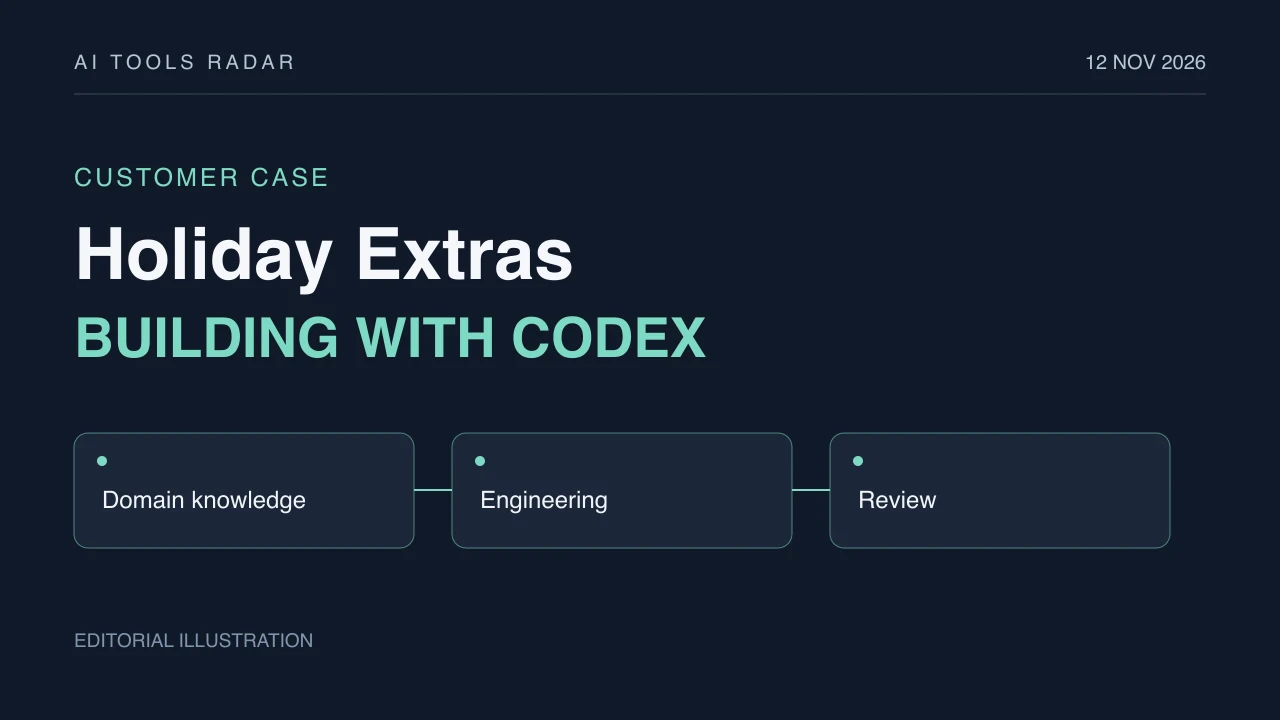
Holiday Extras says Codex helped its team reach a working app rebuild in two weeks, replacing development progress previously expected to take over six months. The November 12 customer case also reports improved bookings and fewer errors after the rebuild.
The useful question is how the work changed. Business specialists contributed customer and operational knowledge, while engineers supplied reusable foundations and retained responsibility for architecture and security.
The results come from an OpenAI-published customer story. They describe one company's experience, with before-and-after comparisons across different periods, rather than a controlled independent test of Codex.
From annual major releases to weekly improvements
Holiday Extras helps customers search for, book and manage travel. Its main app previously centred major changes on an annual release. The rebuild changed both the customer experience and the release cadence.
Liam Thompson, its vice president of AI innovation and former head of design, worked with engineers to translate customer knowledge into software. Small, documented packages provided reusable foundations. Engineers concentrated on architecture, APIs, security and development workflows.
According to the case, the team produced a fully working rebuild within two weeks. That milestone should not be expanded into a claim that every production requirement, review or migration finished in two weeks. The comparison is with development progress that previously would have taken over six months.
The rebuilt experience used customers' bookings, trips and history to provide personalisation. The story says Codex allowed iOS and Android features to develop together, rather than improvements reaching Android later.
In the first month after the rebuild, the main app moved to weekly releases containing multiple new features. The separate Countdown app went from roughly one feature every six months to multiple additions each week. Those are distinct products and measures, not interchangeable release statistics.
What the conversion and error figures actually measure
The company reports a 32.5% increase in open-to-book conversion after the main app rebuild. The story does not give the underlying conversion rates or sample sizes. The figure should not be rewritten as a 32.5-percentage-point increase.
It also reports that the main app's error rate fell from 19% to 9%. That is a reduction of 10 percentage points. Calling it simply a 10% reduction would obscure the difference between a relative percentage and percentage points.
The source explicitly says these results compare the previous and rebuilt main app across different periods. They therefore do not isolate the contribution of Codex from personalisation, other app changes or differences between those periods. The case supports attributed operational results, not a guarantee of the same effect elsewhere.
The distinction matters for teams considering a similar rollout. Faster development and better business outcomes can occur together without the available evidence establishing which change caused each outcome.
Customer feedback becomes development work
The Countdown example shows the described approval boundary. After a customer complained about a missing list view, an agent prepared a fix. Thompson approved it before submission. The customer subsequently changed a one-star review to five stars, according to the case.
This is a concrete example of a shorter feedback loop, not evidence that every agent-written change can bypass human review. The reported sequence includes preparation, approval and submission.
The same approach extended to operations. David Lee, director of innovation and growth, described a system that converts airport-transfer customer chats into actionable tickets. That helps the team identify issues across its supplier network. The source provides no measured ticket-resolution improvement, so the example establishes a workflow rather than a quantified service gain.
Business expertise still depends on engineering foundations
Company-wide ChatGPT Enterprise access preceded the Codex rollout. CEO Matthew Pack also used Codex himself, treating direct experience as a way to understand colleagues' needs and reconsider what the business could build.
The case describes permission to experiment alongside guardrails. Engineers created packages, security controls and workflows that supported contributions from employees outside conventional development roles. An experienced accountant, for example, rebuilt finance systems using business knowledge and colleagues' feedback.
That division of work is central to the story. The reported benefit was not merely producing code faster. People who understood customer and operational problems could help implement changes, while engineers supplied the technical foundations.
Holiday Extras also used OpenAI models in its app's personalised experience. The story describes dots providing coordination and insight, including a proactively prepared post-launch performance report. These are separate uses within the wider relationship; they should not all be attributed to Codex alone.
The next ambition is broader AI administration
Pack wants more company systems administered through AI, with employees directing the work and shaping outcomes. That is an ambition described in the case, not an already completed company-wide transition.
For other teams, the most transferable detail is the combination of domain knowledge, reusable engineering foundations and human approval. The reported two-week rebuild and booking gains make this a useful case to examine. Its different-period comparisons and missing measurement detail limit how far those results can predict another organisation's outcome.