
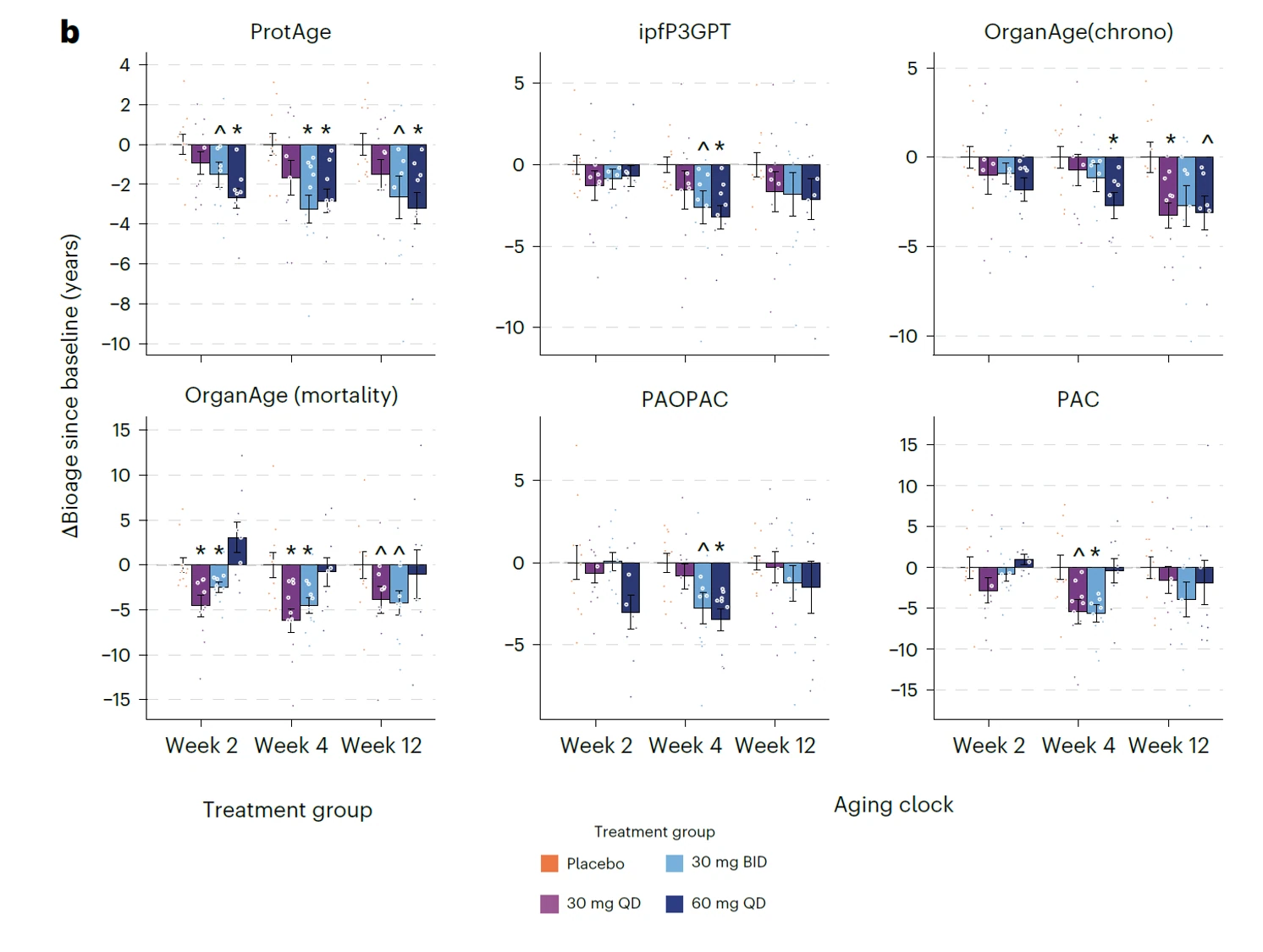
A chart that says a medicine made people look several years younger can travel much faster than the study behind it. Rentosertib, an investigational drug for idiopathic pulmonary fibrosis (IPF), is a useful test of how to read that kind of claim. A 2026 analysis applied six protein-based aging clocks to samples from a Phase IIa trial and reported lower predicted biological age in treated groups than in placebo. That is a serious research result worth following. It is not evidence that the drug reversed human aging, extended life, or is ready for preventive use.
The distinction is more than cautious wording. It determines what patients, investors, AI-drug teams, and journalists should ask for next. A biomarker can be informative long before it becomes a reliable measure of a clinical benefit.

Company-supplied study figure from Insilico Medicine's rentosertib announcement. It visualizes reported changes in predicted age from six proteomic clocks; it is not direct evidence that participants became younger or lived longer.
Start with what the study actually measured
The published analysis used longitudinal blood-proteomic data from 42 participants in a 12-week Phase IIa IPF trial. The researchers applied six models—including ProtAge, OrganAge variants, PAC, ipfP3GPT, and PAOPAC—to protein measurements, then compared changes across treatment and placebo groups. The company reports that the strongest signal occurred at week four in one dosing group.
A proteomic aging clock is not a calendar. It is a statistical model trained to map patterns in circulating proteins to an age-related estimate or risk-related proxy. If treatment changes those proteins, the estimated age can move. That movement may be biologically meaningful. It can also reflect reduced inflammation, altered tissue injury, or other disease-specific effects that a model associates with age.
This is why the most accurate takeaway is narrow: in people with IPF, rentosertib was associated with changes in blood proteins that several aging-clock models interpreted as younger. The result is stronger than a claim based on a single exploratory model, because the direction appeared across multiple clocks. It still remains an exploratory biomarker finding within one small, short trial.
Separate a biomarker from the outcome people care about
A lower predicted biological age is not the same outcome as better survival, more years without disability, or a treatment that is safe for healthy people. Those outcomes require different evidence. A 12-week study cannot establish whether a molecular shift persists, whether it tracks fewer disease-progression events, or whether the balance of benefit and harm works outside the trial population.
IPF makes this especially important. Fibrosis, inflammation, impaired lung function, and blood-protein changes are connected. A drug that changes disease biology may make a clock read younger without proving that it affects the broader process of aging. That would still be valuable if it helps patients with IPF; it simply answers a different question from a longevity claim.
The Phase IIa trial and its registry should therefore be read first as evidence about an investigational IPF program. Rentosertib's Phase III development is more relevant to clinical utility than any headline-sized age estimate. Larger, longer trials can test lung function, progression, adverse events, and whether findings survive variation in patients and sites.
Treat the AI story as a chain, not a shortcut
Rentosertib is notable because Insilico describes both the TNIK target and the molecule as products of its AI-supported discovery workflow. That makes the program a useful case study for AI in drug discovery. It does not exempt the program from ordinary clinical validation.
AI can prioritize a target, generate molecular candidates, and help researchers analyze high-dimensional data. None of those steps establishes that a candidate improves outcomes. The useful question is not whether the workflow produced an impressive chart; it is whether a pre-specified clinical trial later shows a reproducible, meaningful benefit at an acceptable safety cost.
That standard also protects the biomarker research. If aging-related measurements are collected prospectively in disease trials, scientists can test whether they predict or explain clinical outcomes rather than adding an aging narrative after a result is known. The method may accelerate hypothesis testing, but it should not turn a modeled estimate into a promise.
A checklist for the next dramatic aging claim
When a drug announcement cites biological-age reversal, ask four questions. First, who was studied: healthy volunteers, people with a specific disease, or a selected subgroup? Second, what did the clock measure, and was it a pre-specified endpoint? Third, did the study report patient outcomes alongside the biomarker—such as function, progression, hospitalization, or survival? Fourth, can an independent team reproduce the finding in a larger and longer study?
For rentosertib, the evidence currently supports an intriguing protein-level signal in IPF and a rationale for more research. It does not support a consumer anti-aging conclusion. Keeping that boundary clear is not a dismissal of the work. It is how a potentially useful biomarker result earns the chance to become something more.