
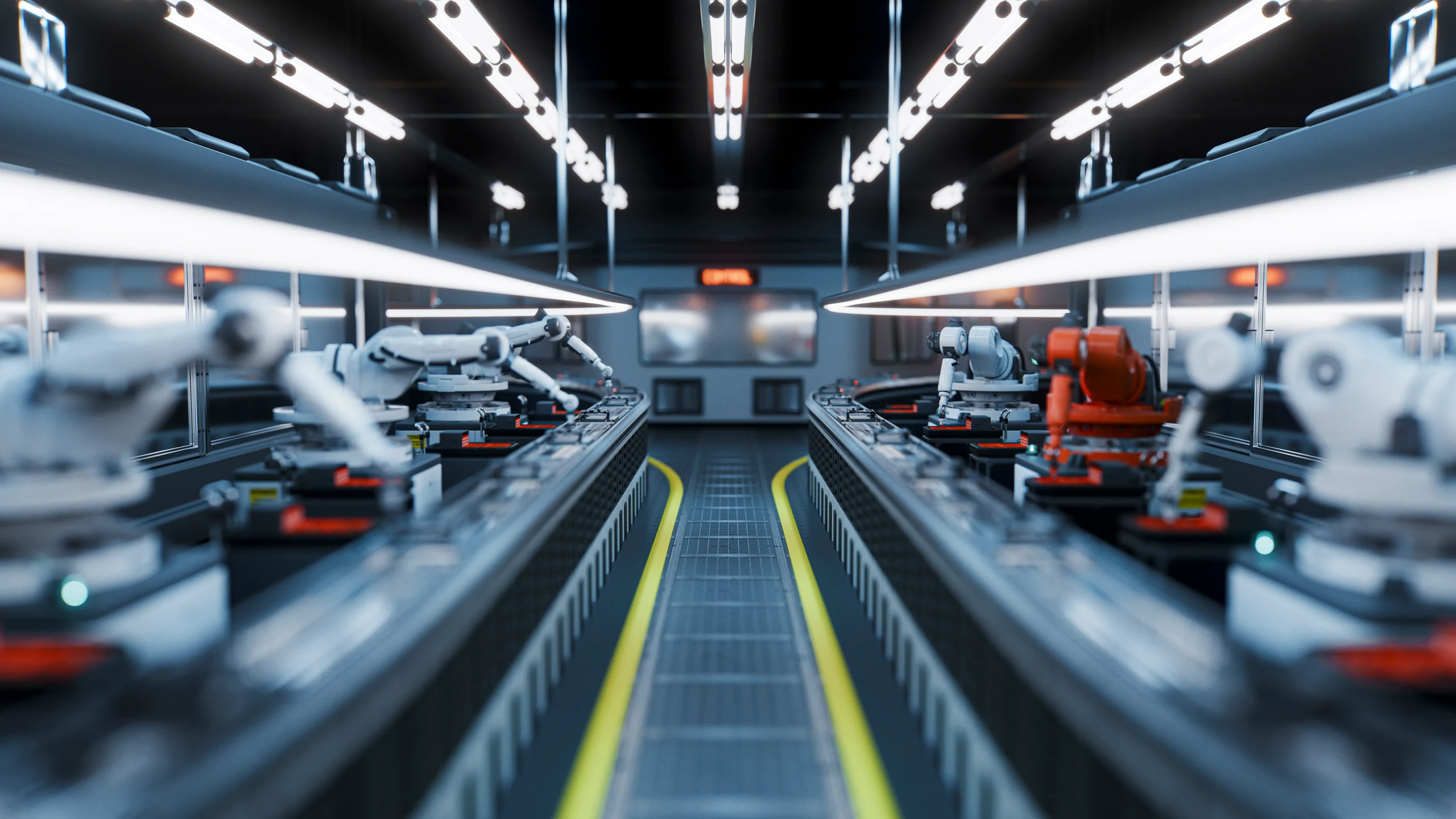
Industrial Next wants to make factory automation reusable when a product changes, rather than turn every revision into weeks or months of integration. The San Francisco startup presented its modular cells at TechCrunch Disrupt on October 13 and announced that BMW Group Technology Office will evaluate its AI-powered dexterous manipulation.
The headline is switching tasks in minutes. The unanswered question is what that clock includes. Teaching a movement is not the same as preparing simulation assets, changing tooling, validating safety and joining a synchronized production line. BMW's evaluation is significant precisely because it can test the surrounding work, not merely a successful demonstration.
The target is delicate assembly, not another generic arm
The original report describes self-contained work cells combining vision, task context and motion control. High-fidelity simulation and demonstrations teach reusable skills instead of prescribing every movement through conventional programming.
Dexterous manipulation means coordinating precise contact with objects that may flex, shift or stick. Industrial Next says stations already serve an unnamed major-smartphone production line, including threading a delicate flex cable and closing a small connector cap, or peeling protective film from camera modules and buttons. Those are specific challenges that rigid sequences often struggle to tolerate.
The company claims film peeling at or above human speed with complete accuracy. Its own materials also list matching accuracy above 99.9%, first-pass completion and cycle time below 3.3 seconds for a deployed cell. These are company figures about particular contexts, not independently verified performance across every task. The customer, number of stations and denominator behind 'complete accuracy' remain undisclosed.
A production claim needs attempts, operating duration, failure definition and treatment of human assistance. A narrow, clean run may be useful evidence without establishing months of first-pass yield. The difference is especially important when scrap, interrupted downstream work and worker safety make mistakes expensive.
Why changeover is a different opportunity from robot adoption
The International Federation of Robotics reports five million industrial robots operating globally in 2025, with more than 600,000 installations that year, up 11%. Manufacturers already buy robots at scale. The remaining problem is not simply putting another arm beside a conveyor.
Fixed automation earns reliability by constraining variation: known part positions, orientations and motions. That remains efficient for stable, high-volume processes. New components, short runs and frequent product revisions can require fixtures, motion programming, inspection changes and safety validation that make a small design change expensive.
Electronics combines fine connectors, flexible cables, adhesive films and reflective surfaces with regular redesigns. Human operators notice misalignment and adjust pressure quickly, though repetitive precision work can be tiring and difficult to staff. Adaptive cells must approach that flexibility while preserving industrial repeatability.
Faster reuse could lower the production-volume threshold at which automation pays, including in higher-wage manufacturing regions. Industrial Next has not published enough deployment pricing, maintenance, utilization, failure and integration data to calculate that threshold. 'Minutes' alone is not a total-cost case.
Simulation replaces part of programming, not physical validation
Robot data is costly because every physical attempt occupies equipment and risks parts. A simulator can reproduce robots, tools and workspaces and generate many trials without stopping a factory. Demonstrations supply a starting example, while variation in position, friction, lighting and noise can reduce dependence on a perfect virtual setup.
Industrial Next says its engine models dynamics closely enough for precise manipulation. But cables deform, transparent film reflects, adhesives change with temperature and tools wear. The reality-gap review identifies persistent problems in sensors, dynamics, contact, deformation and materials. Simulated competence is not automatic physical transfer.
Domain randomization deliberately changes virtual conditions to make learned policies less brittle. Real results still need comparison, adjustment and retraining. If specialists spend days rebuilding a simulation before a minute-long lesson, some engineering has moved out of sight rather than disappeared.
Public disclosures do not give production-cycle totals, intervention frequency, facility-to-facility performance or exception ownership. They also do not show whether rapid retasking includes collision zones, tooling, inspection and upstream handling. A new learned action can require those conventional changes even when its motion is acquired quickly.
Modular cells and humanoids answer different constraints
Industrial Next packages intelligence into stations with familiar arms, fixtures, cameras and safety systems. A stationary cell need not walk, balance or carry power between unrelated jobs; it can optimize reach, lighting and tooling for a useful task family.
Humanoids offer another flexibility: potentially using human-designed spaces and equipment without rebuilding each station. BMW's Figure 02 pilot supported more than 30,000 X3 vehicles in Spartanburg during 2025, moving over 90,000 sheet-metal components in roughly 1,250 hours during ten-hour weekday shifts. That was a defined welding-related task, not proof of free movement among arbitrary jobs.
The two approaches can coexist. Mobile human-shaped machines may suit one process; stable adaptive cells another; conventional automation remains strong where volume is high and variation low. Industrial Next's contest is with the integration burden between manual work and mature fixed stations, not simply with Figure's body shape.
Existing automation suppliers also have installed bases, service networks and factory familiarity, and can add vision, simulation and easier programming. A unified cell must offer integration without making the customer dependent on its vendor for every product change.
What BMW can establish that a launch cannot
The announced evaluation discloses no site, task, duration or success criteria. It is not a production purchase or endorsement of every claim. It does introduce a customer facing quality, scheduling and downtime constraints, with experience evaluating another robotics approach.
Meaningful results would count sustained cycle time, first-pass yield, bad-part recovery, safe retries, requests for assistance, downtime and maintenance. Changeover measurement should start with simulation preparation and end after demonstrations, testing, safety approval and line integration—not stop at a learned motion.
Repeatability matters across materially different tasks, products and named factories. Missing parts, dirty lenses, worn tooling, upstream delays and unexpected human activity test whether the system recognizes when not to proceed. Safe escalation can be worth more than aggressive autonomy.
Manufacturing data also contains designs, tolerances and process knowledge. Industrial Next has not publicly detailed ownership, retention, cross-facility movement or model reuse. Those operating boundaries matter alongside dexterity.
Co-founder Lukas Pankau's longer ambition of assembling an entire car without human contact exceeds the present evidence. The narrower proposition remains consequential: simulation-trained cells might automate delicate, changing work more cheaply than repeated bespoke integration. Named deployments, full changeover accounting and exception data—not a polished cycle—will establish whether the platform delivers.