
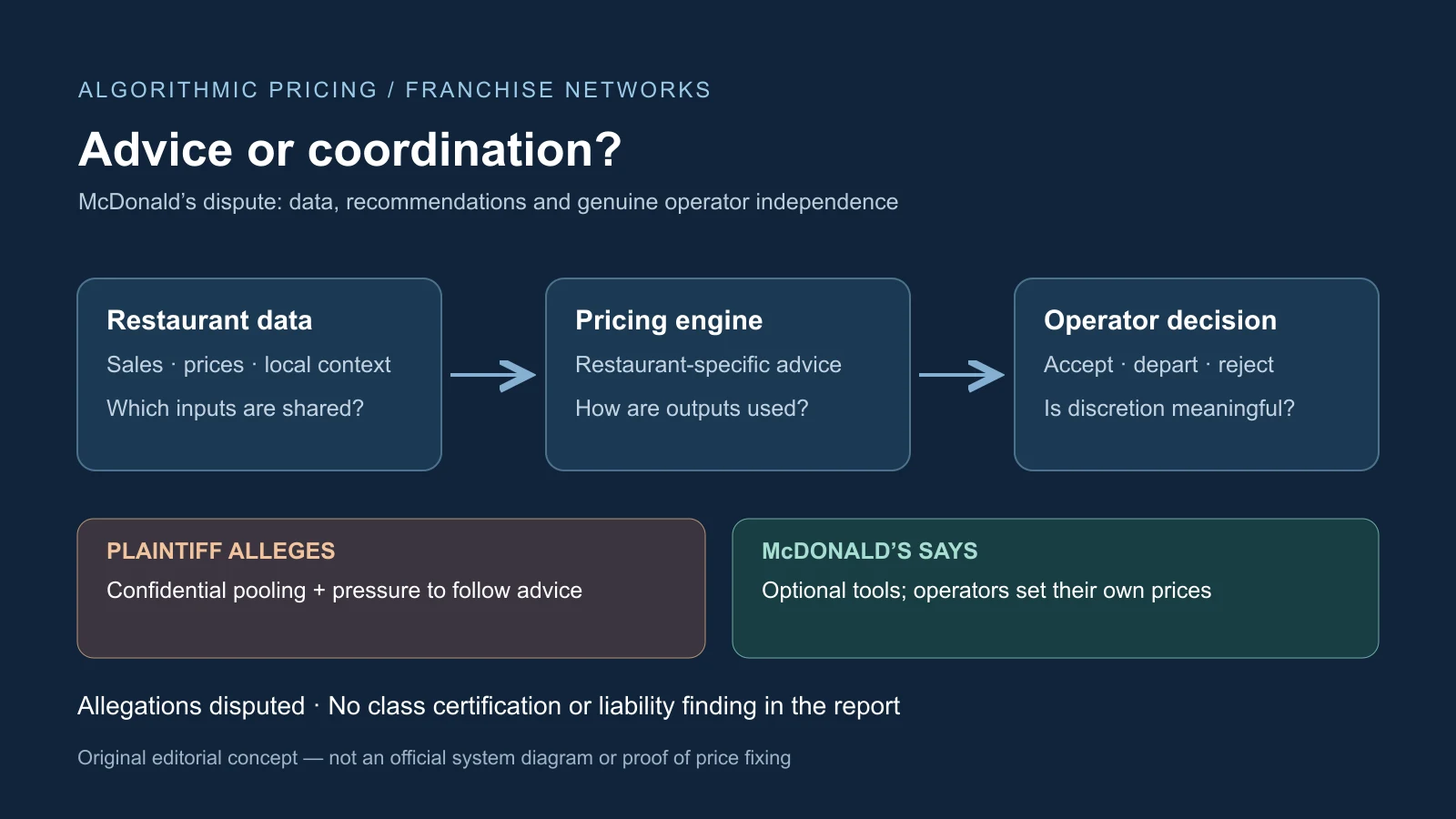
A proposed nationwide consumer class action against McDonald’s asks whether pricing advice can become coordination when independent restaurants feed confidential information into a common system. Michael Thomas filed the complaint on October 2, 2026, in Chicago federal court. McDonald’s rejects the allegations, saying its optional tools neither automate nor coordinate prices and that operators decide for themselves.
At the time described, no court had certified the proposed class, found an agreement or established overcharges. The consequential dispute concerns the data and commercial relationship behind recommendations—not the mere presence of AI, and not a proven finding that software raised every customer’s bill.
The alleged data loop and pressure to follow it
Thomas, a DeKalb, Illinois resident who says he regularly buys food near home, sued McDonald’s USA and McDonald’s Corporation in the Northern District of Illinois. The public docket identifies Thomas v. McDonalds USA, LLC, number 1:26-cv-12149. He noticed differing prices for identical nearby products, but differences alone are not his theory of liability: independent businesses ordinarily may respond differently to costs and demand.
The complaint alleges a common engine receives current, nonpublic restaurant sales and pricing data, analyzes millions of daily transactions alongside store characteristics, local demand, customer price sensitivity and competitor prices, then returns restaurant-specific recommendations for individual menu items. About 95% of roughly 14,000 US McDonald’s restaurants are independently owned and operated. A common brand therefore does not make all participating stores the same legal business.
Thomas also alleges a “30% rule,” under which the tool can recommend an increase after a specified share of nearby restaurants raises the same item’s price. He further claims McDonald’s monitors compliance and that persistent departures can influence eligibility for expansion or franchise renewal. These are the plaintiff’s untested descriptions, not operating rules admitted by McDonald’s or established through discovery. Their importance is the distinction between advice routinely ignored and advice backed by practical commercial pressure.
The requested nationwide class covers US food purchasers during the alleged period, with an Illinois subclass. Claims invoke Section 1 of the Sherman Act, the Illinois Antitrust Act and the Illinois Consumer Fraud and Deceptive Business Practices Act. Thomas seeks certification, damages, fees and an injunction. Treble damages are a potential federal remedy—three times proven losses for a successful private plaintiff—not an existing award or proof of injury.
McDonald’s says local operators retain the decision
McDonald’s October 1 statement, preceding the lawsuit, says AI does not determine any menu item’s price. The company describes restaurant-specific recommendations used alongside operators’ knowledge of local costs, customers and competition. It says the tool does not automatically change digital menu boards during busy periods or assign individuals different prices using personal information.
Three concepts need separating. Algorithmic pricing uses software to analyze information and recommend or select prices. Dynamic pricing changes prices with immediate market conditions. Surveillance pricing uses personal or behavioral information to tailor prices or promotions to people or groups. This complaint primarily alleges coordination among restaurants; it does not establish different charges to two customers ordering the same thing at one location.
McDonald’s told the Associated Press that the complaint contains inaccuracies and that it would defend itself. A spokesperson also said market research and price recommendations predated machine learning. Useful analysis has legitimate applications: operators face food and labor expenses, local competition and traffic changes, and a recommendation may identify when a higher price would reduce visits enough to lower total revenue.
In an August investor call, CEO Chris Kempczinski said only 60% of US restaurants offered a proposed value menu and that management needed agreement with franchisees rather than simply switching it on throughout the network. That example supports the existence of divided authority, not a conclusion about the challenged engine. Rejecting a national promotion does not establish how independently an operator handles store-specific pricing advice.
Why a shared engine is not automatically an agreement
The legal theory concerns Section 1’s prohibition of agreements unreasonably restraining trade. Software is not an exemption from rules applicable to human coordination. In a hotel-pricing filing, the Justice Department and FTC argued that businesses cannot use algorithms for conduct unlawful if performed by people, and that a common starting price can raise concerns even with some final discretion. That is the agencies’ position, not proof of an agreement at McDonald’s.
The complaint depicts a hub-and-spoke arrangement: McDonald’s as the central hub, franchisees as competing spokes. Such a theory still needs evidence connecting each vertical relationship to a horizontal understanding among rivals. Buying the same software or receiving similar advice is not enough. Whether participants knew competitors supplied data and expected others to follow the system is central to the plaintiff’s case.
Franchising complicates that inquiry. Shared trademarks, food and service standards, supply arrangements, advertising and contracts involve lawful coordination. Price is more sensitive if operators compete locally. Their private sales data can reveal responses to price changes and reduce uncertainty about rivals. That uncertainty can otherwise encourage lower prices, better service or acceptance of narrower margins.
Company-operated restaurants add another possible role. McDonald’s subsidiaries run a smaller share of US locations and may compete with franchisees. If corporate stores supplied data and received recommendations from the same engine, the plaintiff would argue the company acted as both platform and competitor. That conditional claim is not a verified technical description. McDonald’s can argue centralized support reflects local differences rather than suppressing them.
Price increases and local gaps do not isolate causation
The complaint cites McDonald’s statement that average US menu prices rose about 40% between 2019 and 2024, linking the period to development and expansion of pricing technology. Timing raises a research question; it does not isolate the algorithm’s effect. Labor, food, packaging, transport and occupancy costs rose, while pandemic conditions and later inflation changed demand. Wage laws, rent, tax and supply conditions varied by region.
A reported example involved Big Mac prices differing by 21% at two Fresno restaurants about two miles apart. This could support independent local judgment or a common engine’s local willingness-to-pay optimization. Location-specific prices do not require identifying individual customers and are not automatically unlawful. Conversely, different prices do not rule out coordination: common rules can recommend varied outputs while reducing independent decision-making.
An economic model would need a counterfactual—prices without the disputed data, rules and alleged pressure—and controls for those costs and demand changes. Nearby-store comparisons are complicated when one franchisee owns several locations. Recommendations, adoption, ownership and costs vary, so proving overcharges across a legally coherent proposed class is separate from showing a tool exists.
The FTC’s broader surveillance-pricing study described intermediaries capable of using location, browsing, demographics and shopping behavior to influence prices or promotions. It did not identify McDonald’s as charging individualized prices. Its relevance is scrutiny of data pipelines, not a finding that this restaurant system performed every practice examined.
Housing and hotel disputes provide a theory, not this case’s result
The Justice Department sued RealPage in 2024, alleging its revenue-management software helped competing landlords coordinate apartment rents, and later added major landlords. RealPage disputed the allegations. Pooled nonpublic inputs, shared recommendations and alleged surrender of independent judgment provide a legal comparison, not an established conclusion for McDonald’s.
The structures differ substantially: RealPage served separate property firms buying from an outside vendor; McDonald’s supplies a franchise network with many lawful shared functions. Hotel owners sharing a brand while remaining independent present another comparison. Agencies have argued that knowingly using a common system can matter even if recommendations are voluntary, but courts must assess each record. The new complaint is a test of those arguments, not already a precedent.
The implications extend to restaurant, hotel, fitness, automotive and service franchises using central analytics. Forecasting, waste reduction and support for smaller operators are genuine possible benefits. Yet the data’s confidentiality, granularity and timing, and whether deviations attract consequences, may matter more than model sophistication. Spreadsheets, consultants and calls can raise the same coordination question; replacing them with AI neither proves nor removes it.
The evidence that would distinguish advice from coordination
Initial dismissal briefing would test whether the pleaded facts plausibly allege a horizontal agreement before access to internal records. If the case proceeds, documents, operator communications, technical logs and testimony could clarify data inputs, participation, adoption and responses to refusal. The public narrative relies substantially on reporting and company materials; proving each element requires admissible evidence, not repeated use of the term AI.
High adoption alone would not prove agreement. Coupled with pressure, competitor awareness and confidential inputs it could strengthen Thomas’s account. Frequent departures without penalties and genuinely different decision methods could support McDonald’s. Aggregated historical information presents a different issue from live store-level prices and sales. Neither the actual technical design nor the claimed coercion should be assumed before those records emerge.
Any future DOJ or FTC participation would signal policy interest, not determine the result. The dispute also arrives as McDonald’s seeks to restore its value reputation among budget-conscious customers: understanding a tool’s limits matters commercially as well as legally. For developers and buyers, the lesson concerns inputs, incentives and deployment—not a generic ban on recommendations. For consumers, local price variation is not proof of misconduct. Whether this engine preserved competition or enabled unlawful coordination remains contested and dependent on evidence not yet public.
Sources
Federal docket · McDonald’s October 1 statement · Associated Press report · DOJ/FTC hotel filing · FTC broader pricing study · DOJ RealPage complaint · Discovery via Google News RSS (aggregator)