
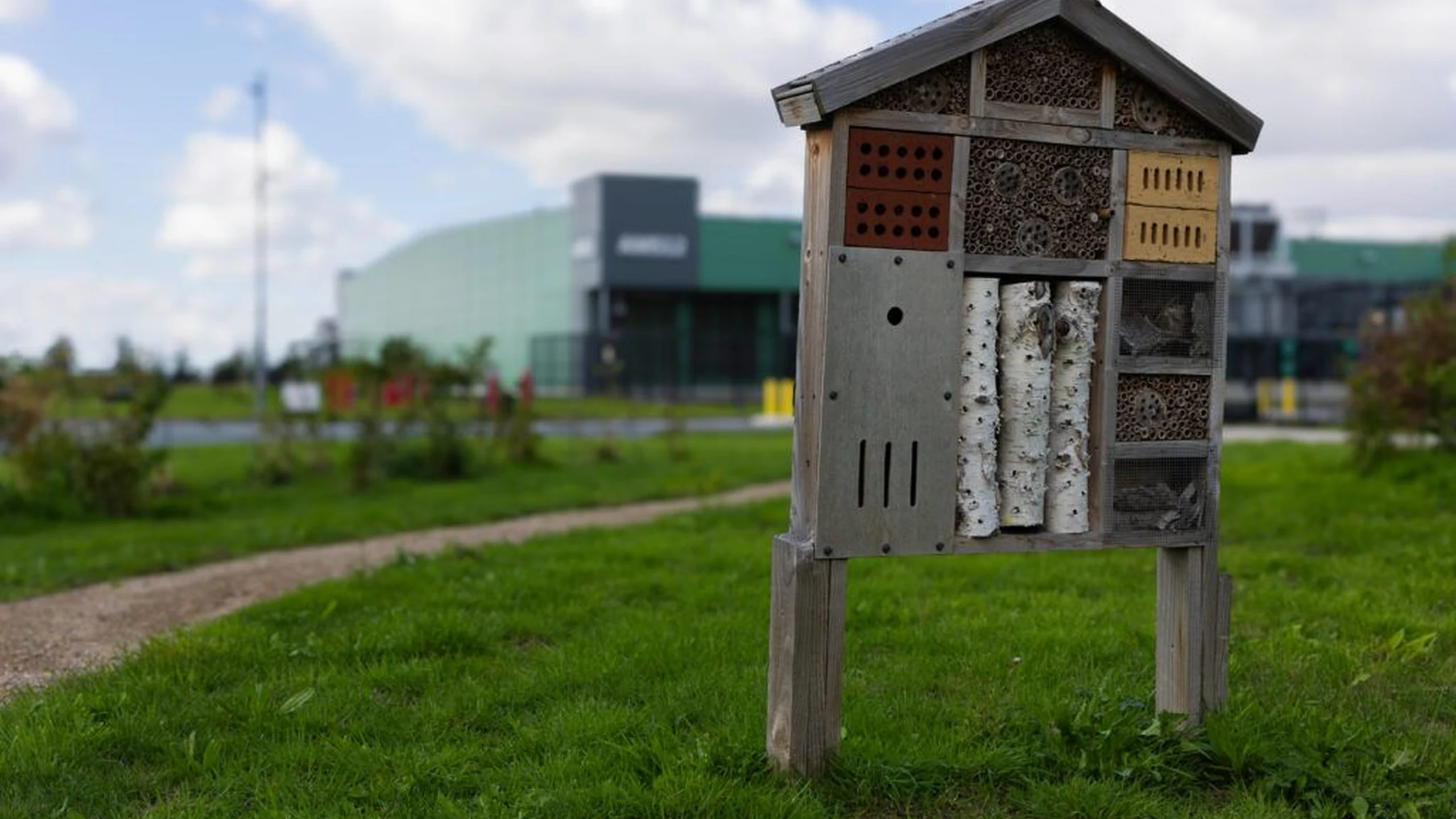
Microsoft’s plan to bring nature-inspired design to every new U.S. data-center project poses a useful question with a limited scope: can industrial sites do less ecological damage? It cannot, by itself, answer whether AI infrastructure is becoming climate-compatible. Wetlands, native planting and restored waterways address local functions; gas generation and construction determine other parts of the footprint.
The company says its approach is expanding to more than 20 locations in the United States and Germany, after experiments at Middenmeer in the Netherlands began in 2022. The scale makes this more than one demonstration garden. But an announced design standard is not evidence that every site already delivers a net environmental gain.
What restoration looks like on the ground
Microsoft’s nature-inspired design account describes projects in Virginia, Wisconsin, Georgia, Germany, Ohio, North Carolina and Wyoming. The company says projects begin with ecological research and community input rather than one fixed landscaping package. Land-strategy director Kaitlin Chuzi emphasizes that conditions in the Netherlands cannot simply be copied to Phoenix, Wisconsin or Ohio.
In Mecklenburg County, Virginia, south of Chase City, Microsoft says it protected more than 230 acres from development. The work includes eight acres of new wetlands, over three miles of trails, 185 acres of restored native pollinator habitat and more than 25,000 planted trees creating 45 acres of forested buffers. These are distinct reported measures, not figures to add into one newly restored acreage total.
County administrator Alex Gottschalk says sustained community and environmental-group feedback moved the plan away from conventional recreation toward biodiversity conservation. That example gives consultation a concrete consequence, rather than reducing it to a presentation after all important choices are fixed.
Near Fairwater in Mount Pleasant, Wisconsin, the focus is Lamparek Creek: native prairie, wetlands, forested stream buffers and restoration of previously straightened channels. Roots stabilize banks; vegetation can intercept sediment and pollutants. Partner Root-Pike Watershed Initiative Network also worked on stormwater ponds with forebays, smaller basins capturing sediment before the main pond.
The reported Wisconsin details put prairie and forest work at about 100 acres. East Point, Georgia, emphasizes native and faster-growing vegetation plus a trail; Bedburg, Germany, combines habitat, wetlands, stormwater controls, ecological corridors and visual barriers. A tree screen can soften appearance or some noise without removing the building, traffic, fragmented habitat or utility infrastructure.
Planting counts are not yet performance measures
The Azure-based Ecosystem Intelligence tool maps environmental functions and evaluates water quality, biodiversity and noise reduction before and after interventions. Its value depends on whether outsiders can inspect comparable evidence, not the sophistication of the internal label.
Microsoft’s broader ecosystem commitments say it protected more land than it used by 2025, exceeding that target by more than 30%. At Middenmeer, it describes 150 trees and 2,300 square meters of native greenery shaped by local input. Neither protected acreage nor planted area alone establishes survival, habitat quality or recovery of a lost ecosystem.
A useful baseline records preconstruction species, soil and habitat. Water readings need comparable upstream, downstream and earlier measurements. Long-term wetland assessment should examine retention, nutrient cycling, vegetation and wildlife use; an engineered basin can catch runoff without functioning like a mature natural wetland. Noise monitoring should test actual changes from cooling and electrical equipment, not assume trees solve them.
Houston Advanced Research Center’s Erin Kinney identifies calculation and transparency as the key test. Universities, conservation groups and watershed organizations could validate methods, challenge results and publish independent conclusions. Common reporting of baselines, targets, methods, timelines and verified outcomes can coexist with different goals for a Wisconsin wetland and an Arizona desert site.
Mitigation and restoration must also be distinguished. Trees screening a wall reduce an impact; reconnecting a stream to its floodplain may restore function if monitoring confirms it. Both can help. Calling every improvement restoration overstates the evidence and makes comparisons less useful.
The gas-power agreement belongs in a different ledger
In June 2026, Chevron announced a 20-year supply agreement for a planned Microsoft data center in West Texas. Project Kilby would provide approximately 2.67 gigawatts from natural gas beside the campus, outside the public grid. Initial power was expected in 2028 if the project proceeds, with a final investment decision anticipated before the end of 2026—not a completed operating plant.
The official power agreement allows for later carbon capture or other lower-carbon technology, but those additions were not guaranteed in the described plan. Off-grid generation may shorten waits for transmission connections while creating a long-duration gas dependence.
Public Citizen’s Texas director Adrian Shelley criticizes the mismatch between landscaping and system-wide impact. That criticism does not establish wetlands are worthless. It places them in the right category: local habitat and runoff improvements cannot neutralize emissions from producing and burning gas for continuous electricity.
Microsoft reported total emissions up 25% in fiscal 2025, primarily from data-center infrastructure expansion, also citing a pause in unbundled renewable-energy certificates purchased separately from electricity. That pressures its 2030 carbon-negative goal: removing more greenhouse gases than reported operations and the value chain emit.
The company also says it achieved its water-positive target in fiscal 2025 under its own measurement approach, replenishing more than it consumes. Corporate totals do not automatically relieve local stress. Water replenished in one watershed does not replace water near another campus, just as a renewable contract elsewhere does not remove a local gas plant’s pollution.
Abilene illustrates the wider scale. The existing OpenAI–Oracle campus uses on-site gas generation, while Microsoft is joining an adjacent expansion. Its project includes two additional data-center buildings and a planned 900-megawatt plant; the full complex is expected to reach ten buildings and a reported 2.1-gigawatt computing-campus scale. The Abilene report concerns another project, not Kilby’s capacity.
A separate restored parcel does not settle the siting question
San Antonio’s District 6 already had more than a dozen data centers in the account, with more proposed. In 2022, authorities approved a Microsoft plan involving removal of 2,642 trees from a 33-acre tract. Microsoft separately says it is investing in more than 400 acres of woodland and pollinator-prairie restoration there. Those measures cannot be netted as equivalent ecological functions without evidence.
Councilmember Ric Galvan raised traffic and environmental concerns and proposed an August 2026 moratorium. The council rejected a blanket pause and continued considering zoning. The October 4 reporting described a vote scheduled for October 15; it did not supply that later vote’s outcome. Setbacks, noise limits, tree protections, traffic plans and disclosure remain different instruments from voluntary landscaping.
Asked whether ecological findings could make it abandon a site, Microsoft reportedly supplied no firm threshold; Chuzi described continuing learning. An assessment has limited authority if it cannot trigger redesign, a smaller footprint, stronger safeguards or rejection. Degraded industrial land and intact forest do not present interchangeable risks.
Cumulative effects matter too. One campus may fit local limits while twelve facilities, plus substations, pipelines and power plants, create a different burden. Residents need influence before binding site commitments, not only a choice of planting after selection. Conservation benefits should not become the price of accepting unwanted infrastructure.
The next proof is durable local outcomes, not visual camouflage
Maintenance determines whether initial investments last. Young trees need protection and water, invasive species need control, and storms can expose weak stream-restoration design. Microsoft should identify long-term funding, responsibility if land transfers to a conservation group or government, and corrective action when plantings or wetlands fail. Negative results deserve publication alongside successes.
Root-Pike’s Dave Giordano argues that operators are not identical; Wisconsin’s stormwater accommodations give that view a specific basis. The evidence does not establish Microsoft outperforms every rival. A more defensible benefit is raising expectations so competitors face comparable ecological assessments and outcome reporting.
Early collaboration between ecologists and engineers can prevent harm before roads, drainage and building footprints become fixed. That is stronger than retrofitting attractive planting after construction. It still cannot reduce server-hall electricity demand, guarantee renewables or erase steel, concrete, chip, cooling and backup-power emissions.
The practical tests are public ecological baselines and independent results, enforceable siting standards, and complete energy accounting—including Kilby’s investment decision, expected emissions and any binding carbon-capture obligations. Biomimicry can improve industrial development without carrying Microsoft’s entire climate promise. Keeping those boundaries visible is what makes the program credible.