
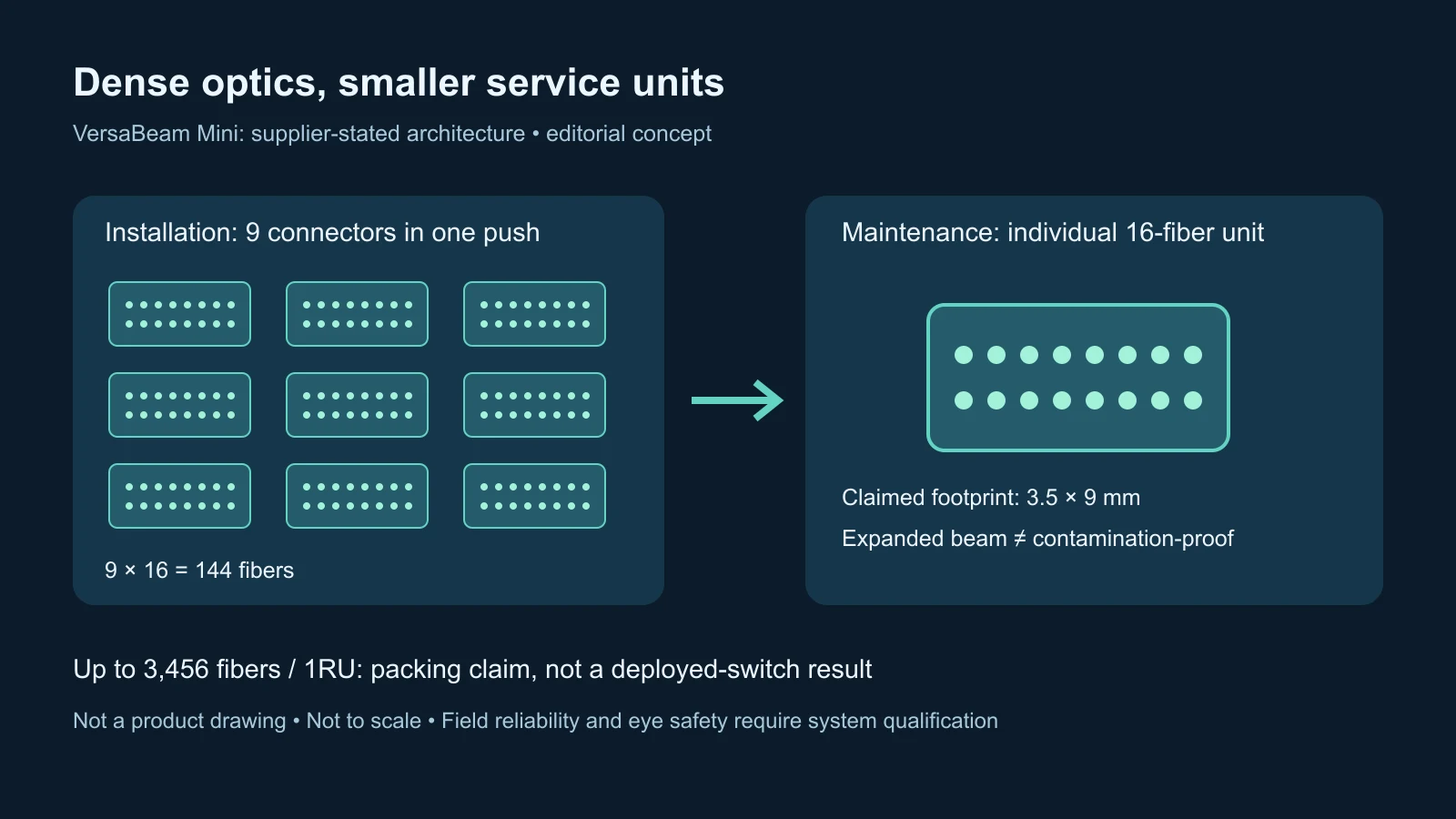
Molex is trying to make the growth of optical connections inside AI systems compatible with ordinary maintenance. Its VersaBeam Mini, announced on September 21, puts 16 fibers in a 3.5 × 9 millimeter connector. The company claims up to 3,456 fibers across a standard one-rack-unit panel and three times the density of its existing VersaBeam 16 connection—not three times every competing connector.
The other part of the proposal is a smaller unit of intervention. Individual 16-fiber connectors remain serviceable even when an optional mechanism installs nine of them, or 144 fibers, with one push. Limited customer sampling was scheduled for the fourth quarter of 2026, with general production planned for the first half of 2027. These are announced specifications and a production schedule, not broad operating results.
A bandwidth problem becomes a mechanical one
AI training repeatedly exchanges data, partial results and synchronization traffic among accelerators. Poor connections can leave expensive processors idle. Adding bandwidth also adds optical and electrical lanes competing for chassis space, panel area, power and cooling. A rack unit remains 1.75 inches high regardless of how many fibers the network needs.
Traditional pluggable transceivers are accessible at the front of a switch, but electrical signals must cross the board from switching silicon to the modules. At high signaling rates, loss demands compensating electronics that consume power and generate heat. Co-packaged optics, or CPO, instead puts optical engines beside the switch ASIC, shortening electrical paths while fibers carry signals farther. Integration can improve efficiency while making access and repair more consequential.
Nvidia says Spectrum-X and Quantum-X photonics switches support 1.6 terabits per second per port. One described CPO package has 32 silicon-photonics engines, each with 16 transmit and 16 receive lanes. Its efficiency and resilience claims still require customer validation. Broadcom's Tomahawk CPO work likewise combines switching silicon, photonics, packaging and fiber. Moving optics inward does not remove fiber: it can increase the paths crossing package, board and enclosure boundaries.
VersaBeam Mini addresses those mechanical boundaries, not the optical engine, switching chip or network protocol. Molex targets front panels, optical backplanes and confined CPO interiors. Backplanes distribute internal connections; panels expose external cables. Scale-up connections among tightly coordinated accelerators and scale-out connections among servers, racks or clusters have different routing and service demands, but both need more fibers.
Separate bulk installation from individual service
Packing many fibers behind one detachable interface reduces connector count, but disconnecting it can disturb more channels. Molex describes a ninefold reduction in “blast radius” for Mini: the channels affected when one connector is disconnected, replaced or rerouted. A 16-fiber unit can avoid disturbing a much larger bundle, including the 144- and 192-fiber options elsewhere in VersaBeam.
That claim is configuration-dependent. It is not a complete failure model for switch ports, optical engines, cabling and software redundancy, and does not guarantee that every network failure stays within 16 fibers. Smaller service units also multiply bodies, latches and cable branches that equipment designers must accommodate and technicians must identify.
The nine-connector insertion option attempts to recover installation speed without sacrificing later individual access. It adds a mechanical layer of its own: consistent engagement under production tolerances and repeated maintenance remains a qualification question. Unlike replacing an accessible pluggable module, work near integrated optics may require opening equipment and reaching components near valuable silicon.
What expanded beam changes—and what it does not
Conventional physical-contact connectors precisely align polished fiber ends. Dust near the small core can block or scatter enough light to impair a channel. Expanded-beam optics uses a lens to broaden and collimate light across an interface, then refocus it into the receiving fiber. Spreading light over a larger area makes small particles less disruptive; it does not confer immunity to contamination.
Mini uses a groove-based 3M expanded-beam optical ferrule, the precision component that holds and aligns fibers. Molex calls the approach “zero-touch” because transmission does not rely on polished fiber ends pressing directly together. It may remove some associated handling and cleaning work, but housings still need controlled handling, accurate mating and appropriate procedures.
Molex says the wider VersaBeam portfolio can reduce deployment, inspection and maintenance overhead by up to 85%. This supplier figure is not an independently established universal result for Mini. Actual savings depend on contamination, connector counts, training, workflow and acceptance criteria; laboratory or selected-customer outcomes may not transfer. The original family, introduced in March 2025, includes 12-, 16-, 144- and 192-fiber configurations.
The published insertion-loss limits are below 0.7 dB for single-mode and below 0.3 dB for multimode connections. Lower insertion loss means less power lost through a connection and more margin for other components. Return loss is above 55 dB for single-mode and above 25 dB for multimode; higher values generally mean less light reflected toward the transmitter. The stated operating range is −10°C to 60°C.
The ferrule omits conventional guide pins and holes. Molex says its grooves support robotic pick-and-place during cable assembly; fewer alignment parts could also reduce the bill of materials. However, production yield, assembly cycle time and connector cost were not disclosed. Automation-compatible construction is not yet proof of consistent high-volume alignment across suppliers and cable assemblies.
Molex also claims inherent laser eye-safety features, relevant when detached fibers remain near active equipment. Application detail is insufficient to compare every condition. Power, wavelength, system controls and enclosure all matter, and equipment manufacturers remain responsible for applicable laser classifications and maintenance requirements. A component feature does not establish system-level safety.
The rival is an established ecosystem, not just a larger plug
MPO physical-contact connectors have a broad supplier base, familiar inspection practices and extensive deployment history. Newer VSFF designs also miniaturize physical-contact interfaces. US Conec's MMC supports 12- and 16-fiber configurations; one published analysis shows 1,152 fibers in 1RU, while current materials describe up to three times MPO density in some configurations. Those differently defined comparisons do not establish that one panel claim is a universal ranking.
Expanded beam introduces lenses and different alignment requirements in exchange for lower contamination sensitivity. Physical contact retains a straightforward light path but requires disciplined inspection and cleaning. Neither removes maintenance. Loss accumulates across removable connections, so the optical budget must include fibers, splices, transceivers, backplanes and every interface rather than a single favorable component specification.
Maximum faceplate density is also different from usable equipment density. Fiber exits need bend radius, strain relief, labels, finger access and traceability without disturbing neighbors. Dense cabling can obstruct airflow and concentrate mechanical loads even if connector faces fit. A system comparison therefore includes occupied volume, installation and repair time, cleaning frequency, optical loss and reconnection errors.
Sampling must establish reliability and adoption
At announcement, independent operators had not published broad Mini field results. Repeated mating, dust, vibration, temperature cycling and realistic cable loads must show stable optical performance. Distributions matter as well as maxima: acceptable average loss can conceal outliers that make commissioning expensive. Less cleaning does not remove damaged-connector detection, power verification or the need for new service tools.
The announcement named no adopting switch manufacturers, interoperability agreements or second-source plans. Existing interfaces already span transceivers, panels, test equipment and cable assemblies. That installed base can outweigh density where customers value standardization and years of supply. Equipment makers may also choose proprietary interfaces or avoid some detachable boundaries altogether. A connector must enter the design before mechanical layouts, optical budgets and manufacturing processes are frozen.
Molex's March 2026 optical-circuit-switching platform and additional CPO components broaden its opportunities to integrate VersaBeam into complete architectures. They do not demonstrate that all components already deliver measurable system gains. A trade-show panel shows mechanical feasibility, not hyperscale operating performance.
Named customer qualifications should clarify whether Mini is used for front-panel patching, near a CPO engine or inside a backplane. Independent reliability and comparable technician-time results would test the maintenance case; large site-to-site variation would expose environmental dependence. Compatible components, standards and multi-vendor agreements during 2027 would test supply breadth. CPO adoption by Nvidia and Broadcom creates attention, not guaranteed demand for one connector format.
The central idea is practical: install optical groups together, then service smaller units separately. VersaBeam Mini need not replace every connector to find a useful role inside dense CPO systems. Its lasting value depends on turning packing density, contamination tolerance and automated assembly into qualified equipment that can be repaired without excessive loss, congestion or downtime—not merely fitting more fibers onto a demonstration panel.
Sources
Product announcement · Nvidia photonics roadmap · Broadcom CPO · 3M technical sheet · Molex connector specifications · Original discovery entry (Google News aggregation)