
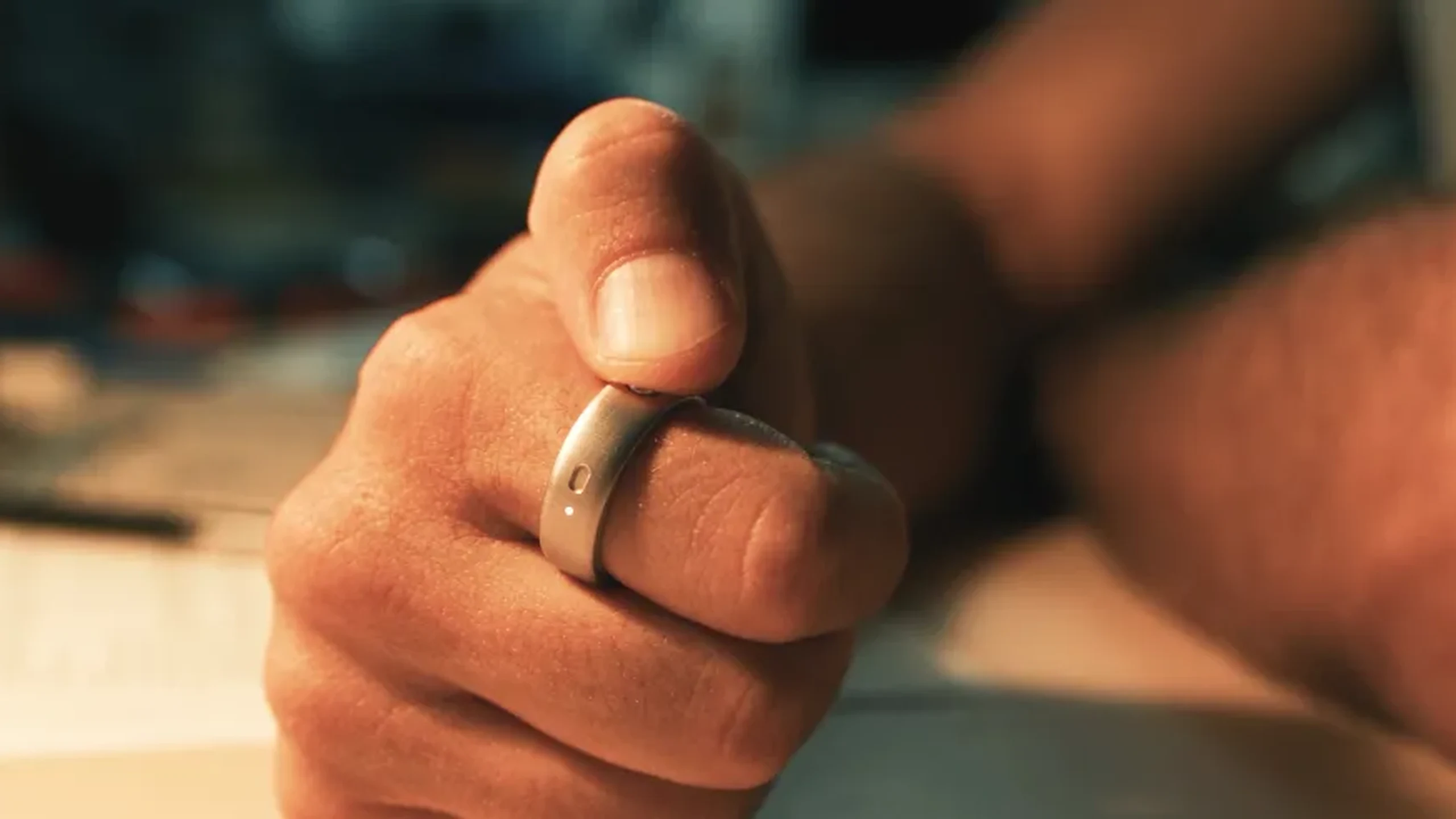
Natura’s Interface ring asks users to begin an AI task with a thumb rather than a phone screen. Hold its physical button, speak, then release: the company says the request goes to an agent and the answer returns through another device or service. The proposal is less a miniature computer than a new starting point for software already running elsewhere.
At the October 8 announcement, that remained a product promise, not independently tested behavior. Interface had not shipped to consumers for hands-on verification of its microphone, comfort, health readings, battery life or integrations. Its significance lies in whether a small physical shortcut can preserve the control people already expect from a phone.
Input on a finger, answers somewhere else
The announced response channels include connected headphones, an iPhone Live Activity and Natura’s NatureOS app. The product specifications also describe WhatsApp, Telegram and iMessage replies. Separating capture from output avoids putting a screen on the ring; demanding work still depends on phones, applications, cloud services and AI systems.
Natura names Claude, ChatGPT, Meta’s Muse, Grokbot and Instinct among the services it intends to connect. Users would choose agents for different jobs, such as coding with Claude and handling administrative work elsewhere. These are company compatibility claims, not evidence that every named integration is shipping or that the providers share accounts, memory, permissions or policies.
The integration paths remain important unknowns. Direct account authorization and structured tool access can expose task status and errors; passing transcribed text through a phone or messaging service offers a different degree of control. Natura has not publicly explained every route. A long list of agent names cannot establish reliable action across documents, calendars, shops and computers.
Proposed uses range from capturing a thought, summarizing a schedule, starting workout tracking and recording a meeting to ordering household goods, sharing notes, controlling a computer and operating connected devices. They do not carry equal authority. A mistaken private note is easier to reverse than a purchase or a confidential message sent to the wrong person.
Why the phone remains part of the system
Phones already combine microphones, screens, biometric authentication, connectivity and notifications. Their disadvantage is the sequence of retrieving, unlocking and finding an app. Each step is simple, but together they can discourage a fleeting idea or small, time-sensitive request.
A thumb-accessible button could help a runner, a worker carrying equipment, a meeting participant marking an action item or someone cooking. Those are plausible use cases, not results of tests. A 2026 ring-interface study explored low-friction, screenless agent initiation as a design probe; it did not establish that rings are the best controller.
The first announced compatibility centers on iOS. Interface therefore looks initially like a companion: the ring captures intent while a phone supplies authentication, apps, connectivity, notifications and detailed review. Earbuds and smartwatches have similarly changed access without replacing the supporting phone.
Compared with a watch, the ring offers a direct thumb gesture but less room for visible feedback, navigation or confirmation. It must justify another wearable for people already carrying phones, watches, earbuds or health rings. One successful demonstration is not daily reliability across accents, noise, weak connections, account failures and ambiguous instructions.
Press-to-talk narrows recording, not authority
A physical button gives a clearer intentional listening boundary than an always-listening microphone and may make capture more socially legible. It does not explain retention, processing location or third-party access, and it cannot guarantee that the selected agent understood the instruction.
“Send the notes” leaves the meeting, document, version and recipient unresolved. A screen can display those choices before approval. A ring must use context, follow-up questions or another channel; a confirmation arriving after an action starts may be too late. Capturing an idea can stay quick, while sharing a confidential document calls for stricter authorization.
Natura has not published a detailed permission and exception-handling model. Users need to know which agent is listening, which account and tools it can access, what it may do and how to stop ongoing work. An activity history showing the transcript, acting agent, tools used and resulting changes would support both trust and recovery; these are needed safeguards, not confirmed Interface features.
Multi-agent routing also risks adding decisions while promising to remove friction. Explicit selection provides control but makes users remember which service suits coding, scheduling, research or device control. Automatic selection can obscure why a sensitive task reached a particular provider. Learning preferences could ease that burden, but introduces stored behavioral context that should be inspectable, correctable, portable and separable between work and private life.
Health sensing adds context—and another unverified claim
Natura says Interface tracks heart rate, resting heart rate, heart-rate variability, sleep stages, movement, steps and skin temperature. That puts its hardware alongside health-focused Oura, RingConn, Samsung and Ultrahuman, whose appeal depends on sensor accuracy, useful trends, comfort and consistent wear. Missing nights or unreliable readings weaken a longitudinal baseline.
Combining those readings with agents might allow schedule changes after poor sleep or lighter work suggestions after unusual measurements. Such scenarios are possibilities, not demonstrated health outcomes or medical validation. A related discussion of personal versus team knowledge bases describes the broader value of retrieving context; it is not evidence of Natura’s integration quality.
Voice adds a separate hardware burden. A finger is farther from the mouth than earbuds or a nearby phone, and wind, clothing noise, crowds and distant speakers can impair transcription. Comfort must survive typing, exercise, sleep, hand washing and household work. A broader smart-ring review identifies size, energy, comfort and feedback as persistent constraints across sensing and interaction.
Battery reporting is not settled. Launch coverage described a broad multi-day estimate and a stated recharge time, while Natura’s product page said a final tested battery figure would appear before orders opened. The source material does not resolve that difference. Frequent recording, wireless communication and synchronization can produce different endurance from passive health sensing; no independent number should be inferred.
A recording button does not settle the privacy chain
Interface could combine spoken intentions, work projects, relationships, purchases, location, health routines, messages and calendar context. That concentration may help assistance, but also magnifies weak access controls or a compromised account: the system could expose sensitive data and act with delegated permissions.
The unresolved data path spans ring, phone, Natura servers and third-party agents. Clear policies need to distinguish raw audio from transcripts, operational use from model training, and private-assistant learning from shared-model learning. Deleting audio offers limited protection if a transcript remains in agent memory; deleting a request in NatureOS may leave copies with a messaging or AI provider.
Disconnecting an agent should revoke its authority and explain historical copies elsewhere. Wearing the ring is not sufficient authentication: it can be removed, lost, shared or used while its owner sleeps. Protection against unauthorized pairing and replayed commands, plus trusted-phone or biometric checks for high-impact actions, matters more than the physical button alone.
Meeting capture also affects other people. Notice, consent and workplace rules remain relevant; pressing a button does not supply another participant’s permission. Consumer health measurements should not automatically be assumed to have medical-record protections, which depend on the service, jurisdiction and use. The cited ring-security study discusses weaknesses in the broader category and stronger encryption; it does not demonstrate a discovered Interface vulnerability.
The outcome depends on completed tasks, not invocation speed
The announcement anticipated an order window and later shipments, but the source report does not establish delivered units or validated launch timing. Independent hardware reviews must separate passive sensing from frequent voice use and examine ordinary outdoor, transit, office and home conditions, rather than treating a controlled demo as proof.
Integration depth is the second test. Meeting capture needs a route through consent, transcription, summary review, recipient choice and delivery confirmation. Purchases need merchant, quantity, payment approval and cancellation; computer control needs authentication, scope and error recovery. The meaningful measure is safe end-to-end completion, not the number of logos on a compatibility list.
The third test is recurring use after novelty fades: repeated requests, successful completion, return to the phone and continued charging and wearing. Dependable health features might sustain use between agent requests, but unreliable automation could damage confidence in the whole device. Work use additionally requires identity administration, data-location and retention controls, and audit history—not merely consumer convenience.
Natura’s thesis need not replace every screen. It must make enough recurring tasks faster without hiding authority or forcing users to supervise every step elsewhere. If that works, Interface could become a useful companion to existing devices. If not, it may simply move the microphone while leaving the hard parts of delegation untouched.
Sources and related context
Interface specifications · Launch and routing reporting · Ring-interface design study · Related context: personal and team knowledge bases · Smart-ring review · Smart-ring security research · Original launch aggregation entry