
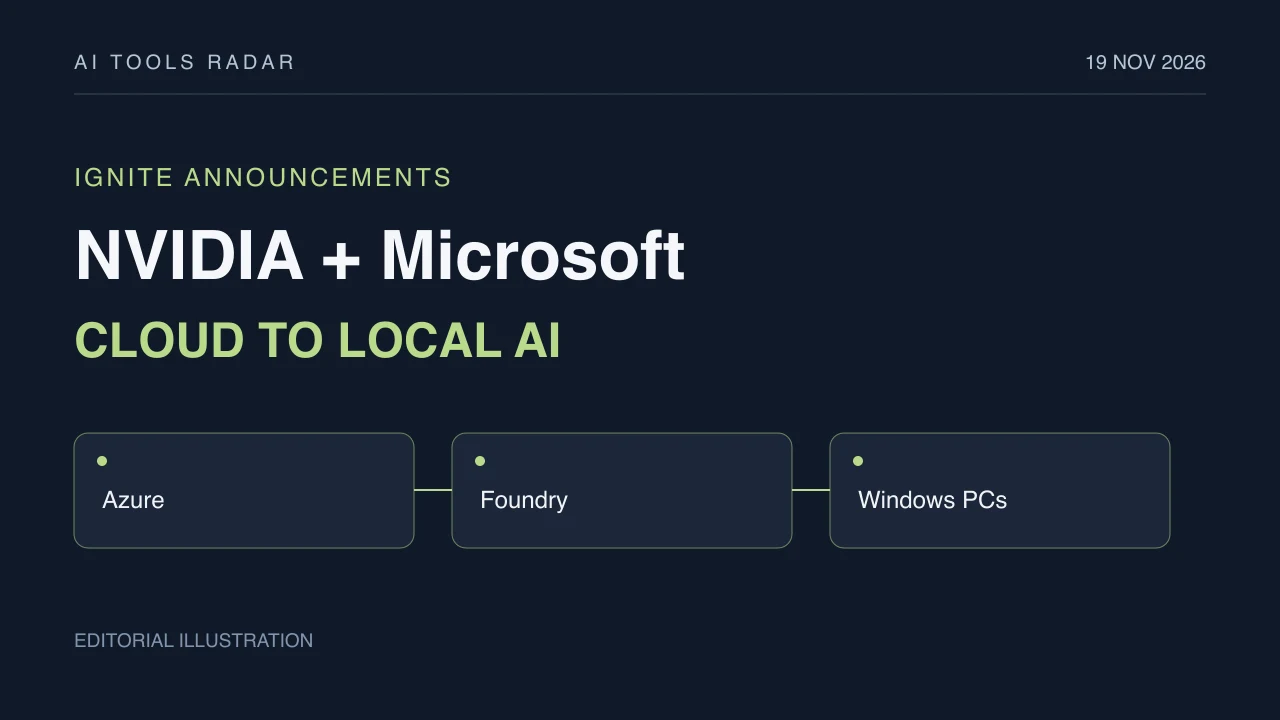
NVIDIA and Microsoft announced an expanded AI computing collaboration on November 19, spanning Azure infrastructure, enterprise model customization, industrial systems and Windows PCs. The important distinction is that the package combines running infrastructure with previews and future capabilities.
NVIDIA's Ignite announcement describes a common route from large-scale training and inference to models operating closer to enterprise data. Its performance figures and customer results apply to specified systems and evaluations, rather than the entire portfolio.
Rubin infrastructure and Blackwell results describe different things
NVIDIA says Vera Rubin NVL72 systems are running in Azure data centers, supporting demanding reasoning, agent workloads and large-scale training and inference. Azure's Rubin offering is described as a preview.
The companies are also working to extend confidential computing to bare-metal and rack-scale infrastructure. Attestation is intended to verify the environment before sensitive models, data or keys are released. Collaboration on NVIDIA MaxLPS targets better use of available power; the announcement gives no measured power-saving percentage.
The benchmark examples concern earlier Blackwell systems. In MLPerf Training v6.1, Azure scaled GB200 NVL72 systems to 10,240 GPUs on DeepSeek-V3. In MLPerf Inference v6.1, GB300 NVL72 systems led cloud submissions on DeepSeek-R1 interactive throughput by over 10%, according to Signal65.
Those results should not become Rubin benchmarks or a promise of a universal 10% application speedup. Hardware, task and comparison set are part of the claim.
Foundry connects customization with deployment
Microsoft's serverless Programmed Training gives developers control over post-training workflows while Foundry manages infrastructure. Foundry Managed Compute adds deployment of custom model weights.
NVIDIA cites EY's use of Programmed Training to adapt Nemotron models for corporate purchasing-record classification. The reported result is a 55% accuracy improvement on EY's evaluation dataset and a 15-fold cost reduction against proprietary frontier models.
These are attributed customer results. The announcement does not provide baseline accuracy, dataset size or the full comparison conditions. The accuracy improvement should not be recast as 55 percentage points or a guarantee for another task.
Nemotron 3.5 Super targets long-running coding, research and business agents; Lightning targets faster responses and tool use. Embed and Rerank support retrieval, Parse handles document extraction, and Content Safety detects harmful material. Bolt, for lower-latency reasoning, and Transcribe, for speech recognition, are described as coming soon.
Local and Cloud PC paths have separate availability
Foundry Local support for Nemotron 3.5 extends reasoning, coding and tool use to Azure Local environments. Retrieval capabilities cover text, document images, charts and tables.
Azure Local will support RTX PRO 6000 Blackwell GPUs through hardware partners, while expansion to Jetson Thor and Jetson Orin targets industrial vision, robotics and autonomous operations. NVIDIA's Cosmos physical-AI models are also being brought to Foundry Local.
On Windows PCs, RTX Spark devices will demonstrate local language-model experiences at Ignite. A demonstration is not a statement that every PC configuration already supports the same workload.
For GPU-accelerated Windows 365 Cloud PCs, Direct Stream supports up to two 4K streams at 60 frames per second. Limited-preview sign-ups are open, with public preview planned for early 2027. The announcement describes low latency over difficult networks without publishing a general latency guarantee.
Scientific agents still lead to laboratory validation
BioNeMo Agent Toolkit and ALCHEMI Toolkit are expanding into Microsoft Discovery for life sciences, drug discovery, materials and chemistry. BioNeMo lets scientists describe computational biology work in natural language while agents coordinate tools and model calls.
An initial integration uses RFD4-Proteina, developed with the University of Washington's Institute for Protein Design, to generate candidate protein structures and amino-acid sequences. Further evaluation and laboratory validation remain necessary; candidate generation is not evidence of a validated treatment.
Microsoft is also using the stack internally
Microsoft AI uses Dynamo for reinforcement-learning rollout inference during post-training. NVIDIA says it coordinates inference across GPU fleets, including requests, model updates and recovery from failures. RTX PRO 6000 Blackwell GPUs also support Bing search models.
For enterprise teams, the announcement expands options across hosted customization, local execution and managed desktops. Decisions still depend on the exact service's availability, suitable hardware and workload-specific evidence. The published results do not erase those boundaries.